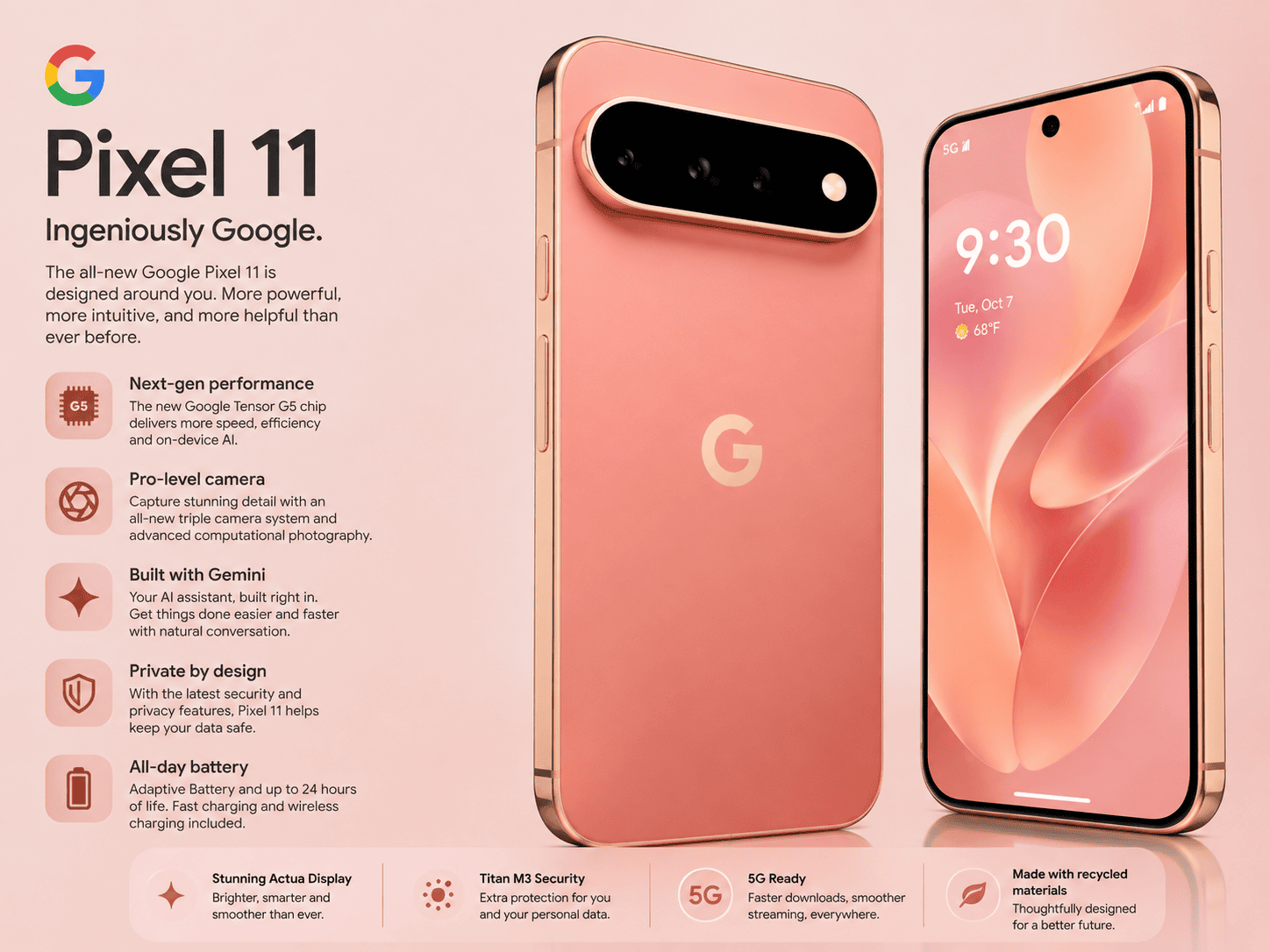
Google Pixel 11 Pro adds 120x Pro Zoom, Tensor G6 and HiLight to Google’s compact flagship
Google’s Pixel 11 Pro is the smaller of the company’s two conventional Pro smartphones for 2026, combining a 6.3-inch LTPO OLED display with the Tensor G6 processor, a three-camera system and Google’s expanding Gemini Intelligence features.
Google unveiled the Pixel 11 Pro alongside the Pixel 11 and Pixel 11 Pro XL on 12 August 2026. The phone reached shelves in supported markets on 20 August 2026, with a US launch price starting at $1,099 for the 256GB model.
The Pixel 11 Pro is particularly notable because Google has retained a relatively compact 6.3-inch format while giving it the same core Pro camera system as the larger Pixel 11 Pro XL. That includes a new 50MP main camera, 48MP ultrawide and redesigned 48MP 5x telephoto camera capable of Google’s new 120x Pro Zoom.
TechnologyBlog.co.za has not tested the Pixel 11 Pro. This article therefore focuses on its verified specifications and features rather than making conclusions about camera quality, battery endurance or real-world performance.
Pixel 11 Pro sits above the standard Pixel 11
Google’s Pixel 11 family now consists of the Pixel 11, Pixel 11 Pro, Pixel 11 Pro XL and Pixel 11 Pro Fold.
TechnologyBlog.co.za has already covered the standard model and its Tensor G6 processor, updated camera hardware and seven-year software-support commitment. Read our Google Pixel 11 article
The Pixel 11 Pro retains the standard phone’s relatively compact dimensions but moves to higher-end display and camera hardware.
Its 6.3-inch Super Actua display has a resolution of 1280 × 2856 pixels and uses an LTPO OLED panel capable of varying its refresh rate between 1Hz and 120Hz. Google rates it for up to 2,400 nits of HDR brightness and 3,600 nits of peak brightness.
The standard Pixel 11 also has a 6.3-inch display, but it uses a 1080 × 2424 OLED panel with a 60Hz to 120Hz refresh range and a lower 3,000-nit peak-brightness rating.
That makes the display one of the clearest hardware distinctions between the two phones.
Tensor G6 powers the Pixel 11 Pro
At the centre of the Pixel 11 Pro is Google Tensor G6, accompanied by the Titan M3 security coprocessor.
Google describes Tensor G6 as its fastest Pixel processor to date. The company says its upgraded CPU can deliver 25% faster web browsing and 15% quicker application launches under its test conditions.
Tensor G6 also provides 50% more TPU compute than its predecessor. Google says on-device AI tasks can run up to 3.5 times faster while using up to 3.5 times less energy, depending on the workload.
Those figures are manufacturer performance claims rather than independent TechnologyBlog.co.za benchmarks.
The more important point is how Google uses Tensor. The processor supports Gemini Nano, computational photography, speech processing, camera functions and the wider Gemini Intelligence platform.
Pixel continues to be a hardware-and-software proposition rather than a smartphone designed purely around processor benchmark scores.
Pixel 11 Pro receives a new 50MP main camera
Google has made significant changes to the Pro camera system.
The rear array consists of:
- 50MP wide camera
- 48MP ultrawide camera with autofocus and Macro Focus
- 48MP 5x telephoto camera with optical image stabilisation
The main camera uses a 1/1.3-inch image sensor with an f/1.68 aperture. The ultrawide provides a 123-degree field of view, while the telephoto uses a 1/1.95-inch sensor and f/2.8 aperture.
Google describes the main sensor as new for the Pixel 11 Pro generation.
The company has also redesigned the telephoto system. Google says its new sensor provides 30% greater light sensitivity than the previous Pro telephoto camera.
TechnologyBlog.co.za has not independently tested the improvement.
120x Pro Zoom is the headline camera feature
The Pixel 11 Pro’s telephoto camera provides 5x optical zoom, but Google combines the hardware with Tensor G6 and computational imaging to offer Pro Zoom up to 120x.
Google lists optical-quality shooting points at 0.5x, 1x, 2x, 5x and 10x.
The distinction matters. A 120x Pro Zoom image is not created by a 120x optical lens. Google combines its camera hardware, cropping and computational imaging models to reach that maximum zoom level.
The company has also enabled Portrait Mode at 5x, providing more framing options when using the telephoto camera.
Google says changes to Tensor G6, its image signal processor and camera software allow Night Sight to capture images up to 4.5 times faster under its testing. This is another manufacturer claim that will require independent camera testing before conclusions can be drawn about real-world image quality.
Magic Capture looks through hundreds of frames
The wider Pixel 11 family introduces Magic Capture, one of Google’s more unusual computational-camera features.
A Magic Capture session can analyse around 400 frames using a combination of on-device intelligence and Gemini models. The software then selects moments that it considers suitable for photographs, such as an expression or fast-moving action.
Google says the system can also apply selected edits such as cropping, straightening and unblurring when the user allows it.
The important distinction is that Magic Capture is not simply another high-speed burst mode. Google is using AI models to decide which frames should become finished images.
Users who prefer greater manual control can continue using conventional camera modes.
Camera Looks changes the photograph at capture time
Google has also introduced Camera Looks across the Pixel 11 generation.
Instead of applying a filter only after taking a photograph, users can select an aesthetic while composing the image and customise the resulting look.
This represents another part of Google’s effort to give Pixel users more control over the character of its computational photography.
The Pixel 11 Pro additionally provides Pro controls and high-resolution capture at up to 50MP.
42MP front camera has autofocus
The front camera uses a 42MP Dual PD sensor with autofocus and provides a 103-degree ultrawide field of view.
That wider field of view can be useful for group photographs and video calls where more of the surrounding scene needs to fit into the frame.
Both the front and rear cameras support 4K video.
Google also lists 8K recording at 24 or 30 frames per second through Video Boost on the Pro models. Video Boost relies on Google’s processing pipeline rather than representing conventional entirely on-device 8K capture.
Other video functions include Pro Stable Video, Night Sight Video, Audio Magic Eraser, 10-bit HDR video and the new Creator Suite.
HiLight puts notifications on the camera bar
One feature limited to the Pro members of the family is HiLight.
The Pixel 11 Pro uses colour-coded lighting on the rear of the phone to provide selected information while the handset lies face down.
For example, HiLight can display different patterns while Gemini is listening, thinking or responding. Users can also assign colours to selected contacts, allowing them to identify some incoming calls without turning over the phone.
Google says it plans to expand the functionality over time.
HiLight does not replace the phone’s normal notification system. Its purpose is to provide selected information without requiring the user to look at the display.
Storage configuration affects RAM
The Pixel 11 Pro starts with 256GB of storage and 12GB of RAM.
The 512GB and 1TB versions increase memory to 16GB of RAM and use what Google calls Zoned UFS storage for improved performance.
That means buyers considering local AI workloads or heavier multitasking should pay attention to more than storage capacity.
The 256GB Pixel 11 Pro does not have the same amount of RAM as the larger-storage configurations.
Google does not provide microSD expansion, so users need to select enough internal storage at purchase.
Pixelsnap brings Qi2.2 magnetic charging
The Pixel 11 Pro supports Pixelsnap wireless charging, built around the Qi2.2 standard.
Google rates wireless charging at up to 25W.
Pixelsnap also enables magnetic accessories that can attach to the back of compatible Pixel devices.
This allows Google to build an accessory ecosystem around magnetic chargers, stands and other compatible products without requiring a proprietary wireless-charging specification.
Wired charging reaches up to 55% in roughly 30 minutes when using a compatible 30W USB-C PPS charger or higher, according to Google’s testing.
The charger is sold separately.
Battery capacity is 4,850mAh
Google equips the Pixel 11 Pro with a 4,850mAh typical battery, with a rated minimum capacity of 4,707mAh.
The company claims more than 30 hours of battery life under its standard testing conditions.
That should not be interpreted as guaranteed endurance for every user.
5G reception, display brightness, camera use, gaming, Gemini features, background applications and navigation can all substantially change real battery life.
TechnologyBlog.co.za has not independently tested the Pixel 11 Pro’s battery endurance.
Google adds quantum-safe protection to secure boot
Security is another area where Google has updated the Pixel hardware.
Tensor G6 works alongside the Titan M3 security chip, Tensor security core and Trusty Trusted Execution Environment.
Google says the new architecture incorporates quantum-safe cryptography into secure boot, with the goal of protecting the verification process against future cryptographic threats.
The Pixel 11 Pro also includes Google’s anti-malware and phishing protections, spam and scam protection, device theft protection and VPN functionality.
No smartphone should be described as completely secure. Account security, software updates, application permissions and user behaviour remain important regardless of the underlying security hardware.
Seven years of Android and security updates
The Pixel 11 Pro launched with Android 17.
Google promises seven years of operating-system, security and Pixel Drop updates for the device.
Long software support can increase the useful life of a smartphone, particularly for users who do not replace their devices every two or three years.
It does not guarantee that every future Pixel feature will operate on the Pixel 11 Pro. Some functions may depend on newer hardware, supported countries, languages or cloud services.
Pixel 11 Pro specifications
| Specification | Google Pixel 11 Pro |
|---|---|
| Display | 6.3-inch Super Actua LTPO OLED |
| Resolution | 1280 × 2856 |
| Pixel density | 495 PPI |
| Refresh rate | 1–120Hz |
| HDR brightness | Up to 2,400 nits |
| Peak brightness | Up to 3,600 nits |
| Cover glass | Gorilla Glass Victus 2 with anti-scratch shield |
| Processor | Google Tensor G6 |
| Security processor | Titan M3 |
| RAM | 12GB or 16GB depending on storage |
| Storage | 256GB, 512GB or 1TB |
| Main camera | 50MP |
| Ultrawide | 48MP with autofocus |
| Telephoto | 48MP, 5x optical |
| Maximum Pro Zoom | Up to 120x |
| Front camera | 42MP autofocus |
| Video | Up to 8K through Video Boost |
| Battery | Typical 4,850mAh |
| Wired charging | Up to 55% in around 30 minutes with compatible charger |
| Wireless charging | Pixelsnap Qi2.2, up to 25W |
| Wi-Fi | Wi-Fi 7 |
| Bluetooth | Bluetooth 6 |
| Water and dust resistance | IP68 |
| Operating system at launch | Android 17 |
| Software support | Seven years |
| Dimensions | 152.7 × 71.9 × 8.4mm |
| Weight | 204g |
| Colours | Canyon, Olive, Fog and matte Obsidian |
Specifications are based on Google’s current Pixel 11 Pro documentation. Feature and network availability can differ by country.
Pixel 11 Pro and Pixel 11 Pro XL share the same camera system
The Pixel 11 Pro and Pixel 11 Pro XL use the same core Tensor G6 platform and Pro rear-camera system.
The main difference is size.
The Pro uses a 6.3-inch display and weighs 204g, while the Pro XL moves to a 6.8-inch display and weighs 226g. The larger phone also increases typical battery capacity from 4,850mAh to 5,115mAh.
Charging differs as well. Google rates the Pro XL to reach up to 75% in approximately 30 minutes with a 45W or higher compatible USB-C PPS charger, while the smaller Pro reaches up to 55% with a compatible 30W charger.
A separate TechnologyBlog.co.za article will cover the Pixel 11 Pro XL in detail.
South Africa is not an official Pixel 11 Pro Google Store market
South African buyers face an important limitation.
Google’s current list of countries where the Pixel 11 Pro is officially available through the Google Store does not include South Africa. Supported markets include Australia, Canada, India, Japan, Singapore, Taiwan, the UK, US and multiple European countries.
This does not mean South Africans cannot encounter imported Pixel 11 Pro phones through independent retailers.
It does mean buyers should not assume an imported handset receives the same purchasing experience as a phone sold in an officially supported Google Store market.
Before buying an imported Pixel 11 Pro, South African consumers should confirm:
- the exact regional model;
- supported mobile-network bands;
- eSIM compatibility;
- warranty arrangements;
- who handles repairs;
- whether Google-specific calling features work locally;
- availability of satellite features;
- availability of Gemini functions in South Africa;
- whether the retailer provides local after-sales support.
Official South African Google Store pricing and availability had not been announced at the time of publication.
A compact Pro phone without dropping the flagship camera hardware
The strongest argument for the Pixel 11 Pro is its combination of size and hardware.
Google has kept the Pro at 6.3 inches while providing the same 50MP, 48MP and 48MP rear-camera arrangement used by the larger Pro XL. The phone also gets the Super Actua LTPO display, HiLight, Pro camera controls and 120x Pro Zoom.
Users who want the larger display and battery can move to the Pro XL without changing the core camera system.
For South Africans, however, purchasing is more complicated. Google still does not list South Africa as an official Pixel 11 market, making warranty arrangements, network compatibility and regional feature support important checks before importing the device.
For readers who do not need the Pro camera hardware or HiLight system, the standard model remains worth considering. TechnologyBlog.co.za’s existing Google Pixel 11 coverage provides a closer look at the more affordable member of the same Tensor G6 generation. Read the Google Pixel 11 article


