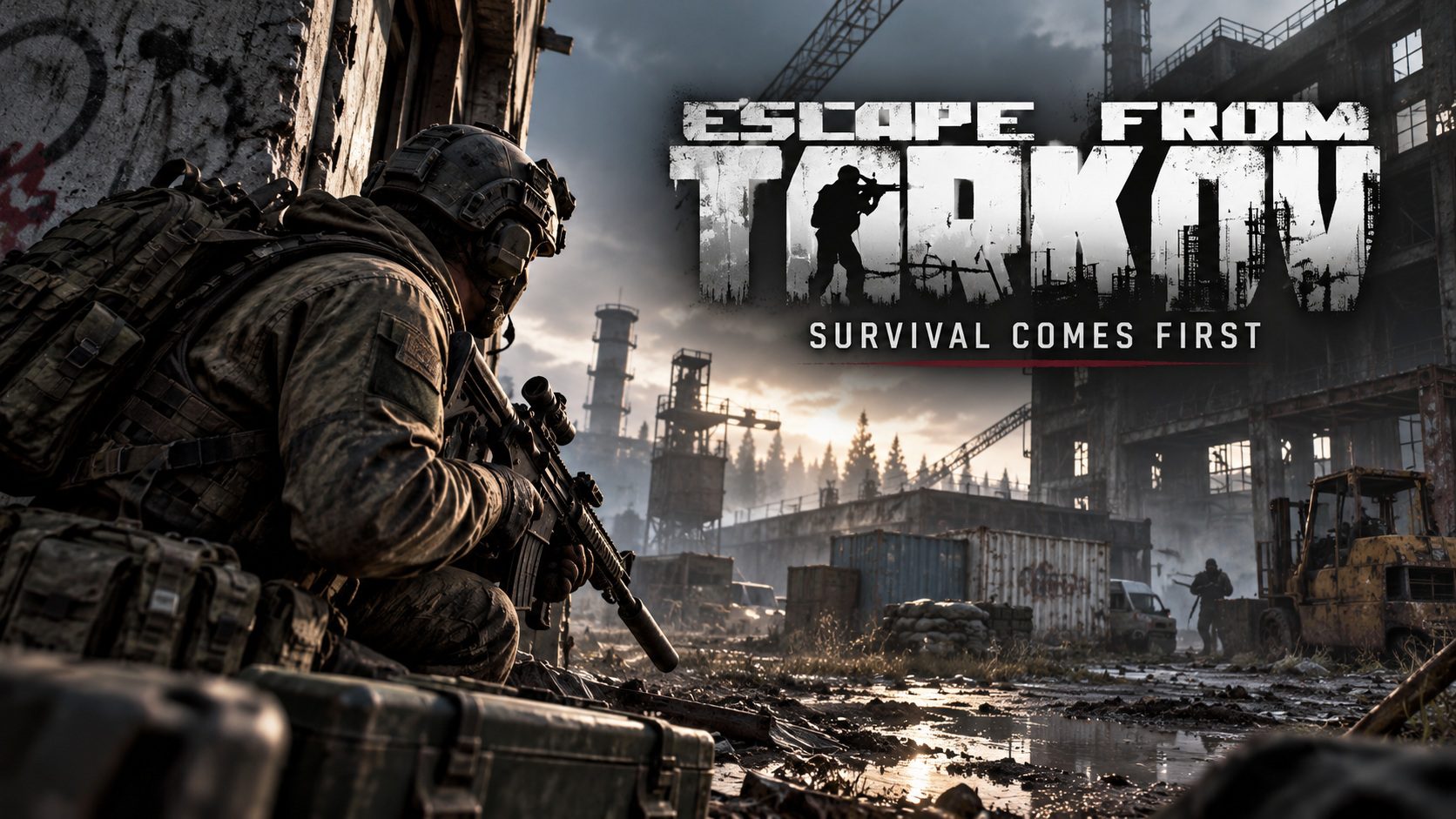
Escape from Tarkov makes survival more important than winning a firefight
Escape from Tarkov can make opening a door feel more dangerous than firing a rifle.
Somewhere beyond it might be another player. Perhaps they heard you approaching. Perhaps they are searching the same building, or perhaps they have been waiting for somebody to make exactly that mistake.
You have a rifle, ammunition, medical supplies and equipment worth keeping.
You also have a backpack containing items collected during the raid.
A firefight might be winnable. However, winning could leave you wounded, exposed and without enough ammunition to survive the next encounter.
That is the problem at the centre of Battlestate Games’ extraction shooter.
Killing enemies is useful. Completing objectives matters. Finding valuable equipment can transform your progress.
Yet none of those achievements guarantees that you will leave the map alive.
Escape from Tarkov starts before the raid
Unlike conventional shooters that give players a predetermined loadout, Tarkov makes preparation part of the experience.
Before entering a raid, players choose what to carry.
Weapons need ammunition. Magazines need filling. Medical supplies occupy inventory space, while armour, helmets and tactical equipment can improve the chances of survival.
Every item represents a decision.
Better equipment can increase your effectiveness, but it also raises the potential cost of failure.
A heavily equipped player might have a tactical advantage over somebody carrying a basic rifle. However, the better-equipped player may also have considerably more to lose.
That imbalance creates an unusual form of pressure before the fighting even begins.
The city of Tarkov is a hostile place
The game takes place in and around the fictional city of Tarkov, within the Norvinsk region.
A political and military crisis has left the area isolated and dangerous. Private military contractors, armed scavengers and other hostile forces operate throughout the environment.
Players take the role of a contractor associated with one of the game’s principal PMC factions, USEC or BEAR.
The setting provides a reason for the raids, but the environment is more than background scenery.
Industrial areas, residential buildings, forests and military installations create different tactical challenges.
Open ground can expose movement. Interior spaces limit visibility, while unfamiliar routes can lead directly into another player’s position.
Learning the maps becomes a form of progression in its own right.
Every raid is a gamble
A Tarkov raid begins with uncertainty.
You know what you brought.
You know which location you entered.
You may have a task to complete or particular equipment to find.
What you do not know is exactly how the encounter will unfold.
Other PMCs may be operating nearby. AI-controlled Scavs occupy parts of the environment, while more dangerous enemies can complicate an otherwise manageable route.
A simple plan can unravel quickly.
You might enter a building expecting to collect supplies and instead encounter another squad.
You might hear gunfire and decide to avoid the area.
Alternatively, the sound could suggest an opportunity to recover valuable equipment from the aftermath.
Tarkov constantly encourages players to evaluate risk against potential reward.
Escape from Tarkov makes firefights expensive
Gunplay is one of Tarkov’s defining features.
Weapons can be extensively customised, and ammunition selection matters alongside the firearm itself.
A familiar rifle can behave differently depending on its configuration.
Optics affect aiming. Attachments influence handling, while ammunition and protective equipment shape the outcome of engagements.
The game also models injuries and damage through systems that go beyond a simple regenerating health bar.
A player can survive an encounter but emerge in poor condition.
Bleeding, damaged limbs and other injuries may require different medical supplies.
Consequently, winning a firefight does not necessarily mean the danger has passed.
You still need to reach extraction.
Sound can reveal the enemy before you see them
Tarkov frequently rewards listening.
Footsteps may reveal movement in another room.
Gunfire suggests fighting elsewhere on the map.
A player moving through a building can accidentally reveal their presence before establishing where an opponent is hiding.
This creates periods of tension between encounters.
Players stop moving to listen. They check corners, consider possible routes and attempt to work out whether somebody else has already entered the area.
The result is a shooter where information can become as valuable as ammunition.
A player who understands what is happening nearby may avoid a fight altogether.
That can be the smartest decision of the raid.
Equipment becomes personal because it can disappear
In many multiplayer shooters, dying means waiting for the next round.
Tarkov makes the consequences more substantial.
A failed raid can cost the equipment carried into it, subject to the game’s equipment protection and recovery mechanics.
That changes how players value their belongings.
A customised rifle is not merely something selected from a menu.
It might contain expensive parts collected or purchased over time.
A backpack may hold items needed for progression.
Even a modest collection of supplies can become important when the player has struggled to obtain them.
This attachment creates what players often describe as gear fear: reluctance to risk equipment because losing it would hurt.
Tarkov turns that hesitation into part of its identity.
Escape from Tarkov makes looting a strategic decision
Finding valuable equipment should feel rewarding.
In Tarkov, it can create another problem.
Inventory space is limited.
Weight and equipment management influence what players can reasonably carry, while different items have different uses and values.
A player might find ammunition, medical supplies, weapon components or items required for tasks.
Taking everything is rarely practical.
Instead, the player must decide what matters most.
An item that appears unimportant today might become valuable later for a Hideout upgrade or trader task.
Knowledge gradually changes how players loot.
Experienced players are not necessarily searching for the most visually impressive object.
They are looking for the items that best serve their immediate goals.
Traders give the raid a purpose
Tarkov’s traders provide another layer of progression.
They offer equipment, supplies and tasks that encourage players to visit particular locations or complete specific objectives.
Some assignments involve collecting items.
Others require visiting areas, recovering objects or eliminating enemies under particular conditions.
Tasks help structure the experience without removing the freedom to decide how to approach a raid.
A player might enter with a single objective.
Then circumstances change.
A valuable item appears.
Gunfire blocks the planned route.
An unexpected encounter consumes medical supplies.
Suddenly, completing the original task may no longer be worth the risk.
The player must choose whether to continue or extract.
The Hideout gives recovered items another purpose
Outside raids, Tarkov offers the Hideout.
This personal facility provides progression systems that connect scavenging with longer-term development.
Different modules require resources and upgrades.
Consequently, ordinary objects recovered from raids can become important components of a larger plan.
The Hideout also helps explain why Tarkov’s economy feels interconnected.
Loot is not always something to sell immediately.
Some items support crafting or upgrades. Others can be useful for tasks, trading or future equipment preparation.
The player is building something beyond the next loadout.
That longer-term investment makes successful extraction more meaningful.
Scav runs offer another approach to survival
Tarkov does not require every raid to begin with the player’s primary PMC.
Scav gameplay provides a different route into the environment, using a separate character with a supplied loadout.
The equipment is not necessarily ideal.
However, the reduced personal equipment commitment changes the calculation.
A Scav run can provide an opportunity to recover supplies, explore and learn the environment without placing the same PMC loadout at risk.
The experience also creates different interactions with other Scavs and players.
It is another example of Tarkov building multiple kinds of decisions around the same maps.
Extraction is the real objective
A raid can contain several victories.
You might defeat another player.
Complete a task.
Find valuable ammunition.
Recover an expensive weapon.
Discover a useful route through an unfamiliar area.
Yet those achievements can be undermined if you fail to extract.
Extraction points turn the final stage of a raid into another tactical problem.
The player needs to understand where to leave, which exits are available and how to reach them.
A route that seemed safe earlier might now contain enemies.
A wounded player may be running short of supplies.
The backpack might be full of equipment too valuable to risk in another fight.
Tarkov creates some of its strongest tension when the player has already achieved what they came to do.
Now they must escape.
Escape from Tarkov rewards knowledge as much as reflexes
Mechanical shooting skill certainly matters.
However, Tarkov also rewards preparation and familiarity.
Understanding ammunition can improve equipment choices.
Knowing a map helps players avoid dangerous routes.
Recognising useful items makes looting more efficient.
Learning where enemies may appear improves survival chances.
Even understanding when not to fight becomes important.
That creates a demanding learning curve.
New players face several interconnected systems before they fully understand how those systems affect one another.
However, that complexity also gives experienced players more ways to improve beyond simply aiming faster.
Multiplayer makes every encounter unpredictable
AI enemies provide danger, but human opponents introduce another level of uncertainty.
Players can behave cautiously or aggressively.
Some hunt other PMCs.
Others concentrate on tasks.
Some avoid conflict whenever possible.
A heavily equipped squad may dominate an area, while a poorly equipped player might survive through patience and positioning.
That unpredictability gives Tarkov its particular atmosphere.
The game does not need to manufacture constant action.
The possibility that another person is nearby can be enough.
Escape from Tarkov reached full release in 2025
Battlestate Games brought Escape from Tarkov to its full 1.0 release on 15 November 2025, alongside its Steam debut.
That was a significant milestone for a game associated with a lengthy development and testing period.
The Steam release also placed Tarkov in front of a wider storefront audience.
However, full release did not mean development stopped.
Post-launch updates continued into 2026, addressing technical problems, matchmaking, AI behaviour and other aspects of the experience.
Steam Store
+1
For a game built around interconnected systems, continued maintenance remains particularly important.
Changes to AI, matchmaking or equipment balance can affect the experience of every raid.
The Steam reception shows a divided audience
At the time checked, Tarkov’s Steam reviews carried a Mixed classification.
The listing showed approximately 62% positive English-language reviews, while recent reviews were also Mixed. These figures are time-sensitive and will change as more players submit feedback.
Steam Store
That reception is worth acknowledging.
Tarkov’s demanding design is central to its identity, but difficulty alone does not explain every criticism.
Technical performance, accessibility, matchmaking, account requirements and the wider player experience also matter.
Steam additionally lists a required Battlestate Games account and kernel-level BattlEye anti-cheat.
Those are practical considerations for prospective players, not details that should be hidden beneath the game’s reputation for hardcore combat.
Escape from Tarkov remains demanding in 2026
Tarkov’s full release did not transform it into a conventional shooter.
The central structure remains unforgiving.
Prepare a loadout.
Enter a dangerous location.
Complete objectives.
Search for supplies.
Avoid or confront enemies.
Manage injuries.
Find extraction.
Survive.
Its complexity can be frustrating, especially for newcomers unfamiliar with its maps, ammunition and progression systems.
However, the same complexity creates the tension that defines the experience.
The game asks players to make decisions without complete information, knowing that a mistake may cost more than a lost match.
Why Escape from Tarkov still matters
Escape from Tarkov changes what winning means.
In a conventional shooter, success might be measured by eliminations, points or the final result of a match.
Tarkov offers a different calculation.
You entered with a rifle, armour and supplies.
You completed a task.
You found something valuable.
You heard another player approaching.
You could have fought.
Instead, you waited.
They passed.
You reached extraction.
Nobody saw you leave.
That might not sound like a spectacular victory.
But the equipment survived. The task progressed. The valuable items returned with you.
Tomorrow, you can use them again.
In Tarkov, sometimes the most successful firefight is the one you never started.


