ChatGPT Latest Features and Updates for 2027
This 2027 ChatGPT update tracker starts with the latest product changes OpenAI documented through 28 September 2026 and should be refreshed as new releases arrive. It separates generally available features from changes that depend on plan, platform, rollout, region or workspace settings.
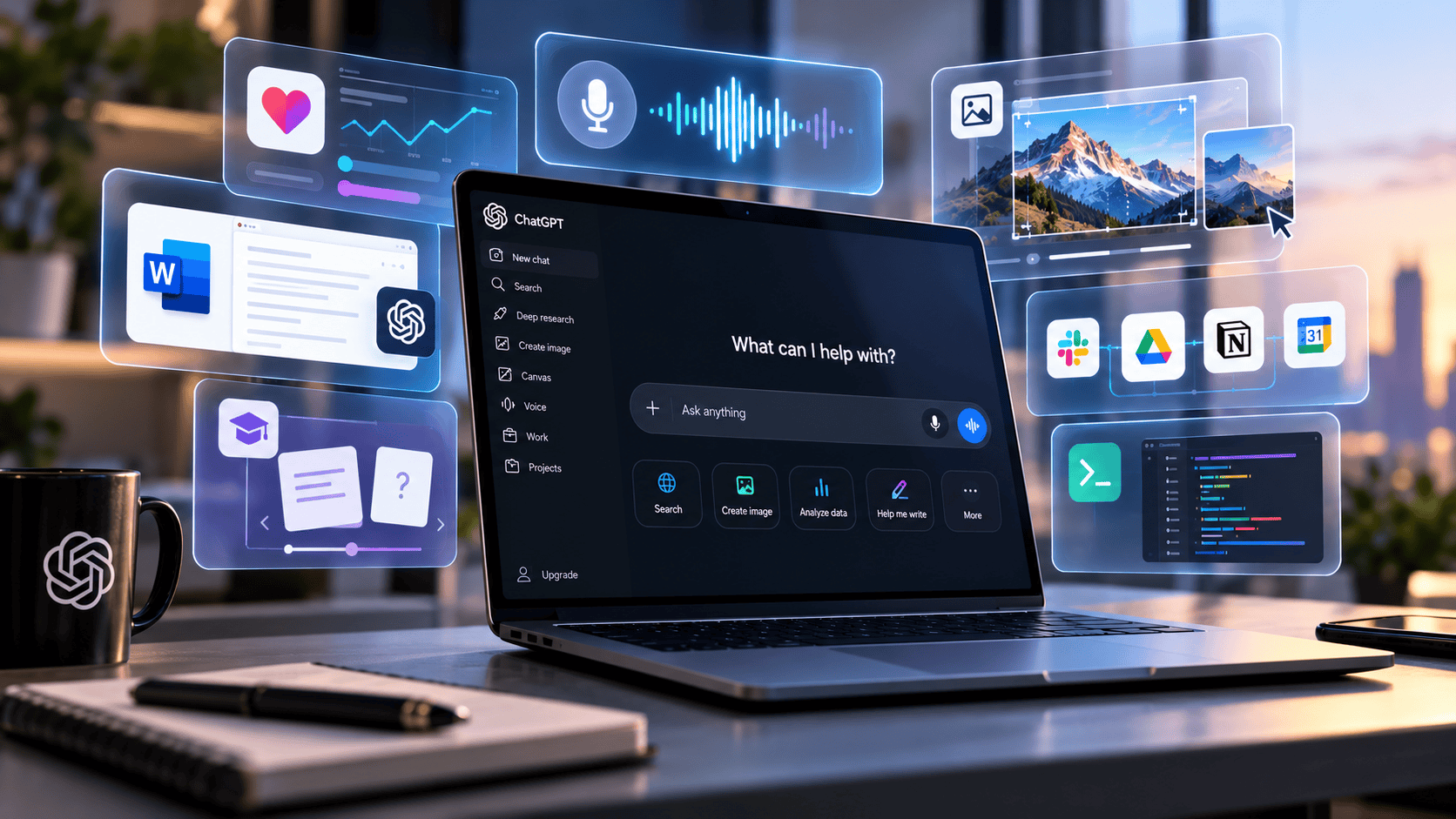
As of 29 September 2026, OpenAI’s current release notes document personalized Health-data summaries, security history, plugins in Voice, GPT-6 Sol and Luna in Work and Codex, interactive flashcards, ChatGPT for Word, Privacy Center changes, Images 2.5 and updated Voice model behaviour. For the evergreen overview, see our complete ChatGPT guide for South Africa.
Health data gained personalized summaries on 28 September
OpenAI says eligible Health users can now select a chart, metric or synced record in the Health tab to receive personalized explanations and insights based on connected health information. The update builds on Health’s ability to combine supported records and Apple Health data into a more contextual view.
This is not a generally available South African feature. OpenAI currently limits Health to eligible logged-in Free, Go, Plus and Pro users in the United States who are 18 or older, with support on web and iOS. South African readers should therefore treat the 28 September change as a product-development update rather than a capability available to local accounts.
Security history arrived on 25 September
OpenAI introduced a security-history view that lets users review recent account activity such as sign-ins, sign-outs and changes to multi-factor authentication, passkeys and other security settings.
This is an account-security feature rather than an AI capability, but it matters because ChatGPT increasingly connects to files, apps and work systems. Better visibility into account activity becomes more important as the product gains access to more useful context.
Plugins came to Voice on 23 September
OpenAI says Live now supports plugins on web, iOS and Android. Users can speak requests while using the plugins and connected apps available to their account.
This moves Voice further from a standalone conversational mode toward an interface for connected work. Exact app access still depends on account permissions, installation and plan support.
GPT-6 Sol and Luna came to Work and Codex on 22 September
OpenAI introduced GPT-6 Sol and GPT-6 Luna in ChatGPT Work and Codex, while noting that these models are separate from the models available in ordinary Chat and that plan and workspace settings affect model access.
For readers, the practical lesson is that a model name should always be tied to the product surface where OpenAI says it is available rather than presented as if every ChatGPT user has the same model picker.
Interactive flashcards launched on 22 September
ChatGPT can now create interactive flashcards from a topic or uploaded notes. Users can flip cards, mark whether they knew the answer, shuffle the deck and return to saved flashcards later.
This adds a structured learning tool inside the conversation rather than requiring the user to copy generated questions into another study app.
ChatGPT for Word launched on 17 September
OpenAI added ChatGPT to Microsoft Word through an add-in. The release notes describe drafting from notes, summarising a document, revising selected text and adjusting headings and formatting from a sidebar.
The significance is workflow location: instead of moving content between Word and a browser tab, the assistant can operate closer to the document being edited.
Privacy Center began rolling out in September
OpenAI has also been rolling out a Privacy Center that explains options covering chat privacy, memory, data use, connected apps and account security. The controls themselves remain in Settings; the Privacy Center is designed to help users understand and find them.
South African users should still consider local legal and organisational requirements such as POPIA when deciding what information belongs in an AI system.
Images 2.5 arrived on 8 September
OpenAI says ChatGPT Images 2.5 improves detail, editing precision and generation speed. The update also adds templates, sketch-to-image workflows, full-screen mobile editing and prompt sharing.
For creators, marketers and publishers, the editing improvements may matter more than raw generation. Real production often requires changing a specific element rather than recreating an entire image.
Voice model and limit changes landed on 9 September
OpenAI also changed how Voice can use models for more difficult search or reasoning tasks and simplified usage-limit structures. Because model access is plan-dependent and changes frequently, users should check the current account controls rather than relying on a static table.
Custom GPTs are moving toward plugins
OpenAI announced in September that it plans to retire custom GPTs across ChatGPT plans and provide a migration path to plugins. Timing can vary by plan and workspace.
This is strategically important because it shows where OpenAI wants reusable instructions and connected actions to live in the future. Existing users should follow the official migration notices instead of assuming older GPT workflows will remain unchanged indefinitely.
ChatGPT Work remains one of 2026’s biggest product changes
Introduced in July, ChatGPT Work is designed for longer tasks that can involve research, connected apps, files, browser activity and finished deliverables. This is part of a broader shift from conversational answers toward multi-step outcomes.
That trend also increases the importance of permissions and review. An AI that can act across connected systems requires stronger controls than an AI that can only draft text.
GPT-6.1 Astra was reportedly shelved after safety testing
Reuters reported on 28 September that OpenAI decided not to release a planned GPT-6.1 Astra model that had been expected in October after internal safety and alignment testing raised concerns. This is not a ChatGPT release-note feature announcement; it is a reported product-development decision and should be treated separately from confirmed feature rollouts.
The distinction matters because the existing GPT-6 Astra release documented by OpenAI on 3 September is not the same thing as the reported GPT-6.1 Astra follow-up. Version numbers and dates therefore need to remain explicit when these changes are described.
What has changed for everyday users?
The broader pattern matters more than any single release. ChatGPT is becoming more multimodal, more connected to external apps, more capable of longer tasks and more integrated into workplace software.
Our ChatGPT tools guide explains where those capabilities fit, while our ChatGPT alternatives comparison puts the changes in competitive context. For evidence-based analysis of where these signals could lead next, read the future of ChatGPT in 2027.
Why this page needs frequent updates
This is a living freshness page because OpenAI publishes product changes frequently and feature access can vary by plan, platform, workspace and rollout stage.
The page is most useful when it changes for a material product update rather than for a cosmetic date refresh. Evergreen explainers can then stay focused on durable concepts while this tracker carries dated feature changes.
What should trigger the next update?
Material changes include a new core workflow, a major privacy or security control, a significant model-access change, a new Office or app integration, or a feature that changes how ordinary users work with ChatGPT.
Small interface changes can be noted when relevant, but they should not justify a date refresh on their own. Freshness should reflect new information, not cosmetic editing.
Why exact dates matter on this page
ChatGPT changes frequently enough that relative phrases such as “recently” can become misleading. Each material update should keep its announcement date, and the distinction between the date OpenAI announced a feature and the date a specific user actually received it should remain explicit.
The most reliable way to maintain a page like this is to anchor each material change to a dated OpenAI release note and preserve the distinction between an announcement and the account experience a user actually sees.


