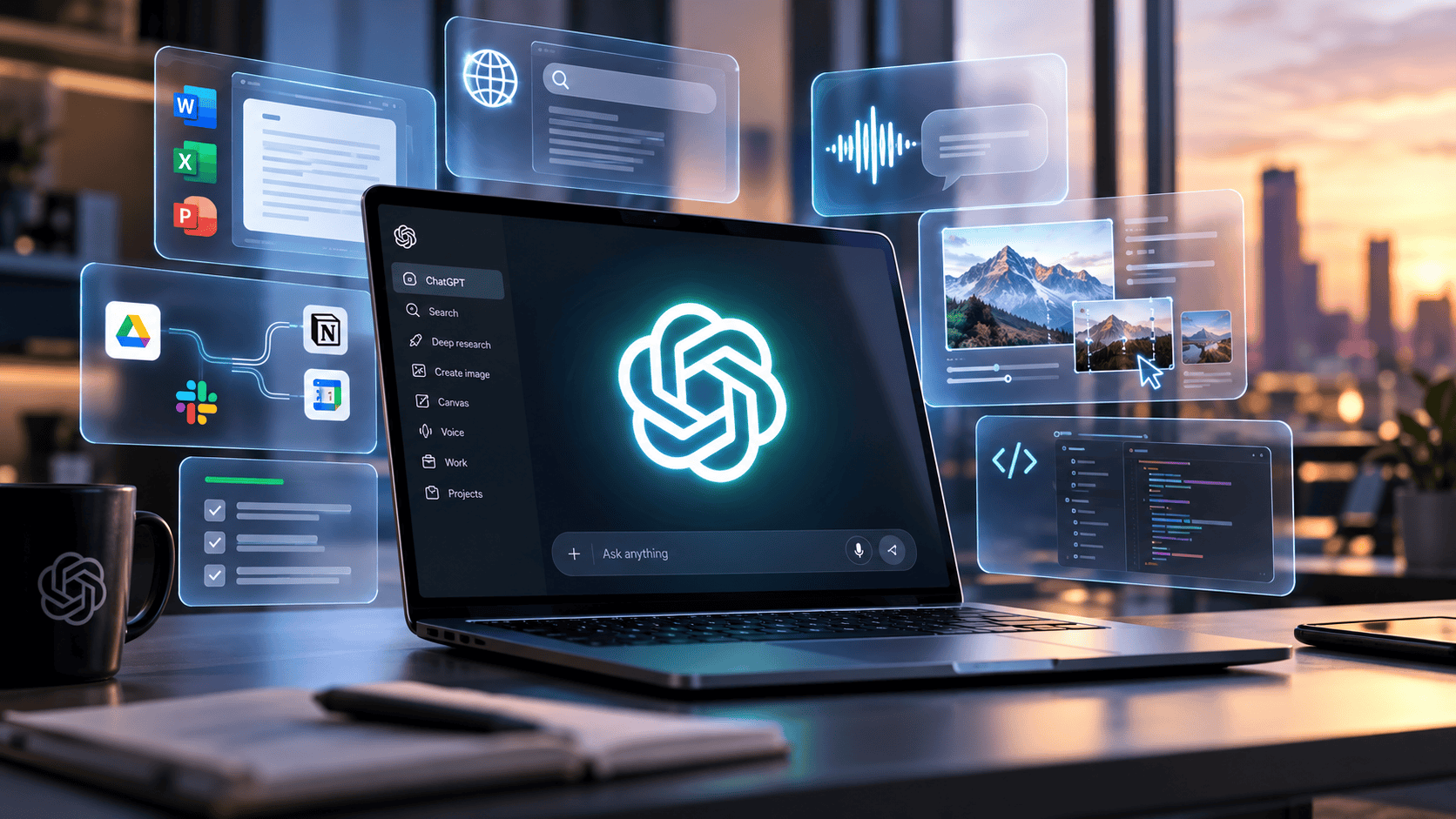
Future of ChatGPT in 2027: What Current Trends Suggest
The future of ChatGPT in 2027 cannot be described as a confirmed roadmap unless OpenAI publishes one. Exact future models, release dates and capabilities remain uncertain, so this article separates documented 2026 signals from analysis about what those signals could mean next.
What we can do is look at the product direction visible in OpenAI’s 2026 releases and identify trends likely to shape the next year. This is analysis, not a roadmap. For what is available now, use our complete ChatGPT guide for South Africa and latest ChatGPT features and updates.
1. ChatGPT is likely to become more task-oriented
One of 2026’s clearest shifts is from answers toward outcomes. ChatGPT Work is designed for longer, multi-step tasks involving files, apps, research and finished deliverables.
If that direction continues, 2027 ChatGPT use may feel less like “ask a chatbot” and more like “delegate a bounded job, review progress and approve important actions”.
2. Connected apps will become more important
OpenAI has been expanding plugins and connected-app workflows, including support in Voice. This suggests that context from the tools people already use will become a larger part of the product.
The opportunity is obvious: less copying between systems. The risk is also obvious: more permissions and more sensitive context. In 2027, product quality may be judged as much by permission design and auditability as by raw model capability.
3. Voice could become a general interface
Voice has already moved beyond conversational novelty. Plugin support means a spoken request can increasingly connect to work rather than ending as a spoken answer.
The next step is likely deeper continuity between text, voice, files and task execution, although exact 2027 features remain unconfirmed.
4. Multimodal creation will keep moving toward editing
Images 2.5 emphasises more precise editing, templates and sketch-driven workflows. That reflects a broader shift: generation is becoming easier, while useful production depends on control, revision and consistency.
For publishers and businesses, 2027 value may come less from “make an image” and more from “change this specific element while preserving everything else”.
5. Workplace integration will deepen
ChatGPT for Word joined OpenAI’s growing workplace integration efforts in September 2026. The direction is clear: AI is moving into the documents, spreadsheets and presentations where work already happens.
That could reduce the need to move content into a separate chatbot window. It also means enterprise administrators will care more about retention, access, compliance and data boundaries.
6. AI safety controls will become more visible
Capability growth creates governance pressure. TechnologyBlog’s report on OpenAI Astra’s cybersecurity assessment showed how advanced systems can move into security-sensitive territory that demands stronger access controls.
OpenAI has also added account-security and privacy features during 2026. If agents gain more ability to act, users should expect confirmations, permissions and monitoring to remain central rather than disappear.
7. The model name may matter less than the workflow
Model lineups change faster than most evergreen articles can be maintained. Users increasingly experience the product through modes, tools and outcomes: search, voice, work, coding, images, files and plugins.
By 2027, the practical question may be less “which model am I chatting with?” and more “which workflow is handling this job, what can it access and what needs my approval?”
8. Memory and personalisation will need clearer controls
OpenAI describes Memory as a way to use relevant preferences and details from chats and other sources, with availability varying by account and region.
More useful personalisation creates a corresponding need for transparency: what is remembered, where it came from, how it can be changed and which contexts should remain isolated.
9. Competition will accelerate product specialisation
ChatGPT is not developing in isolation. Anthropic is pushing agentic Claude workflows, Google is making Gemini more proactive across its ecosystem, Microsoft is integrating Copilot into work, and Perplexity continues to build around web-first research.
This competition is likely to push assistants toward distinct strengths rather than identical chat interfaces. Our ChatGPT alternatives comparison tracks those differences.
10. South African adoption will depend on practical value and trust
For South African businesses, schools, professionals and consumers, the important 2027 question is how AI fits into real workflows under local governance, privacy and accountability requirements.
Local relevance will increasingly come from how organisations apply AI under POPIA, sector rules, infrastructure constraints, education needs and real workplace processes.
11. AI literacy may become more important than prompt tricks
As the product handles more of the interface complexity, users may spend less time learning prompt formulas and more time learning judgement: how to verify a source, recognise uncertainty, protect sensitive information and decide what should remain a human decision.
That is a more durable skill than memorising a menu layout or a model name.
What not to predict
There is no responsible basis today for stating a guaranteed future model name, a specific 2027 launch date or a promised autonomous capability unless OpenAI publishes it.
A good future-of-ChatGPT article should therefore be updated as evidence changes. Questions about reliability, governance and failure modes belong in our ChatGPT risks and limitations guide; this page should remain clearly labelled analysis of direction and implications.
What would change this outlook?
These expectations should be revised if OpenAI changes product strategy, regulators impose new restrictions, enterprise customers resist deeper agent access, or technical limits slow the expansion of autonomous workflows.
The opposite is also possible: better reliability, stronger permission systems and clearer audit trails could accelerate adoption faster than expected. The important editorial discipline is to update the forecast when evidence changes rather than defending an old prediction.
The most durable prediction is organisational, not technical
Whatever model names arrive, organisations will still need people who can frame a task, judge evidence, protect data and take responsibility for the result. Better models may reduce manual steps, but they do not remove the need for governance. That is likely to become more important as AI gains more access to tools and systems.
What is already visible by late 2026
The strongest evidence for these expectations is not a rumoured 2027 model. It is the product architecture already visible by late September 2026. OpenAI has separated ordinary Chat from Work for longer multi-step tasks, expanded plugins into Voice, added Microsoft Word integration, and introduced different model families for Chat versus Work and Codex. Those are concrete product choices that make the assistant less dependent on one conversational surface.
They also create a clear constraint on future progress: reliability has to improve alongside agency. A system that drafts a paragraph can be corrected after the fact; a system that can use apps, browser tools or connected files needs permission boundaries, action approvals and an audit trail before it is trusted with more consequential work. The direction toward agents is therefore inseparable from the direction toward governance.


