No dedicated The Sims 4 article surfaced in the TechnologyBlog duplicate check, so this is clear to proceed.
The current angle is strong: the game is 12 years old in 2026, remains extremely active on Steam, and EA is still releasing substantial expansions and core quality-of-life updates. On 22 September alone, Maxis released a major autonomy and stability update based partly on community feedback. EA
1. Article Setup
Article title: The Sims 4 in 2026: Why millions are still playing after 12 years
Game: The Sims 4
Developer: Maxis
Publisher: Electronic Arts
Original release: 2 September 2014
Steam release: 18 June 2020
Steam App ID: 1222670
Genre: Life simulation / sandbox / building
Business model: Free-to-play base game with paid expansions and additional content
Focus keyphrase: The Sims 4 in 2026
Primary angle: Twelve years after launch, The Sims 4 remains one of gaming’s dominant life simulations. Steam alone continues attracting tens of thousands of simultaneous players, while Maxis is still releasing expansions and significant updates rather than treating the game as a legacy product. EA
2. Internal SEO Strategy
The primary future cluster should be:
The Sims 4 in 2026 ↔ Maxis
The next logical developer profile is:
Who is Maxis? The studio behind The Sims and SimCity
Electronic Arts can also be linked contextually because TechnologyBlog already has an EA developer/publisher profile in its gaming coverage.
The eventual structure should be:
Electronic Arts → Maxis → The Sims 4
with a future article on the broader The Sims franchise if useful.
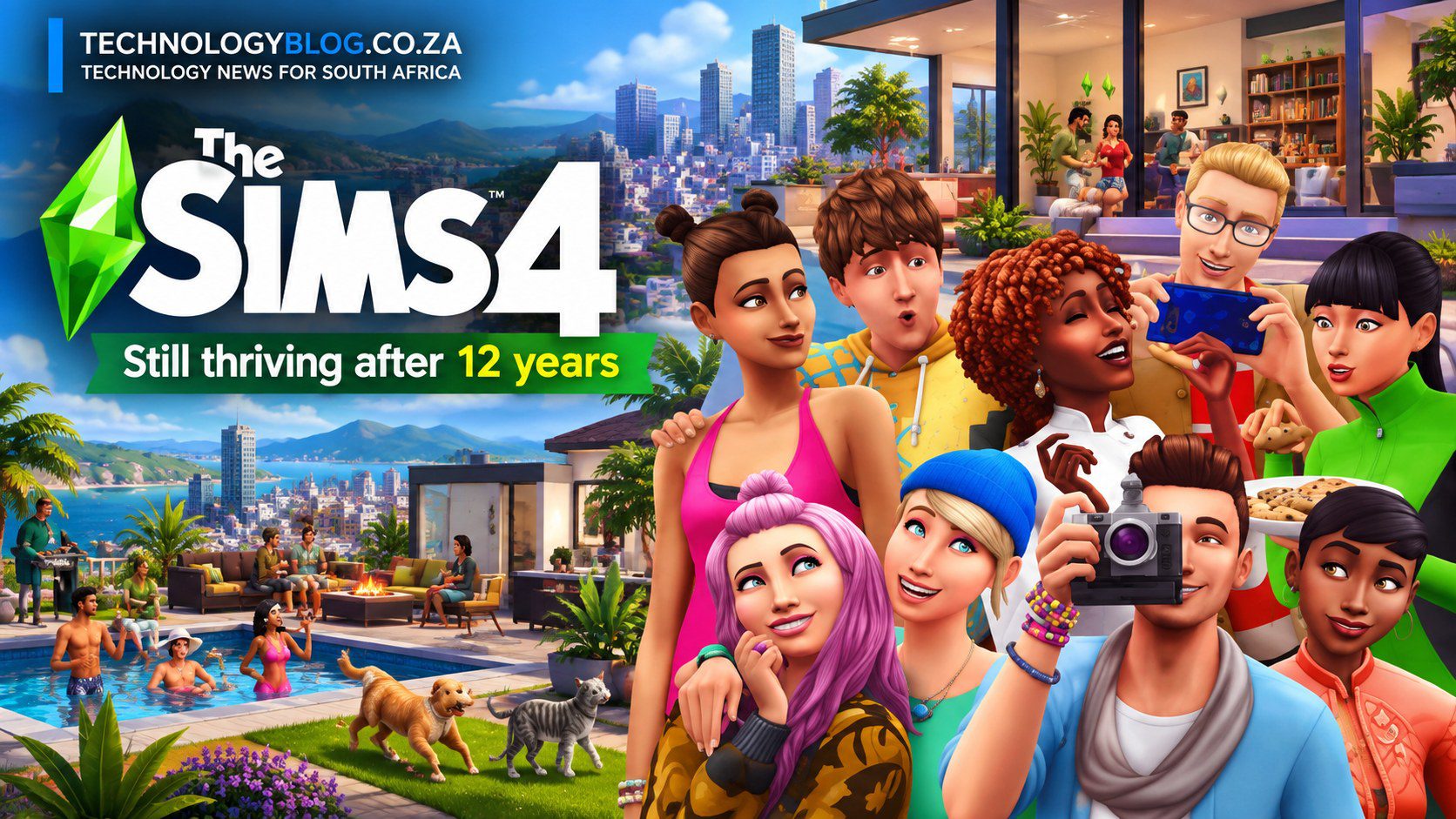
3. Featured Image Direction
Headline: THE SIMS 4
Subtitle: Still thriving after 12 years
Use a bright, polished Sims-style suburban environment showing several Sims with recognisably different lifestyles and personalities. Include a detailed house or neighbourhood in the background to represent both Live Mode and Build Mode.
Featured image alt: The Sims 4 in 2026
Dimensions: 1672 × 941
Final: JPG below 2 MB
4. Key Facts / Editorial Notes
The Sims 4 originally launched in September 2014. Its Steam version followed on 18 June 2020. Maxis is the developer and Electronic Arts the publisher. SteamDB
The base game became free-to-play in October 2022.
The latest SteamDB snapshot showed approximately 33,900 concurrent Steam players, with a 24-hour peak at roughly the same level. Its Steam all-time peak remains 96,328 concurrent players, recorded on 23 October 2022. These figures measure simultaneous Steam users, not unique daily/monthly players and not the game’s total cross-platform audience. SteamDB
SteamDB currently records more than 200,000 Steam reviews, with approximately 86.3% positive user reviews and an adjusted SteamDB rating of about 85.4%. SteamDB
The current EA catalogue lists 57 packs in its September 2026 sale catalogue, spanning expansions, game packs, stuff packs and other content. This should not be described as 57 expansion packs. EA
Recent expansions listed by EA include Royalty & Legacy, Adventure Awaits, Enchanted by Nature, Businesses & Hobbies, Life & Death and Lovestruck. EA
The 22 September 2026 update focused heavily on Sim autonomy and stability, including more logical autonomous behaviour and relationship-system tuning. EA
5. Main Article
The Sims 4 in 2026: Why millions are still playing after 12 years
The Sims 4 in 2026 is something Maxis probably could not have fully anticipated when the game launched in September 2014.
Twelve years later, it is still the current mainline Sims game.
More importantly, people are still playing it in enormous numbers.
During TechnologyBlog’s latest check, approximately 34,000 people were playing simultaneously through Steam alone. The game has accumulated more than 200,000 Steam reviews, while Maxis continues releasing expansions, fixes and substantial updates. EA
The Sims 4 is therefore not simply an old game that Electronic Arts continues selling.
It remains an active platform.
Players are still building houses, creating families, destroying relationships, starting businesses, raising children, becoming supernatural creatures and discovering increasingly strange ways for their Sims to die.
Twelve years later, life goes on.
The Sims 4 in 2026 is still remarkably active
Steam provides only one part of The Sims 4 audience, but it gives us a useful public measurement.
During the latest check, SteamDB recorded roughly 33,900 simultaneous players, with a similar 24-hour peak. SteamDB
The all-time Steam record stands at 96,328 concurrent players, set on 23 October 2022.
That timing matters.
The record did not happen when The Sims 4 first reached Steam in 2020.
It arrived shortly after the base game switched to free-to-play in October 2022.
Removing the initial purchase barrier fundamentally changed how easy it became for new players to enter the Sims ecosystem.
Steam only shows part of the audience
Those numbers need important context.
Steam does not represent the entire Sims 4 player base.
The game also exists through EA’s own PC ecosystem and on consoles.
Therefore, a Steam concurrency figure cannot responsibly be described as the total number of people playing The Sims 4.
Nor should concurrent players be confused with unique daily or monthly users.
What Steam does show is that tens of thousands of people can still be playing simultaneously on one PC storefront more than a decade after the game’s original release.
That alone is significant.
The Sims 4 began very differently
Anyone encountering The Sims 4 today is seeing the result of 12 years of accumulated development.
The launch version was much smaller.
Some features associated strongly with the franchise were absent or limited at release.
The years that followed brought free updates alongside an enormous catalogue of paid content.
That gradually transformed the game.
The modern Sims 4 contains so many interconnected systems that comparing it directly with the original 2014 version can be difficult.
The basic idea has barely changed
Despite all that expansion, the central concept remains remarkably simple.
Create people.
Give them somewhere to live.
Then interfere with their lives.
Players can control careers, relationships, families, homes, hobbies and ambitions.
Alternatively, they can create a household and watch what happens.
There is no single correct objective.
The Sims 4 is a sandbox.
That flexibility is one reason the game can remain relevant for so long.
Create a Sim is effectively a character creator for stories
Everything starts with a Sim.
Create a Sim allows players to determine appearance, clothing and personality before sending that character into the world.
However, the creator serves a bigger purpose than appearance.
A Sim is the starting point for a story.
Maybe the player creates themselves.
Maybe they recreate friends.
Perhaps they build a fictional family.
Others create celebrities, characters from games or films, or entirely original people.
The tool provides the pieces.
The player decides who those people become.
Build Mode is almost a game of its own
Some Sims players spend relatively little time actually controlling Sims.
They build.
Build Mode allows players to construct homes, apartments and increasingly elaborate structures.
Rooms can be shaped.
Walls moved.
Furniture placed.
Colours changed.
Landscaping adjusted.
Then somebody discovers that the kitchen does not work because a chair is half a square too close to something.
Back to Build Mode.
That construction system has developed into one of The Sims 4’s strongest creative tools.
Players do not need to play the same way
This is one of the game’s greatest strengths.
A player interested in architecture can concentrate on building.
Someone interested in character creation can spend hours in Create a Sim.
Another player can build enormous multigenerational families.
Some create businesses.
Others concentrate on careers.
Some chase supernatural storylines.
Then there are players whose main objective appears to be discovering exactly how much chaos one household can survive.
The same game supports all of them.
The Sims creates stories without requiring a conventional story
The Sims 4 has authored content.
It has lore.
Characters and locations have histories.
Expansions introduce themes and scenarios.
Yet some of the most memorable stories emerge from systems interacting unexpectedly.
A relationship collapses.
Someone starts a fire while cooking.
A visitor behaves strangely.
A career goes badly.
A wedding becomes a disaster.
None of these events needs to be a scripted campaign moment.
The player remembers them because they happened to their Sims.
That personal ownership is difficult for conventional narrative games to reproduce.
The Sims 4 became free-to-play
One of the biggest changes in the game’s history came in October 2022.
Electronic Arts made the base game free.
Players no longer needed to buy The Sims 4 simply to enter its world.
That significantly reduced the barrier to entry.
Anyone curious about the game could install the base experience before deciding whether additional content interested them.
The timing also coincided with a dramatic Steam surge.
SteamDB records the game’s all-time peak of 96,328 concurrent players on 23 October 2022. SteamDB
Free access clearly expanded the potential audience.
The business model moved towards expansions
Free does not mean the entire Sims 4 experience costs nothing.
The base game is the entrance.
A huge catalogue of additional content surrounds it.
Expansion packs add substantial systems and worlds.
Other packs provide narrower experiences, objects, clothing and activities.
EA’s current September 2026 catalogue contains 57 listed packs and content products across several categories. EA
That amount of content creates both choice and complexity.
A new player does not need everything.
Trying to understand what is actually useful can nevertheless become a project of its own.
Twelve years of DLC created an enormous ecosystem
The current catalogue stretches across very different themes.
Cats & Dogs added pets.
Seasons introduced changing weather and seasonal activities.
Discover University expanded education.
Cottage Living moved towards rural life.
High School Years concentrated on teenagers.
Growing Together expanded family relationships.
Horse Ranch added horses and ranching.
For Rent expanded residential rental properties.
Life & Death explored mortality and what comes afterwards.
Then development continued.
The Sims 4 has effectively become a collection of overlapping life simulations.
Businesses & Hobbies expanded another part of everyday life
Businesses & Hobbies continued that trend.
The expansion focuses on entrepreneurship, creative interests and running small businesses.
That fits The Sims particularly well.
Work has always been part of Sim life, but businesses give players more direct control over what their characters actually do.
A career can become another storytelling system.
Instead of simply sending a Sim away to work, players can shape something around their interests and skills.
That is the broader pattern behind successful Sims expansions.
They create another way to live.
Enchanted by Nature moved towards fantasy
Not every Sims experience needs to resemble ordinary life.
Enchanted by Nature pushes the game towards a more magical relationship with the natural world.
That flexibility is another reason the platform can support so much additional content.
One household can resemble suburban everyday life.
Another can become supernatural.
Another can concentrate on farming.
Another can contain vampires, werewolves or spellcasters.
The Sims 4 does not require all those possibilities to make perfect sense together.
Players decide which parts belong in their version of the world.
Adventure Awaits added another direction
Adventure Awaits is also among the current expansion catalogue listed by EA in 2026. EA
Its presence illustrates how Maxis continues finding new themes long after the obvious life-simulation categories have already received attention.
After 12 years, the challenge is not simply adding more furniture.
New content needs another reason for players to create characters, travel, build or tell stories.
That becomes increasingly difficult as the catalogue grows.
Royalty & Legacy is part of the current 2026 game
The latest EA catalogue also lists Royalty & Legacy among the current Sims 4 expansion packs. EA
That means the 2026 game continues extending into themes far removed from the ordinary suburban life associated with early Sims games.
At this stage, The Sims 4 is broad enough to accommodate dramatically different fantasies inside the same underlying simulation.
Players can build an ordinary family.
Or they can create something far less ordinary.
The sandbox accommodates both.
Maxis is still updating the core game
Paid content gets attention, but the underlying game also continues changing.
On 22 September 2026, Maxis released a substantial quality-of-life update.
One of the major targets was Sim autonomy.
The developers made dozens of adjustments designed to make Sims behave more logically when acting without direct player instructions. EA
That may sound mundane compared with a new expansion.
For a life simulation, it is fundamental.
Sims should behave like people, at least occasionally
Autonomy determines what Sims do when players are not directly controlling every action.
That makes it central to the illusion of life.
The September update addressed numerous behaviours.
Sims should make better decisions about where to perform certain actions.
Social interactions received attention.
Relationship autonomy was adjusted for systems connected with Lovestruck and Growing Together. EA
These changes target something more important than adding another object.
They attempt to make Sims themselves behave more convincingly.
Yes, the sink problem received attention
Long-time Sims players know that virtual people sometimes make baffling decisions.
A particularly familiar example is choosing a distant sink rather than the obvious one nearby.
Maxis explicitly referenced Sims washing their hands in the actual bathroom sink instead of wandering towards the kitchen as an example of the September autonomy improvements. EA
It is a small detail.
It is also extremely Sims.
A life simulation succeeds or fails partly through thousands of tiny behaviours that players notice precisely because they understand how a person should act.
Stability remains important after 12 years
The September update also addressed major causes of crashes.
That matters because The Sims 4 has accumulated an extraordinary amount of interconnected content.
Every new system potentially needs to interact with systems created years earlier.
Relationships interact with family mechanics.
Careers interact with skills.
Objects interact with animations.
Expansions interact with other expansions.
Mods add another layer.
Keeping such a mature platform stable becomes increasingly complicated.
New content is only useful if the underlying simulation continues functioning.
Community feedback is influencing development
Maxis says the September quality-of-life work was influenced directly by player feedback from Discord developer Q&As, Reddit and highly voted issues on EA Forums. EA
That is particularly important for a game this old.
Players have spent years identifying recurring frustrations.
Some have enormous save files.
Others use combinations of packs that expose interactions developers may not encounter immediately.
A mature game’s community effectively becomes an enormous long-term testing environment.
The challenge is deciding which problems deserve priority.
Mods are another reason The Sims 4 keeps evolving
The official game is only part of the PC experience.
The Sims franchise has one of gaming’s most established modding communities.
Players create custom clothing, hairstyles, objects and gameplay modifications.
Some changes are cosmetic.
Others substantially alter systems.
That community dramatically expands what players can do with the game.
However, there is a trade-off.
Major official updates can break mods.
Players using heavily modified installations therefore need to pay attention when Maxis releases significant patches.
Custom content turned The Sims into a creative platform
Custom content deserves particular attention because character creation and building are already central to the game.
Players want more options.
More hairstyles.
More clothing.
More furniture.
More decorative objects.
More ways to make their households distinct.
Community creators provide an enormous amount of that material.
The result is a feedback loop.
The game’s creative tools attract creators.
Creators make more content.
That content gives players more reasons to keep using the creative tools.
Twelve years later, the ecosystem is enormous.
The Sims 4 reviews remain positive on Steam
The Steam review picture is strong, although not flawless.
SteamDB currently tracks more than 200,000 reviews, with approximately 86.3% positive and an adjusted SteamDB rating around 85.4%. SteamDB
That indicates a broadly positive long-term reception.
However, The Sims 4 has also attracted criticism over the years.
Some players object to the amount and cost of additional content.
Others criticise bugs or individual expansion quality.
Those criticisms coexist with an extremely active audience.
Popularity does not mean universal satisfaction.
The DLC catalogue can be intimidating
This is probably the biggest practical problem for somebody discovering The Sims 4 in 2026.
There is a lot of content.
EA’s current catalogue shows 57 pack listings in its September sale. EA
A new player can easily look at that list and assume everything is required.
It is not.
The better approach is to treat the base game as the starting point.
Play it.
Discover which parts of Sim life interest you.
Then look at expansions that deepen those areas.
Someone interested in families needs different content from someone interested in supernatural gameplay.
The free base game makes experimentation easier
This is where the free-to-play model helps.
Players can discover whether they actually enjoy The Sims 4 before building a library of additional content.
That is especially useful because Sims players can want very different things.
Someone may discover that they spend most of their time building.
Another person may care almost entirely about relationships.
Another wants careers.
Another wants animals.
Another wants supernatural chaos.
There is little reason for all of them to own exactly the same packs.
The Sims 4 is unusually good at becoming someone’s personal game
Many games provide essentially the same experience to everyone.
The Sims works differently.
Two players can own the same base game and use it in completely different ways.
One builds houses.
One creates elaborate family histories.
One makes characters.
One experiments with careers.
One installs mods.
One creates chaos and watches the consequences.
The systems are shared.
The stories are not.
That personalisation is probably one of the strongest reasons The Sims 4 survived for 12 years.
There is no conventional ending
The Sims 4 also avoids another problem faced by long-running games.
Players cannot really finish it.
A Sim may die.
A family may reach a goal.
A house may finally be complete.
A career can reach its highest level.
None of that ends the game.
Create another Sim.
Start another family.
Build another house.
Move to another world.
Try another expansion.
The game provides systems rather than a final destination.
Generational play creates extremely long saves
Some players take that idea literally.
They build families across generations.
Children become adults.
Adults become parents.
Older Sims die.
New generations inherit the story.
A household can therefore become a history rather than a temporary playthrough.
That makes apparently ordinary systems surprisingly powerful.
A family photograph means more when the player remembers the people in it.
A house matters more when several generations lived there.
The simulation turns time into storytelling.
Death is part of life in The Sims
The franchise has always had a peculiar relationship with death.
Sims can die.
The Grim Reaper arrives.
Ghosts may remain part of the world.
Players can mourn.
Or, depending on the person controlling everything, they may have deliberately caused the entire situation.
Life & Death expanded that side of the simulation considerably.
It fits because The Sims has never only been about creating life.
It is about observing an entire exaggerated lifecycle.
Sometimes that lifecycle ends because somebody forgot to install a smoke alarm.
The humour remains essential
The Sims would feel very different if it took itself completely seriously.
Its humour gives the simulation personality.
Sims exaggerate emotions.
Animations become theatrical.
Ordinary situations can become ridiculous.
Unexpected interactions create comedy.
The language itself is nonsense.
That prevents the game from becoming a dry simulation of household management.
The Sims resembles life just enough to be recognisable.
Then it becomes absurd.
Build Mode helped The Sims reach beyond traditional gamers
The game’s creative tools also appeal to people who may not think of themselves primarily as gamers.
Building a house is understandable.
Decorating a room is understandable.
Creating a person is understandable.
These activities do not require familiarity with shooters, role-playing systems or complex strategy mechanics.
That accessibility widens the potential audience.
The Sims can function as a game.
It can also function as a digital dollhouse, architecture tool, character creator or storytelling platform.
The Sims 4 in 2026 has enormous accumulated depth
This is where age becomes an advantage.
A new life simulation may have more modern technology.
It cannot instantly reproduce 12 years of accumulated systems and content.
The Sims 4 has careers, relationships, families, pets, seasons, businesses, education, supernatural systems, holidays, hobbies, properties and numerous other layers.
Not every system is equally deep.
Not every pack is equally successful.
However, their combined breadth is difficult to replicate quickly.
The game has accumulated a world.
Age also creates technical debt
The opposite is equally important.
Twelve years of development creates baggage.
Systems designed at different points in the game’s history need to coexist.
New content can expose old problems.
Updates can affect mods.
Interactions between packs can become complicated.
Quality-of-life work such as the September autonomy update demonstrates that Maxis is still addressing fundamental behaviours rather than simply adding new content. EA
Longevity creates depth.
It also creates maintenance.
The Sims 4 in 2026 for South African players
The Sims 4 in 2026 has an obvious advantage for South African players: its core experience does not depend on low-latency multiplayer.
This is primarily a single-player life simulation.
There is no competitive matchmaking requirement.
No regional server population determines whether a player can enjoy the main game.
Latency therefore does not create the same barrier it can for online shooters or competitive multiplayer games.
For South African PC and console players, that makes The Sims 4 straightforward to experience regardless of distance from major international gaming-server regions.
Internet still matters for the wider ecosystem
That does not mean the experience is completely disconnected from online services.
Downloads matter.
Updates matter.
Additional content matters.
The EA ecosystem matters.
PC players may also download mods and custom content.
However, once a player is actually controlling a household, the central experience does not rely on maintaining a competitive connection to other players.
That distinction is valuable.
The game can operate at the player’s pace.
The Sims 4 does not need a huge concurrent audience to work
The Steam player count therefore means something different here than it does for an online shooter.
The Sims 4 could remain completely playable with a dramatically smaller audience.
There is no matchmaking queue that needs filling.
The current tens of thousands of simultaneous Steam players are interesting because they demonstrate continuing popularity, not because the game mechanically requires them. SteamDB
A player returning years later does not need to worry whether enough other people are online.
Their Sims have enough problems already.
Twelve years is an extraordinary lifespan for a mainline Sims game
The Sims launched in 2000.
The Sims 2 followed in 2004.
The Sims 3 arrived in 2009.
The Sims 4 launched in 2014.
Earlier generations therefore lasted considerably less time before a numbered successor appeared.
The Sims 4 changed that pattern.
By 2026, it has spent 12 years as the current numbered Sims game.
That makes this era fundamentally different from the earlier franchise cycle.
Maxis continues treating The Sims 4 as current
The most important evidence is not simply age.
It is development activity.
Maxis is still releasing substantial expansions.
EA is still marketing new packs.
Core systems are still being adjusted.
Crashes are still being addressed.
Autonomy is still being improved.
Community feedback is still influencing patches. EA
Those are not the actions associated with a game that has quietly entered archival maintenance.
The Sims 4 remains active development software.
Is The Sims 4 worth starting in 2026?
TechnologyBlog has not conducted a new scored review of The Sims 4 in 2026, so this is not a purchase recommendation.
The free base game nevertheless changes the question considerably.
Players can try the core experience without purchasing the original game.
The more complicated decision comes later.
Which additional content actually suits the way they play?
With such a large catalogue, buying everything is unnecessary for understanding what makes The Sims 4 work.
The base game provides the answer first.
Then individual players can decide what kind of life they want to simulate.
Why The Sims 4 in 2026 still matters
The Sims 4 in 2026 occupies an unusual position.
It is 12 years old.
Its underlying technology comes from another era of PC and console hardware.
It carries more than a decade of expansions, updates and technical baggage.
Yet people continue playing.
Tens of thousands can be online simultaneously through Steam alone. SteamDB
Maxis continues releasing new content.
Core behaviour is still being improved.
New players can enter through the free base game.
Creators continue building houses, Sims, mods and custom content.
The game has become bigger than any individual expansion.
It is a platform for stories.
Some are carefully planned across generations.
Others begin when somebody decides to build a beautiful house.
And some end five minutes later because a Sim set the kitchen on fire.
After 12 years, The Sims 4 remains capable of all three.


