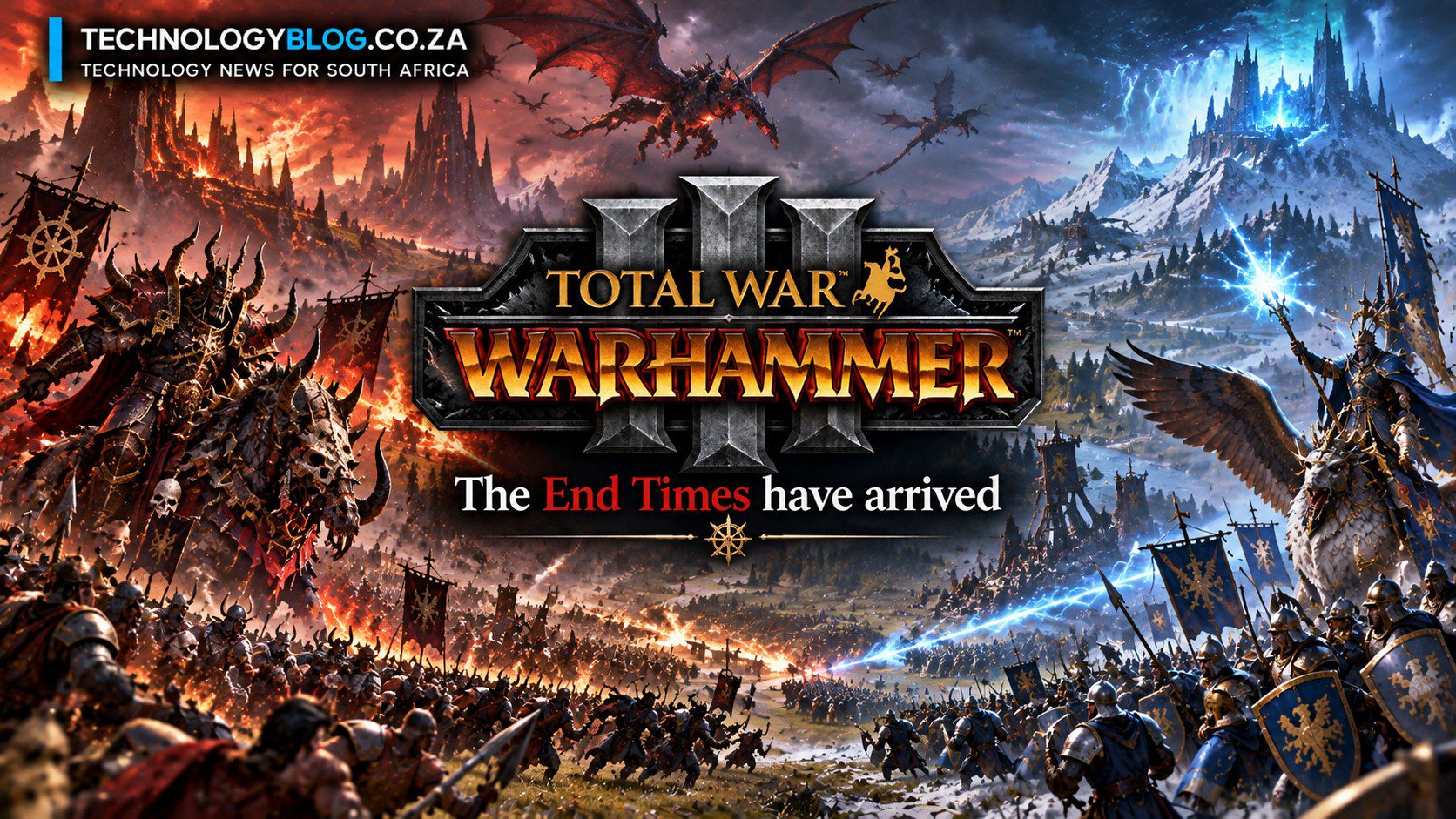
Total War WARHAMMER III turns an empire into a battlefield
Total War WARHAMMER III asks you to think like two different commanders.
The first sits above the world.
Cities need developing.
Armies need recruiting.
Borders need defending.
Enemies need watching.
Diplomacy can buy time.
Money determines what can actually be built.
Then one of those carefully constructed armies meets somebody else’s.
The strategic map disappears.
Suddenly, hundreds or thousands of individual soldiers are standing on a battlefield waiting for orders.
Infantry needs positioning.
Cavalry needs somewhere to charge.
Missile troops need clear lines of fire.
Artillery needs protecting.
Then a dragon flies overhead.
A spell tears through a formation.
Something enormous walks towards your front line.
The strategy has not disappeared.
It has simply changed scale.
That transition between managing an empire and personally directing its armies remains the foundation of Total War: WARHAMMER III on Steam, four years after its 2022 release. Steam Store
Total War WARHAMMER III begins above the battlefield
Before soldiers fight, somebody needs to build the army.
That happens on the campaign map.
Settlements provide the foundation of an empire.
Buildings support recruitment, income and other strategic needs.
Armies move between regions.
Characters develop.
Territory changes hands.
Diplomacy creates allies and enemies.
The campaign therefore gives every battle context.
An army is not simply a collection of units generated for one match.
It represents an investment.
Recruiting troops costs resources.
Losing experienced units can hurt.
Losing the army itself can leave settlements exposed.
A battle matters because something happens afterwards.
Every army represents an economic decision
It is easy to want another army.
Paying for it creates the problem.
Military strength depends on the economy supporting it.
Settlements need development.
Income needs protecting.
Recruitment infrastructure determines what units become available.
Expanding too aggressively can create borders that become difficult to defend.
A successful campaign therefore involves more than winning individual battles.
You need enough military strength to survive without building an empire that cannot afford its own ambitions.
That tension sits underneath much of Total War.
WARHAMMER III simply adds considerably stranger armies to the equation.
Total War WARHAMMER III changes when battle begins
When two armies meet, the game switches from turn-based strategy to real-time tactical combat.
The scale becomes immediate.
Units need orders.
Formations matter.
Terrain can create opportunities.
Fast troops can attack exposed positions.
Missile units can punish enemies from range.
Artillery can force an opponent to move.
A defensive line can collapse when attacked from the wrong direction.
The army built on the campaign map becomes a tactical toolbox.
The problem is figuring out how to use it.
Then Warhammer breaks the normal battlefield
Historical warfare already gives Total War plenty of variables.
Warhammer adds another layer.
Magic.
Monsters.
Flying creatures.
Daemons.
Undead.
Heroes.
Legendary Lords.
Some units tower over ordinary soldiers.
Others can fly over defensive lines.
Spellcasters can influence large areas of the battlefield.
Certain armies rely heavily on ranged power.
Others want to reach melee combat as quickly as possible.
That changes the tactical problem.
A formation designed to stop infantry may have another problem when something enormous lands behind it.
Total War WARHAMMER III makes factions genuinely different
Faction variety goes deeper than changing uniforms.
The Warhammer setting allows armies to approach warfare in fundamentally different ways.
One faction might rely on disciplined infantry and ranged fire.
Another can overwhelm enemies with numbers.
Another brings monsters.
Another uses speed.
Another depends heavily on magic.
Some forces contain units that would be impossible in a historical Total War game.
That asymmetry creates one of WARHAMMER III’s most important strengths.
Learning your own army is only half the problem.
You need to understand what the enemy can do.
Legendary Lords change more than the army’s appearance
Warhammer’s named characters also give factions another layer of identity.
Legendary Lords are not simply generic generals with elaborate armour.
They can have their own campaign mechanics, abilities, bonuses and objectives.
Their presence can influence which units become particularly useful and how a campaign develops.
That means selecting a faction is only the beginning.
Choosing its leader can change the experience again.
As years of additional content accumulated, that variety expanded substantially.
Magic creates another tactical resource
A strong infantry line is useful.
Then somebody casts a spell into it.
Magic gives WARHAMMER III another way to disrupt the traditional logic of battlefield formations.
Spells can damage units.
Others provide support.
Some interfere with enemy forces.
The threat itself matters because armies must account for what an opposing spellcaster might do.
Concentrating troops creates strength.
It can also create an extremely attractive target.
Fantasy changes tactics because the impossible has become another battlefield mechanic.
Monsters change the meaning of a front line
Then there are the large units.
Warhammer contains creatures capable of physically dominating a battlefield.
Their size makes them obvious.
Their tactical implications can be less simple.
Large monsters can cause enormous disruption, but visibility also makes them potential targets.
Anti-large units create another counter.
Missile fire can become dangerous.
The result is not simply spectacle.
The creature itself becomes another tactical decision.
Where should it attack?
What should stop it?
What happens if it reaches the wrong part of the army?
Those questions help fantasy elements fit inside Total War’s tactical structure rather than merely sitting on top of it.
Flying units add a third dimension
Traditional formations mostly worry about what is in front, behind and beside them.
Flying units introduce above.
They can cross obstacles that would slow ground troops.
They can threaten vulnerable ranged units.
They can move rapidly between parts of a battle.
However, isolation creates its own dangers.
Mobility is valuable only when it is used properly.
WARHAMMER III repeatedly works this way.
Fantasy creates extraordinary abilities.
Strategy determines whether they actually help.
Siege battles bring the fight to settlements
Eventually, campaign expansion means attacking defended territory.
Settlements turn warfare into another tactical problem.
Defensive positions matter.
Attackers need to break through.
Forces become compressed into different spaces.
An army built for open terrain may need to operate differently when fighting around buildings and defensive structures.
Again, the campaign and battlefield layers connect.
Capturing the settlement changes the strategic map.
Winning the tactical battle creates the strategic reward.
Diplomacy can delay the next war
Not every problem needs an immediate battlefield solution.
Diplomacy allows factions to manage relationships while pursuing their wider objectives.
Agreements can create opportunities.
Allies can become useful.
Enemies can become temporarily inconvenient rather than immediately fatal.
However, diplomacy exists inside a world where territorial ambitions frequently collide.
Peace can therefore be valuable.
It does not necessarily last.
That makes the turns between battles important.
A player is constantly preparing for conflicts that may not have started yet.
Total War WARHAMMER III launched with the Realm of Chaos
WARHAMMER III originally arrived in February 2022 as the third main game in Creative Assembly’s Total War: WARHAMMER trilogy. Steam describes it as the trilogy’s conclusion and centres its original campaign around the Realm of Chaos. Steam Store
The launch game introduced another major collection of factions and characters to a series that had already expanded significantly through WARHAMMER and WARHAMMER II.
However, the game that exists in 2026 is considerably larger than the one released four years ago.
The reason is Immortal Empires.
Immortal Empires changed the scale
Immortal Empires takes the trilogy’s accumulated content and brings it into one enormous sandbox campaign.
Creative Assembly describes it as Total War: WARHAMMER’s flagship sandbox.
It combines maps, races, Legendary Lords and locations from across the trilogy into a shared campaign where factions build empires, form alliances, betray rivals and wage wars across the Warhammer world. G2G Total War
This changes how WARHAMMER III should be understood.
It is not simply the third isolated campaign.
It has become the platform supporting the trilogy’s accumulated sandbox.
The trilogy became one enormous strategy ecosystem
The first Total War: WARHAMMER established the collaboration between Total War’s strategic structure and Games Workshop’s fantasy world.
WARHAMMER II expanded it.
WARHAMMER III pushed farther again.
Immortal Empires then connected those layers.
Years of DLC added additional Legendary Lords, races, units and campaign systems.
Free updates changed existing content.
Older factions received reworks.
New characters appeared.
The result is a strategy game carrying a decade of development history.
That history also makes the game more complicated for somebody arriving for the first time.
Creative Assembly itself acknowledged that the trilogy now spans three games, dozens of DLC packs, hundreds of units and years of free content when publishing its September 2026 guide for newcomers. G2G Total War
Total War WARHAMMER III kept expanding after launch
WARHAMMER III has received a substantial catalogue of post-launch content.
That includes additions such as Champions of Chaos, Forge of the Chaos Dwarfs, Shadows of Change, Thrones of Decay, Omens of Destruction and Tides of Torment.
The latter arrived in December 2025 with Aislinn for the High Elves, Dechala for Slaanesh and Sayl for Norsca. It launched alongside Update 7.0. G2G Total War
Creative Assembly also continued changing existing factions and systems through free updates.
The game’s development therefore became a combination of paid expansion and revisions to the wider sandbox.
The road to 2026 was not always smooth
That continuing development has also involved criticism and course corrections.
Creative Assembly acknowledged difficulties around its WARHAMMER III support in its end-of-2025 message to players. The studio specifically referenced the controversy surrounding Shadows of Change and said it intended to continue updating and fixing the game. G2G Total War
Tides of Torment itself was delayed after internal playtesting.
Creative Assembly said in July 2025 that the content had not met the standard it wanted and needed additional development time. G2G Total War
It eventually launched in December.
That history matters because WARHAMMER III’s current state did not arrive through an uninterrupted series of uncomplicated releases.
It was built through expansions, updates, criticism, revisions and further development.
Total War WARHAMMER III reached its End Times in 2026
The latest chapter is appropriately apocalyptic.
Lords of the End Times released on 24 September 2026.
Creative Assembly describes it as the largest DLC released during the Total War: WARHAMMER series’ ten-year history. G2G Total War
The expansion brings four new Legendary Lords into Immortal Empires.
Nagash.
The Glottkin.
Boris Todbringer.
Thanquol.
Each arrives with new units and campaign mechanics.
Yet the paid characters are only part of the update.
Nagash finally entered Immortal Empires
Nagash is one of the headline additions.
Creative Assembly describes his campaign around transforming the world into a Land of the Dead, building necropolises and strengthening the Black Pyramid.
He must gather his Mortarchs and recover the Books of Nagash while pursuing his rise towards godhood. G2G Total War
That gives the character a campaign identity larger than simply conquering neighbouring settlements.
His objectives fit the apocalyptic theme of the DLC.
The world is not merely territory.
It is something to transform.
The End Times also brought major free changes
Players do not need the paid DLC to see WARHAMMER III change again.
The accompanying free update adds Neferata as a Legendary Lord.
Creative Assembly also introduced a Vampire Counts rework, changes to Archaon the Everchosen, new End Game Scenarios and revised Victory Conditions for legacy Legendary Lords. G2G Total War
Update 9.0 also changes how Daemonic factions can return to Immortal Empires after being defeated under appropriate corruption conditions.
Archaon receives another significant change, including the ability to subjugate other Chaos Legendary Lords after defeating them and an optional End Times-focused campaign direction after achieving his Short Victory. G2G Total War
The result is not merely four new paid characters.
Older parts of the sandbox change around them.
Total War WARHAMMER III is becoming easier to enter
There is another significant change in 2026.
New players no longer necessarily need to begin by purchasing one of the three main WARHAMMER games.
Creative Assembly says purchasing any Lords of the End Times character pack provides access to Immortal Empires without requiring WARHAMMER I, II or III. G2G Total War
That purchase includes the selected Legendary Lord and associated content, the relevant core race roster, applicable free content, Immortal Empires, the WARHAMMER III Prologue and Bretonnia.
Additional content still depends on ownership of the relevant games or DLC. G2G Total War
It is a notable structural change for a trilogy whose accumulated ownership requirements could otherwise be difficult for newcomers to understand.
Immortal Empires remains the centre of the experience
The scale of Immortal Empires explains why individual DLC packs can keep extending WARHAMMER III.
A new Legendary Lord does not need an entirely separate strategy game around them.
They enter an existing world filled with factions developed across a decade.
That creates interactions Creative Assembly could not have built into the original 2016 release because many of the participants did not exist yet.
Every additional faction changes the strategic ecosystem.
New neighbours appear.
New enemies arrive.
Campaign geography changes.
Another army introduces another tactical problem.
The sandbox becomes denser.
No two armies need to solve war the same way
This accumulated variety returns WARHAMMER III to its central strength.
War is not one problem with one solution.
A battle against one faction may reward aggressive pressure.
Another requires patience.
Monsters change target priorities.
Flying units threaten vulnerable positions.
Magic punishes careless formations.
Artillery forces movement.
Cavalry punishes exposure.
A Legendary Lord can change the centre of an army.
Then the next opponent presents a completely different combination.
The strategic map determines where the war happens.
Faction design determines what that war looks like.
Why Total War WARHAMMER III still works in 2026
Total War WARHAMMER III begins with a map.
There are settlements.
Borders.
Resources.
Armies.
Allies.
Enemies.
You build.
Recruit.
Expand.
Negotiate.
Prepare.
Then two armies meet.
The map disappears.
Suddenly, all those strategic decisions become soldiers standing on a battlefield.
The expensive elite unit you recruited needs to survive.
The artillery needs protecting.
The infantry needs to hold.
The cavalry needs an opening.
Then Warhammer adds another problem.
A dragon.
A daemon.
A spell.
An undead army.
A monster large enough to walk through the formation you carefully constructed.
Four years of WARHAMMER III and ten years of the wider trilogy have made those possibilities considerably broader.
Immortal Empires turned three games into one huge strategic sandbox.
DLC continued filling it.
Free updates kept changing it.
Now the End Times have arrived.
Yet the underlying rhythm remains intact.
Build the empire.
Raise the army.
Choose the battlefield.
Then find out whether the strategy survives contact with something enormous.

