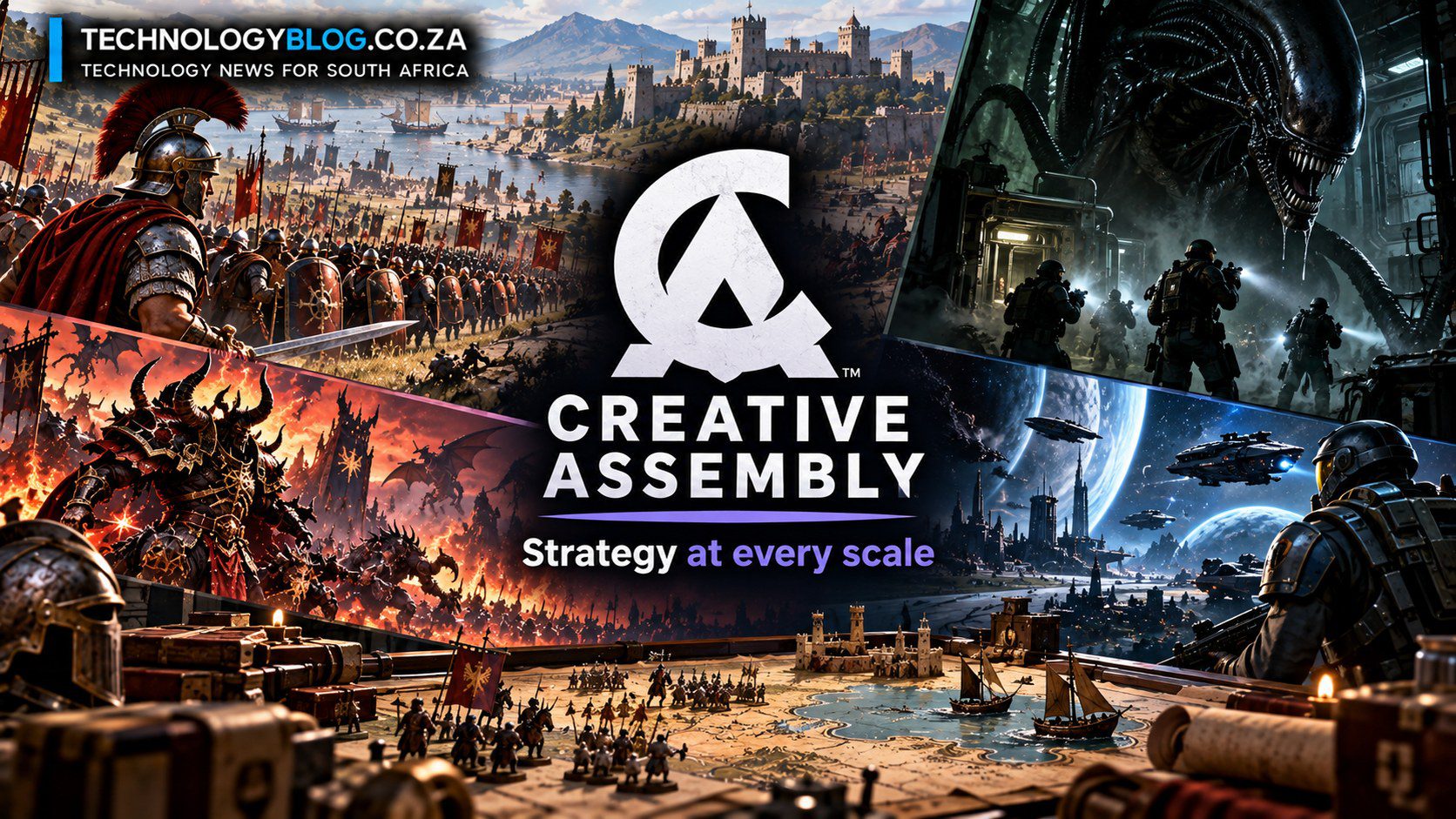
Creative Assembly built worlds at both ends of the scale
Creative Assembly can make you responsible for an empire.
It can also make you afraid to open a door.
Those experiences seem almost incompatible.
One asks players to manage territory, diplomacy, economies and armies containing thousands of soldiers.
The other puts a single vulnerable character aboard a space station with something hunting them.
Yet Total War and Alien: Isolation emerged from the same British developer.
Creative Assembly has spent almost four decades building games around remarkably different scales. However, its defining franchise emerged from a simple idea.
Let players control the war.
Then let them fight the battle.
That idea became Total War.
Twenty-five years after Shogun: Total War, the studio is preparing another technological and creative transition.
Total War: MEDIEVAL III is in development.
Total War: WARHAMMER 40,000 is taking the series into the 41st Millennium.
An Alien: Isolation sequel is being developed.
Meanwhile, Total War: WARHAMMER III continues expanding.
Creative Assembly is simultaneously looking backwards at the ideas that built the studio and forwards at what those ideas can become.
Creative Assembly began before Total War
Creative Assembly predates the franchise that would eventually define it.
The studio was established in 1987.
That means more than a decade of Creative Assembly history existed before the first Total War game appeared.
The company worked on different projects during those early years, including conversions and sports titles.
Then came a strategy game set in feudal Japan.
It changed the direction of the studio.
Creative Assembly found its identity with Shogun
Shogun: Total War arrived in 2000.
The fundamental idea was ambitious.
A player would manage the larger strategic conflict through a turn-based campaign.
Then armies would meet.
Instead of resolving that confrontation entirely through numbers or an abstract simulation, the game would move onto a real-time battlefield.
Creative Assembly described the original vision years later as an attempt to combine grand strategy with real-time tactical battles so players could feel like commanders of vast empires. G2G Total War
That transition became Total War’s defining feature.
You made the strategic decision.
Then you had to survive its tactical consequences.
Total War made two strategy games depend on each other
The campaign and battlefield layers could have existed separately.
Instead, Total War connected them.
Recruiting an army requires resources.
Moving that army creates strategic opportunities and risks.
Losing it can expose territory.
Winning can open another path for expansion.
Then the battle itself introduces another set of decisions.
Infantry needs positioning.
Cavalry needs room.
Missile troops need useful lines of sight.
Terrain changes tactics.
Morale matters.
Timing matters.
The campaign determines why the battle is happening.
The battle determines what happens to the campaign afterwards.
That loop became the foundation Creative Assembly repeatedly rebuilt.
Creative Assembly took Total War through history
Once the formula worked, history gave the studio an enormous playground.
Medieval: Total War moved into medieval warfare.
Rome: Total War tackled the ancient Mediterranean.
Medieval II returned to the Middle Ages on a larger scale.
Empire: Total War brought gunpowder warfare and naval battles into a sprawling campaign.
Napoleon narrowed the focus around one historical figure and his era.
Shogun 2 returned to Japan.
Rome II returned to antiquity.
Attila explored an empire under pressure.
Three Kingdoms moved into ancient China.
Pharaoh focused on the Bronze Age collapse.
Different periods changed armies, politics, technology and geography.
The underlying question remained recognisable.
What happens when strategic decisions become battles you must personally command?
Total War became Creative Assembly’s identity
By 2025, Total War had existed for 25 years.
Creative Assembly marked the anniversary by looking back at a franchise that began in a small one-room office before expanding through historical and fantasy settings. G2G Total War
The studio itself has described Total War as part of Creative Assembly’s identity. G2G Total War
That relationship makes sense.
Few developers spend a quarter-century continuously developing variations of one strategy framework.
However, Creative Assembly did not remain exclusively historical.
Eventually, Total War entered a world where cavalry charges could encounter dragons.
Warhammer broke Total War’s historical rules
Total War: WARHAMMER arrived in 2016.
Suddenly, Creative Assembly no longer needed to build every battlefield around things that could actually have existed.
Magic entered Total War.
So did monsters.
Flying creatures.
Undead armies.
Daemons.
Legendary characters.
The underlying strategy remained recognisable, but faction design could become dramatically more asymmetrical.
A historical cavalry unit still needs to obey something resembling the physical limitations of a horse.
A dragon does not.
That gave Creative Assembly an opportunity to stretch Total War’s battle system in directions its historical games could never attempt.
Three Warhammer games became one enormous sandbox
Total War: WARHAMMER became a trilogy.
Each game expanded the world.
New factions arrived.
More Legendary Lords appeared.
Additional campaign systems accumulated.
Then Immortal Empires brought content from across that trilogy into the enormous sandbox now centred on Total War: WARHAMMER III.
TechnologyBlog’s Total War: WARHAMMER III profile looks at how that game combines empire management with huge fantasy battles and how its 2026 End Times content continues expanding the sandbox.
INTERNAL LINK: Link Total War: WARHAMMER III profile to the TechnologyBlog article completed immediately before this developer profile.
The scale is now far beyond the original Shogun campaign.
Yet the central Creative Assembly idea remains visible.
Build the empire.
Raise the army.
Fight the battle.
Creative Assembly also built Alien: Isolation
Then there is the other side of the studio.
Alien: Isolation does not ask players to conquer continents.
It does not give them thousands of soldiers.
It does not put an empire under their control.
Instead, it removes power.
The player becomes Amanda Ripley, trying to survive aboard Sevastopol station while being hunted by a Xenomorph.
The contrast with Total War is enormous.
Total War asks:
How do you control all of this?
Alien: Isolation asks:
How do you survive something you cannot control?
That shift demonstrated that Creative Assembly’s identity could extend beyond strategy.
Alien: Isolation changed the scale without abandoning systems
Despite the obvious differences, there is an interesting connection.
Both experiences depend heavily on systems producing situations.
In Total War, armies, factions, diplomacy and campaign decisions interact.
In Alien: Isolation, player actions, environmental opportunities and the threat of the Xenomorph create tension.
Neither experience needs every memorable moment to be completely scripted beforehand.
Systems can collide.
Plans can fail.
Unexpected situations can emerge.
The scale is radically different.
The appeal of uncertainty remains.
Creative Assembly has also worked beyond its two defining franchises
Total War and Alien dominate the studio’s modern identity, but they do not represent everything Creative Assembly has developed.
The studio has worked on other genres and properties during its history, including sports titles and Halo Wars 2.
That broader catalogue matters because it prevents the studio’s history from becoming too simple.
Creative Assembly is not merely “the Total War developer.”
However, Total War remains its longest-running creative foundation.
And that foundation has experienced difficult periods as well as successful ones.
Creative Assembly has had to rebuild trust
The studio’s recent history has not been uninterrupted growth.
Creative Assembly itself has acknowledged problems surrounding parts of Total War’s development and communication.
In its 2025 year-end message, Total War Vice President Roger Collum referred openly to successes and failures and reiterated a commitment to greater transparency with the community. G2G Total War
That matters because modern Creative Assembly is not operating without baggage.
Players have challenged decisions around content, pricing, updates and communication.
The studio has responded by changing some content plans, revisiting existing releases and speaking more openly about development.
That relationship remains part of the current Total War story.
Total War reached 25 years with another transition approaching
The 25th anniversary in 2025 was more than a retrospective.
Creative Assembly used it to reveal where Total War goes next.
Three projects became particularly important.
One looks backwards to one of the franchise’s most requested historical settings.
Another pushes Total War farther from conventional history than ever before.
Underneath both sits new technology.
Total War MEDIEVAL III is finally happening
Creative Assembly confirmed Total War: MEDIEVAL III during its 25th Anniversary Showcase.
The announcement came unusually early.
The game was still in pre-production, and Creative Assembly explicitly warned that it remained years away from release. G2G Total War
That early announcement is deliberate.
The studio says it wants players involved in the development journey and intends to share behind-the-scenes information as work progresses.
For a franchise with decades of history, returning to Medieval carries obvious expectations.
Medieval II remains one of Total War’s defining historical releases.
Creative Assembly therefore describes the new game as both a tribute to its predecessors and an attempt to rethink historical Total War for a new generation. G2G Total War
Creative Assembly is rebuilding Total War’s foundations
The next generation also involves new technology.
Creative Assembly calls it Warcore.
The studio describes Warcore as a new evolution of the Total War engine foundation designed with a long-term future in mind. G2G Total War
That distinction matters.
The objective is not merely to build one new Medieval game.
Creative Assembly intends Warcore to evolve across future Total War development.
New technology creates opportunities.
It also creates risk.
Decades of Total War mechanics, expectations and workflows cannot simply disappear because the engine underneath them changes.
The challenge will be modernising the foundation without losing what makes Total War recognisable.
Total War is preparing to move beyond PC
Warcore also opens another door.
Creative Assembly says future Total War titles can potentially launch on PlayStation and Xbox. G2G Total War
That would represent a significant shift for a franchise historically built around PC controls and interfaces.
The studio has already addressed the obvious concern.
Roger Collum said PC remains central to Total War’s design ethos and argued that console development should expand player choice rather than compromise the PC experience. G2G Total War
Whether Creative Assembly can successfully translate Total War’s enormous interfaces and tactical controls across platforms will become an important part of the franchise’s next era.
Creative Assembly is also taking Total War into the 41st Millennium
If Medieval III represents a return, Total War: WARHAMMER 40,000 represents another enormous departure.
Creative Assembly has confirmed that the Total War formula is moving into Games Workshop’s science-fiction universe. G2G Total War
This changes almost everything about the battlefield.
Guns become fundamental rather than exceptional.
Armoured vehicles matter.
Artillery changes.
Flying units change.
Technology changes.
Battlefield distances change.
The studio has confirmed factions including Space Marines, Orks, Aeldari and Astra Militarum, alongside extensive army customisation. G2G Total War
The challenge is fascinating precisely because Total War’s core concept remains recognisable while the battlefield around it changes radically.
WARHAMMER 40,000 tests how flexible Total War really is
The Warhammer Fantasy trilogy already proved that Creative Assembly could move beyond historical warfare.
WARHAMMER 40,000 pushes much further.
A Roman legion and a medieval knight operate in different worlds, but both still belong to recognisable pre-modern warfare.
A tank does not.
Neither does a futuristic artillery platform.
Nor a genetically engineered super-soldier carrying a firearm.
Creative Assembly therefore needs to answer a question that has followed Total War throughout its history.
How far can the formula change before it stops feeling like Total War?
The answer could shape the franchise’s next decade.
Creative Assembly has not abandoned Alien
While Total War expands in multiple directions, Creative Assembly is also returning to Sevastopol’s legacy.
An Alien: Isolation sequel is in development.
Creative Assembly’s own recruitment material confirms that its Survival team in Horsham is working on the project. Creative Assembly
That gives the studio an unusual current portfolio.
One team is developing the future of historical grand strategy.
Another is taking Total War into Warhammer 40,000.
WARHAMMER III remains active.
Another project returns to survival horror.
Those games could hardly look more different from one another.
Yet all of them belong to Creative Assembly.
Creative Assembly enters 2026 with several futures
The current studio is therefore difficult to define with one project.
Total War: WARHAMMER III remains active and has entered its End Times era.
Total War: MEDIEVAL III is being developed as the next major historical evolution.
Total War: WARHAMMER 40,000 is preparing the franchise for science-fiction warfare.
Warcore is rebuilding the technology beneath future Total War games.
An Alien: Isolation sequel is also in development.
That is a substantial pipeline for a studio approaching four decades in game development.
More importantly, it contains both sides of Creative Assembly’s identity.
Massive scale.
And intimate vulnerability.
Why Creative Assembly still matters in 2026
Creative Assembly has survived because it did not simply make one successful strategy game and repeatedly change the setting.
Total War became a framework.
The studio could ask different questions through it.
What happens when Rome expands?
What happens when medieval kingdoms collide?
What happens when gunpowder changes warfare?
What happens when the battlefield contains dragons?
Now:
What happens when Total War reaches the 41st Millennium?
At the same time, Alien: Isolation proved Creative Assembly could work at the opposite end of the spectrum.
Total War can make you responsible for thousands of lives.
Alien can make you worry about your own.
The next few years bring both identities forward.
A return to Medieval.
A leap into Warhammer 40,000.
A new technological foundation.
And another encounter with the Xenomorph.
Creative Assembly started making games in 1987.
Nearly four decades later, the studio is not simply revisiting its past.
It is rebuilding the systems that will determine what comes next.


