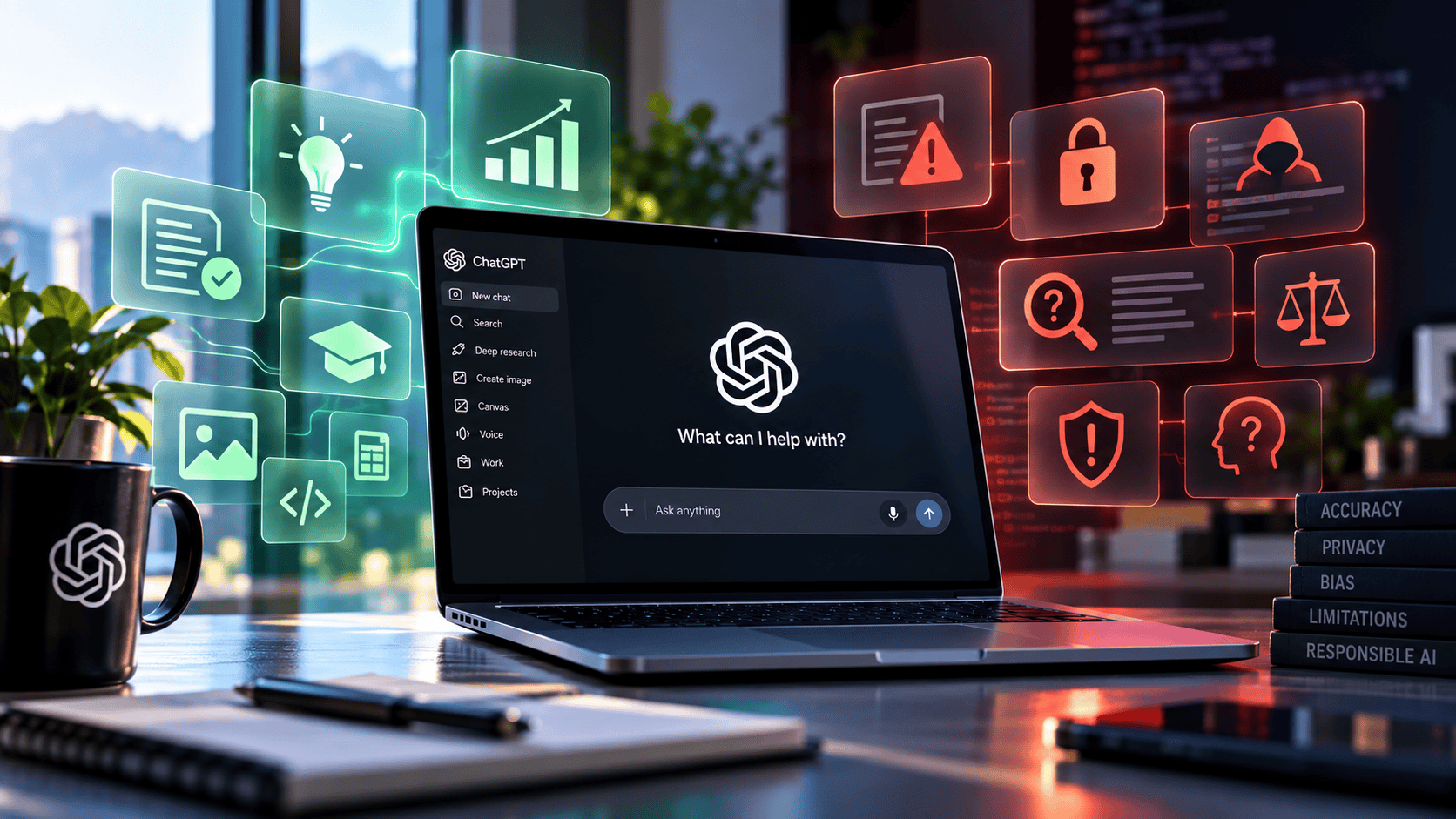
ChatGPT: Benefits, Risks and Limitations
ChatGPT’s strength is that it can turn natural-language instructions into useful work very quickly. Its weakness is that the same fluent interface can make uncertain or incorrect output look more authoritative than it is.
A balanced view needs both sides. ChatGPT can reduce friction in writing, learning, research and analysis, but it should not be treated as an unquestionable source, a substitute for professional responsibility or a safe place for any information simply because it feels private. See the complete South African ChatGPT guide for the broader context.
Benefit: faster first drafts
Writing from a blank page is slow. ChatGPT can produce an initial email, outline, summary, checklist, code example or briefing structure in seconds. The human can then edit rather than start from zero.
This advantage is strongest when the human already knows the goal and can judge the output. AI accelerates production; it does not automatically supply domain expertise.
Benefit: easier access to explanations
Users can ask follow-up questions, request simpler language and approach a topic from several angles. That makes conversational AI useful for learning and for helping non-specialists understand unfamiliar terminology.
The explanation should still be checked where accuracy matters. A clear explanation is useful only if the underlying facts are sound.
Benefit: working across formats
Modern ChatGPT experiences can work with text, files, images, web search and other tools. That makes the product useful for transformation: a document can become a summary; a spreadsheet can become an analysis; notes can become an action list.
Benefit: lower friction in repetitive knowledge work
When a task follows a stable pattern, ChatGPT can help apply that pattern consistently. Research templates, editorial quality gates, support-response structures and project handovers can all benefit from repeatable instructions.
Risk: hallucinations and factual errors
ChatGPT can state false information confidently. Web search and citations improve the verification workflow but do not remove the problem. A cited source can still be misunderstood or a generated sentence can go beyond what the source supports.
Important factual claims should therefore be checked against primary material.
Risk: sensitive data exposure
Consumer AI tools are not automatically suitable for confidential information. OpenAI’s current data-controls documentation gives eligible personal users controls over whether new conversations are used to improve models, and managed workspaces use different defaults.
That is only one part of the issue. Businesses also need to consider internal permissions, POPIA, confidentiality agreements, client expectations and sector rules.
Risk: automation bias
People can over-trust a system that responds quickly and sounds certain. This is especially dangerous when the user knows less about the subject than the model appears to.
A good workflow deliberately creates friction at the final step: verify, test, approve or escalate.
Risk: biased or incomplete output
Generative models learn from large bodies of information that can contain gaps and bias. The prompt also shapes which information is emphasised. A balanced answer is not guaranteed simply because the wording sounds neutral.
For hiring, lending, healthcare, education or public-policy work, this issue can be more serious because the outcome can affect people directly.
Limitation: context can be missing
ChatGPT only has the context available in the conversation, connected sources, memory or tools. It may not know an organisation’s actual policy, a customer’s history, the latest internal decision or a local requirement unless that information is provided.
Limitation: current features change quickly
ChatGPT is a moving product. OpenAI’s release notes show frequent changes to features, integrations, voice, image tools, work modes and account controls. A screenshot or tutorial from a few months ago may already be wrong.
That is why time-sensitive product changes belong in a dedicated latest-features tracker rather than being duplicated across every evergreen explainer.
Limitation: professional judgement remains professional judgement
Medical, legal, financial, cybersecurity and safety-critical questions can carry real consequences. ChatGPT can help a professional research or structure information, but users should not confuse an AI response with a licensed professional relationship or verified operational instruction.
Cybersecurity shows both sides of the problem
AI can help defenders analyse software and security information, but increased capability can also increase misuse risk. TechnologyBlog’s coverage of OpenAI Astra’s cybersecurity assessment illustrates this tension: stronger systems create new defensive possibilities while increasing the importance of access controls and monitoring.
What about memory?
Memory can make ChatGPT more useful by allowing it to apply relevant preferences and context. OpenAI says Memory does not retain every detail and that controls vary by plan, region and workspace.
The risk is not that memory is automatically bad; it is that users may not understand which context is being carried forward. Personalisation deserves active settings management.
How to use ChatGPT more safely
- Do not share secrets or sensitive personal data without an approved reason and environment.
- Ask for sources when claims depend on external facts.
- Open and verify those sources.
- Test generated code and calculations.
- Separate AI suggestions from accountable decisions.
- Use temporary or managed-workspace features when appropriate, but understand what they do.
- Recheck important advice with a qualified human expert.
The right mental model
ChatGPT is best treated as a capable assistant that can accelerate thinking and production but still needs direction, evidence and review. The more expensive the error, the stronger the review process should be.
That approach preserves the benefits without pretending the limitations have disappeared. It also makes the product easier to govern: low-risk drafting can move quickly, while high-impact decisions keep stronger checks. Organisations planning wider deployment should pair this with our ChatGPT for business use-cases guide.
Risk depends on the task, not only the tool
The same ChatGPT account can be low risk in one moment and high risk in the next. Brainstorming five headline ideas is different from interpreting a contract, changing a firewall rule or deciding whether an employee should be disciplined.
Organisations should therefore classify use cases by consequence. Low-impact work can use lightweight review; high-impact work should require stronger sourcing, specialist approval and sometimes a decision not to use generative AI at all.
Practical rule: if you cannot confidently review the output, increase the level of human expertise involved before acting on it.


