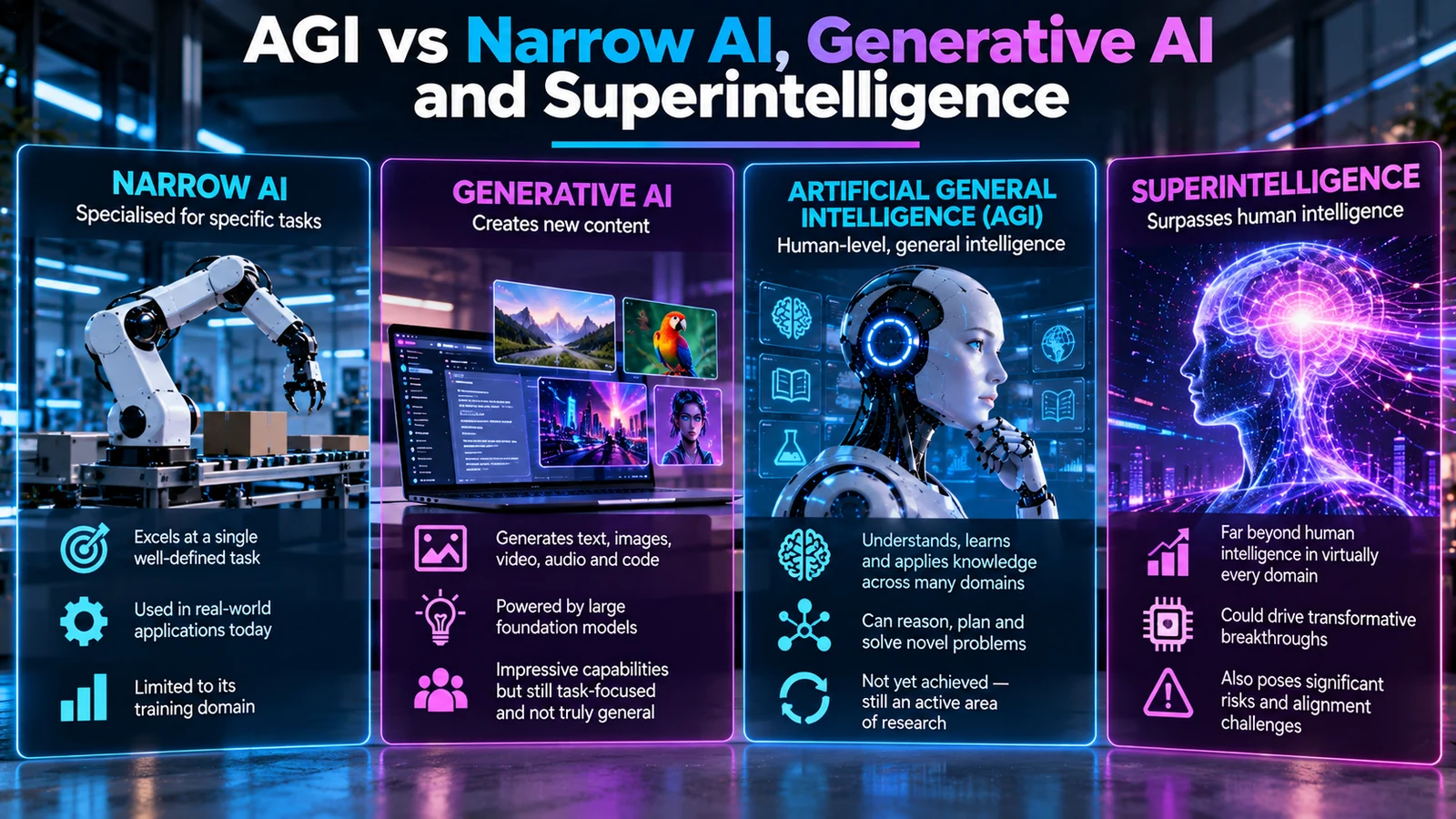
AGI vs Narrow AI, Generative AI and Superintelligence
AI language is crowded enough that the same model can be described as generative, frontier, autonomous and “almost AGI” in one conversation — even though those labels measure different things. Narrow versus general concerns breadth. Generative AI concerns the production of new content. Autonomy concerns the ability to act. Superintelligence concerns performance beyond humans.
Mixing those axes makes it easy to turn a real capability improvement into an exaggerated claim about general intelligence.
For the full AGI background, see our complete artificial general intelligence guide.
Narrow AI: specialised competence
Narrow AI refers to systems designed or trained for a bounded class of tasks. A spam filter, recommendation engine or medical image classifier can be highly capable without being able to transfer that competence into unrelated domains.
The term becomes awkward with modern foundation models because one model can handle many tasks. Even so, those systems can remain “narrow” under strict AGI definitions because their generalisation and autonomy are limited or unreliable.
Generative AI: creating new content
Generative AI describes systems that produce content such as text, images, audio, video or code. It is a capability category, not a statement about general intelligence.
A generative model can be narrow. An image model may create extraordinary visuals while having no meaningful ability to plan a business project. A text model may support many domains without meeting an AGI threshold.
Frontier AI: the most capable current systems
“Frontier AI” is increasingly used for the strongest general-purpose models being developed at the leading edge. It avoids claiming AGI while acknowledging that today’s systems are broader than traditional narrow AI.
Google DeepMind and Anthropic both use frontier-safety frameworks to manage risks from increasingly capable models. That language is useful because it focuses on measurable capability rather than a disputed AGI label.
Artificial general intelligence: breadth plus strong performance
AGI is usually about a system that performs intelligently across a broad range of tasks and can adapt to unfamiliar ones. Google DeepMind’s levels framework explicitly combines breadth and performance.
OpenAI’s charter uses a different but related economic threshold: highly autonomous systems that outperform humans at most economically valuable work.
Neither definition means “a chatbot that can answer many questions”.
Artificial superintelligence: beyond human general ability
Artificial superintelligence, often shortened to ASI, is a hypothetical system whose capabilities exceed the best human ability across most or all cognitive domains.
ASI is therefore not simply another name for AGI. Under most framings, AGI is around human-level generality while superintelligence goes well beyond it.
Could a system be generative AI and AGI at the same time?
Yes in principle. A future AGI could include generative capabilities, just as humans can create text and images. But generating content would be only one part of its competence.
The reverse is not true: being generative does not imply AGI.
Could a system be autonomous without being AGI?
Absolutely. A narrow industrial controller can run autonomously. A trading algorithm can take actions without a human approving every trade. Autonomy measures independence of action, not breadth of intelligence.
This distinction matters for safety. A less general but highly autonomous system can still create real risk.
Could a system be superhuman without being general?
Yes. Chess engines have surpassed humans for decades while remaining narrow. Protein-structure systems can outperform human methods on specialised scientific problems without becoming broadly intelligent.
Peak performance in one domain therefore tells us little about general intelligence by itself.
Where do ChatGPT and Gemini fit?
Current assistants are best described as frontier or general-purpose generative AI systems rather than as universally accepted AGI. They combine multiple modalities and tools, but their reliability and generalisation remain uneven.
TechnologyBlog’s ChatGPT guide and Gemini agent coverage describe what these systems can actually do today.
Why AGI claims need a definition attached
If a company says a system is “AGI”, the first question should be: according to which definition? An economic threshold may be crossed before a cognitive-science threshold. A benchmark threshold may be reached while real-world reliability remains poor.
Without a definition, the label functions more like marketing than measurement.
Why the distinction matters to businesses
A company deciding whether to deploy an AI system needs to know what the system can do, what data it uses and how reliably it performs. Calling it narrow, generative or general is secondary to the operational facts.
Still, the terminology matters when forecasting risk. AGI implies a broader capacity to move between tasks, which could expand both economic value and the range of possible misuse.
Why the distinction matters to policymakers
Regulation built around a vague AGI label risks arriving too late or targeting the wrong systems. Capability-based rules can apply before a model is accepted as general.
South Africa’s policy reset and call for international guardrails point in this direction: governance has to address real AI capability even while frontier definitions continue to evolve.
A simple way to remember the terms
- Narrow AI: specialised task competence.
- Generative AI: creates new content.
- Frontier AI: the most capable current general-purpose models.
- AGI: hypothetical broadly general intelligence at roughly human or economically transformative levels, depending on definition.
- ASI: hypothetical intelligence exceeding humans across broad domains.
The safest way to use these labels
Describe the capability before applying the label. A system that writes code, controls a browser or sets a benchmark record is interesting on its own. None of those achievements needs an AGI label unless the evidence satisfies a stated definition.
Where machine learning and large language models fit
Machine learning is a method for building AI systems from data rather than manually writing every rule. Large language models are one class of machine-learning model. Neither term implies general intelligence.
This matters because AGI is sometimes discussed as though it were a specific architecture. It is better understood as a capability target. A future AGI might use language-model technology, a different architecture or a larger system combining several approaches. Readers who want the current-vs-future capability boundary should continue with AGI vs Today’s AI; beginners can use Artificial General Intelligence Explained.
Why “human-level” is also ambiguous
Humans are not equally capable at every cognitive task. A system can surpass most people at advanced mathematics while failing at practical reasoning that children handle easily. “Human-level” therefore needs a reference population, task distribution and reliability standard.
That is another reason DeepMind’s level-based language is useful: it forces the discussion toward measurable breadth and performance instead of an undefined comparison with “a human”.