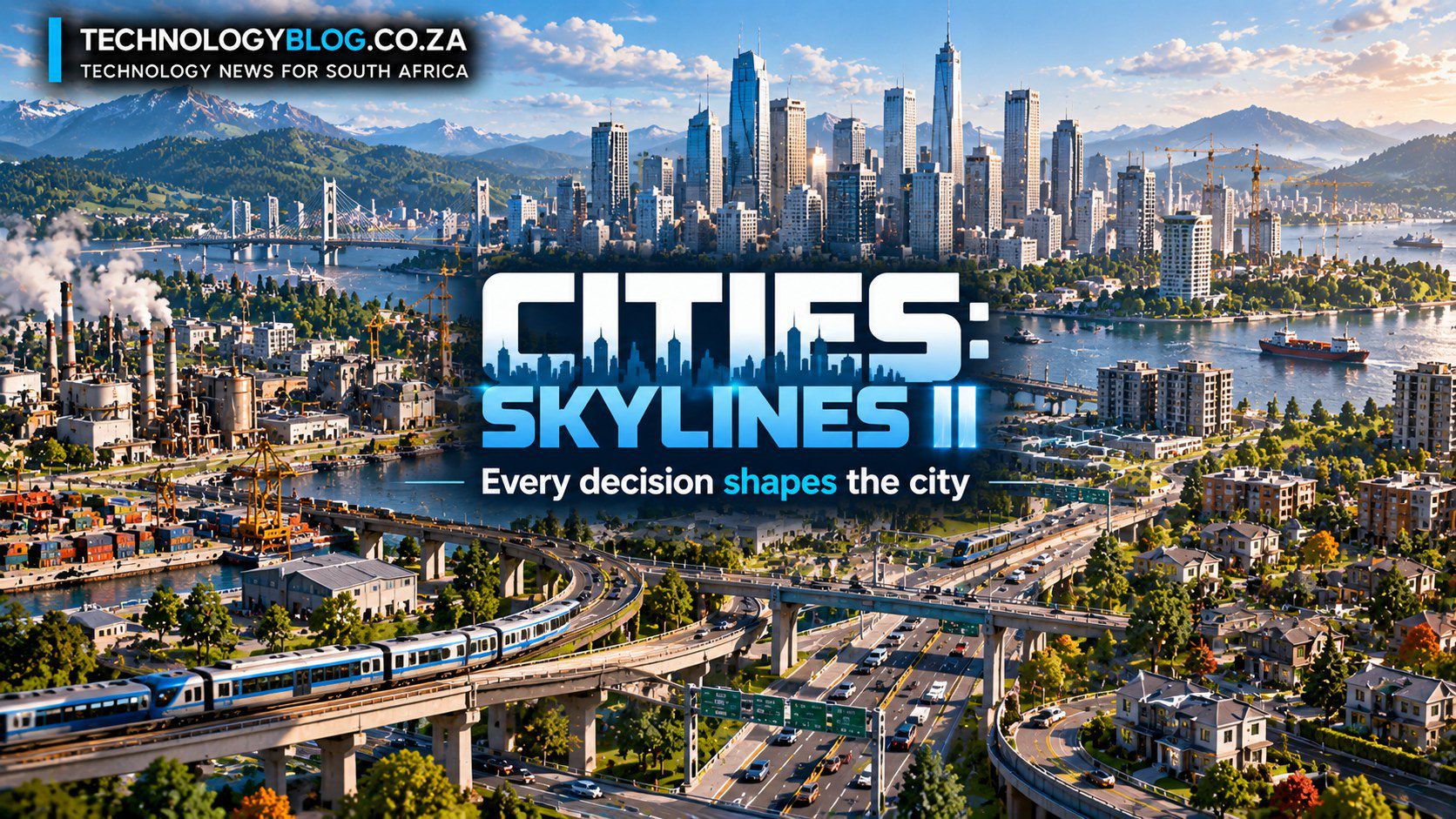
Cities: Skylines II turns every road into another decision
Cities: Skylines II is a city-building simulation where almost every decision creates another problem to solve. A new road attracts development, new homes bring residents, residents need jobs and services, and growing traffic eventually puts the road network under pressure.
That chain of consequences sits at the centre of the game.
You are not simply placing attractive buildings across a map. You are creating a city where transport, businesses, households, public services and infrastructure depend on one another.
Colossal Order originally developed and launched the game in 2023. However, its development story changed dramatically in 2026 when Iceflake Studios assumed responsibility for its future.
The city continues to grow, but the studio building it has changed.
Cities: Skylines II starts with an empty map
At the beginning, there is no metropolis.
There is land, an outside connection and an opportunity to start building.
Roads establish the first structure. Zoning creates space for residential, commercial and industrial development. Electricity, water and sewage infrastructure then support the first residents.
A small settlement begins to appear.
Initially, everything feels manageable.
Then the population starts growing.
Every new resident creates demand
More residents provide workers, customers and taxpayers.
They also need things.
People require housing, education, healthcare and transportation. They generate waste. They travel between homes, businesses and workplaces.
As the population grows, those individual requirements become citywide problems.
Paradox explains that citizens have simulated lifepaths. They can move into the city or be born there, progress through different stages of life and eventually grow old.
That makes population growth more than a number on the interface.
Each resident becomes another participant in the simulation.
Cities: Skylines II makes roads matter
Roads connect almost everything.
Residential neighbourhoods need connections to workplaces. Businesses require customers and deliveries. Industry needs freight routes. Emergency services need to reach incidents.
Every journey uses infrastructure.
Consequently, a road layout that worked perfectly for a small settlement can struggle when thousands of additional residents arrive.
Traffic becomes one of the clearest indicators that something in the city is no longer working efficiently.
However, congestion is often only the visible problem.
The cause may exist somewhere else.
Traffic turns planning into detective work
A traffic jam raises questions.
Where are these vehicles going?
Why are they all using this junction?
Could another route distribute traffic more effectively?
Would public transport reduce some journeys?
Are residential areas too far from major workplaces?
These questions transform traffic management into a form of investigation.
Adding another lane may help.
Sometimes it simply allows more vehicles to reach the next bottleneck faster.
Understanding why people travel can therefore matter more than simply building larger roads.
Public transport creates alternatives
Cars are not the only way citizens can move.
Public transport allows players to connect residential, commercial and employment areas without requiring every journey to use a private vehicle.
However, simply placing transport infrastructure does not guarantee success.
Routes need useful destinations.
Stations need sensible locations.
Different services need connections.
As the city expands, transport becomes a network rather than a collection of individual routes.
A good network helps people reach the places they actually need to visit.
The economy operates beneath the skyline
Buildings may dominate the screen, but an economic simulation operates underneath them.
Households earn and spend money.
Businesses need workers and resources.
Companies consider whether locations make economic sense.
Goods move through production and transportation networks.
Meanwhile, the city collects taxes and pays for infrastructure and public services.
Paradox’s official Cities: Skylines II information explains how companies, households, taxation and production participate in the wider economy.
That means an economic problem may originate somewhere unexpected.
A business struggling to find employees might actually indicate a transportation or education problem.
Once again, one system affects another.
Industry connects resources, workers and transport
Industrial development creates jobs and goods.
It also creates additional logistical requirements.
Resources need to reach production facilities.
Workers need to reach their jobs.
Finished goods need transportation.
Freight vehicles use the same wider infrastructure supporting other parts of the city.
Industry can also influence pollution and surrounding development.
Choosing where to build an industrial district is therefore not merely a zoning decision.
It affects transport, employment, land use and the wider economy.
Public services create another balancing act
Growing cities need increasingly sophisticated services.
Healthcare becomes important.
Schools educate residents.
Police and fire departments respond to emergencies.
Waste needs collection.
Roads require maintenance.
Public transport needs funding.
Each service can improve the city.
Each also costs money.
Expanding services too slowly creates problems for residents. Expanding them too aggressively can place pressure on the municipal budget.
The player constantly needs to balance what the city needs against what it can afford.
Taxes influence the entire system
Taxation provides an important source of revenue.
The game’s Economy Panel tracks revenue, expenses, loans, taxation, service budgets and resource production.
Raising taxes can generate additional income.
However, taxation exists inside the broader economic simulation.
Likewise, cutting spending can reduce expenses while weakening services.
Growth needs infrastructure.
Infrastructure requires money.
Money frequently depends on continued growth.
The cycle never really disappears.
It simply becomes larger.
Citizens make the simulation personal
A city containing tens of thousands of people can easily become abstract.
Individual citizens help prevent that.
Residents have homes.
They work.
They travel.
Their circumstances change.
Most players will never follow every person living in their city.
They do not need to.
The importance comes from knowing that the larger systems represent individual activity.
Traffic represents journeys.
Housing demand represents people looking for homes.
Education affects members of the population.
Employment connects citizens with businesses.
The skyline may be enormous, but the simulation underneath it depends on individuals.
Weather and seasons keep changing the environment
The city does not exist inside a static world.
Different maps feature different climates.
Weather changes.
Seasons alter environmental conditions.
Pollution also forms part of the simulation.
These systems reinforce the sense that the city continues operating even while the player concentrates on one particular problem.
You might spend several minutes redesigning an interchange.
Elsewhere, people continue travelling.
Businesses continue operating.
Services continue responding.
The simulation does not stop while you decide where the next road should go.
Cities: Skylines II rewards careful expansion
Building more is relatively easy.
Expanding without creating additional problems is harder.
A residential district can solve housing demand.
It also creates journeys.
A new industrial area creates employment.
It needs freight infrastructure.
Another highway connection can improve access.
It may also concentrate enormous amounts of traffic around one junction.
Public transport can improve mobility.
It requires investment and thoughtful route design.
Every addition becomes part of the larger system.
That is where city building becomes interesting.
A beautiful city can still fail
Players have considerable freedom over how their cities look.
Roads can follow the landscape.
Skyscrapers can dominate central districts.
Suburbs can spread towards the edge of the map.
Waterfronts can become major features.
Carefully planned districts can look convincing from almost every angle.
Then traffic backs up across half the city.
The simulation does not care how beautiful the interchange looks.
It needs to function.
That creates a constant tension between appearance and efficiency.
The best solution ideally provides both.
The city does not always cooperate.
Cities: Skylines II had a difficult launch
The game launched on PC on 24 October 2023.
Colossal Order developed the original release, while Paradox Interactive published it.
The launch drew criticism, particularly regarding technical performance and expectations surrounding the sequel.
Its Steam review history has continued to reflect a complicated relationship between the game and its community.
Post-launch development therefore became particularly important.
Updates addressed different systems.
Performance work continued.
Modding and Editor development progressed.
Additional content arrived.
Then an even larger change occurred behind the scenes.
Colossal Order stepped away from the franchise
Colossal Order had been closely associated with Cities for more than a decade.
It developed the original Cities: Skylines and subsequently created the sequel.
However, Paradox and Colossal Order announced in November 2025 that their long-running partnership would end.
The companies would pursue separate paths.
That left Paradox with an important question.
Who would continue developing the franchise?
The answer was another Finnish developer.
Iceflake Studios inherited Cities: Skylines II
TechnologyBlog’s Iceflake Studios developer profile explores the team that assumed responsibility for the franchise at the beginning of 2026.
Iceflake did not create the original game.
Colossal Order did.
Instead, the new team inherited an existing simulation containing years of technology, design decisions, community expectations and ongoing development work.
Its responsibilities extend beyond downloadable content.
They include free updates, Editor development, console work, expansions and content packs.
Taking over an existing simulation is a very different challenge from starting a new game.
Iceflake first needed to understand the city another studio had built.
Then it could begin adding to it.
Cities: Skylines II entered a new era in 2026
By September, the development transition had progressed beyond maintaining existing work.
Paradox and Iceflake launched Expansion Pass 2 on 15 September 2026.
The pass began with the Downtown Market Set and includes additional expansions, Creator Packs and a radio station.
More importantly, Paradox describes it as Iceflake’s first wave of original content for the game.
That makes 2026 a particularly significant year.
The transition is no longer simply happening behind the scenes.
Players are beginning to see content produced under the new development structure.
Two developers now define the game’s history
The current Steam listing credits two developers:
Colossal Order and Iceflake Studios.
That unusual credit accurately reflects what happened.
Colossal Order created and launched the sequel.
Iceflake now handles ongoing development.
One studio built the foundations.
Another inherited them.
Paradox Interactive remains the publisher connecting both eras.
TechnologyBlog’s Paradox Interactive profile explores the wider publisher behind Cities and its extensive catalogue of strategy, simulation and management games.
Why Cities: Skylines II remains fascinating
Cities: Skylines II works because building something is rarely the end of a problem.
Draw a road.
People use it.
Build homes.
Residents arrive.
They need jobs.
Businesses need workers.
Everyone needs transport.
Traffic grows.
Services expand.
Expenses increase.
Something eventually stops working efficiently.
Then the player responds.
The cycle starts again.
There is no permanently solved city because growth continually changes the problem.
Interestingly, the game’s development history now has something in common with its simulation.
A city was built.
Problems appeared.
Changes followed.
Development continued.
Then the people responsible for building it changed.
Colossal Order created the foundations.
Iceflake Studios inherited them.
Now another chapter of the city is being built.


