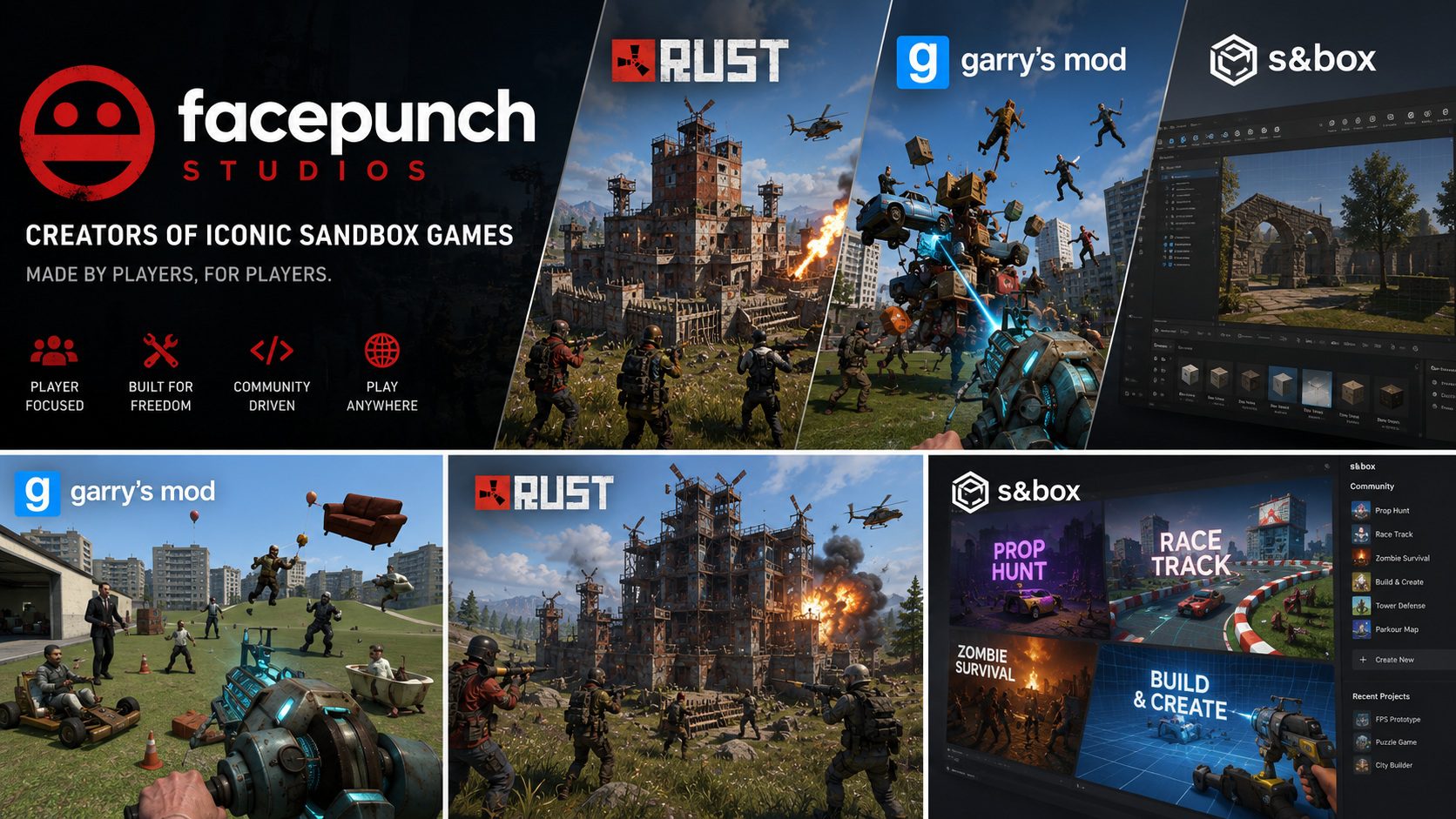
Who is Facepunch Studios? The developer behind Rust, Garry’s Mod and s&box
Facepunch Studios is the British developer behind Rust, but describing it only as the company that made one of Steam’s biggest survival games misses most of the story.
Before Rust, there was Garry’s Mod.
Before modern user-generated-content platforms became one of gaming’s biggest trends, Facepunch had already built a game around giving players tools and allowing them to decide what those tools were for.
More than two decades later, the studio remains independent, self-published and unusually focused on games that communities can reshape long after launch.
Facepunch currently says it has been active for 21 years, has sold 47.5 million games and has sold more than 60 million skins and items across its ecosystem. The company is based in Birmingham, UK, and now employs more than 110 people.
That is a substantial business.
Yet its development philosophy still feels closer to an independent studio than a traditional publisher.
Facepunch Studios started with Garry’s Mod
The roots of Facepunch Studios go back to 2004, when Garry Newman began developing what would become Garry’s Mod. Facepunch itself describes that project as the game that started everything.
The concept was remarkably simple.
Take Valve’s Source engine.
Remove the traditional objectives.
Give players physics tools.
Then see what they build.
Garry’s Mod eventually reached Steam commercially on 29 November 2006. Facepunch describes it as one of the earliest major user-generated-content game platforms and says it has sold more than 25 million copies.
There was no campaign telling players what to do.
No progression system forcing them down a specific route.
No final boss.
You spawned objects, manipulated physics and created whatever made sense to you.
Or whatever made absolutely no sense at all.
That freedom turned out to be far more important than Facepunch could have predicted.
Garry’s Mod became more than a physics sandbox
Calling Garry’s Mod a physics sandbox is technically correct.
It is also incomplete.
The community turned it into something much larger.
Custom maps appeared.
Role-playing servers grew.
Entire game modes emerged.
Machinima creators used it to produce videos.
Modders created weapons, vehicles, characters and systems that Facepunch itself never designed.
For many players, Garry’s Mod became an introduction to programming, game design, level creation and online communities.
Facepunch still updates it.
The official development log shows updates continuing into April 2026, including networking improvements, optimisations, HUD changes and additional mountable game support.
That means a game commercially released in 2006 is still receiving development work almost 20 years later.
This is important because it established the development pattern Facepunch would later repeat with Rust.
Launch was not the end.
It was the beginning of a much longer relationship with the community.
Facepunch Studios then created Rust
In 2013, Facepunch started work on something very different.
Rust began as a survival experiment.
The studio originally tested it through a web browser before bringing it to Steam Early Access in December 2013. Facepunch has openly acknowledged that it did not yet know exactly what the game should become. Early versions even contained zombies.
Instead of pretending the design was finished, Facepunch changed it in public.
Systems were replaced.
Zombies disappeared.
The game was effectively rebuilt.
Base construction grew more complicated.
PvP became central.
Server communities developed their own cultures.
Facepunch eventually moved Rust out of Early Access on 8 February 2018.
However, the studio explicitly said that leaving Early Access would not mean moving the development team elsewhere.
That promise became one of the defining decisions in Facepunch’s history.
Rust became Facepunch Studios’ biggest long-term project
The modern version of Rust has almost nothing in common with the relatively basic survival experiment released in 2013.
Facepunch says the game has now received more than 380 content updates and continues to receive a guaranteed content patch every month.
Those updates expanded practically every part of the game.
Players gained vehicles.
Electricity.
Farming.
Automation.
Trains.
Helicopters.
Boats.
Underwater environments.
Larger monuments.
More complicated base-building systems.
New enemies and factions.
The important part is not simply the amount of content.
Facepunch continued treating Rust as something that could still be redesigned.
The studio has repeatedly changed mechanics that players had already spent years learning.
That willingness can frustrate veterans.
It is also one reason Rust avoided becoming frozen in 2018.
Rust grew instead of fading away
The longevity has been extraordinary.
Facepunch celebrated Rust’s tenth anniversary in December 2023 and revealed that the PC version had sold more than 16 million copies by that point, excluding console sales.
The studio also said Rust had grown year after year throughout its first decade.
That pattern continued.
As TechnologyBlog covered separately in our Rust in 2026 feature, the game remains capable of drawing more than 100,000 concurrent Steam players during daily peaks.
Even more unusually, Rust achieved its all-time Steam concurrent-player record years after launch rather than during its original release period.
That does not happen accidentally.
It requires a combination of development, community activity, content creators and a game structure capable of producing new stories without developers having to script them all.
Facepunch built exactly that.
Facepunch Studios relies heavily on player-created stories
There is a connection between Garry’s Mod and Rust that is easy to miss.
They look completely different.
One is a physics sandbox.
The other is an unforgiving multiplayer survival game.
Yet both rely on players creating much of the experience themselves.
In Garry’s Mod, players create game modes, servers, maps and scenarios.
In Rust, they create alliances, rivalries, raids, settlements and betrayals.
Facepunch builds systems.
Players determine how those systems interact.
That reduces the developer’s need to produce a traditional scripted content pipeline forever.
A single map or tool can generate thousands of different situations depending on the people using it.
That philosophy has become even more obvious with Facepunch’s latest project.
s&box is Facepunch Studios’ spiritual successor to Garry’s Mod
On 28 April 2026, Facepunch launched s&box on Steam.
The studio describes it as the spiritual successor to Garry’s Mod. It is built on Valve’s Source 2 engine and is intended as both a game platform and a development environment.
Players can browse community-created games ranging from shooters and racing projects to role-playing, horror and platformers.
Creators can build their own projects using an editor and C# tools, then publish them directly to the platform.
Facepunch is therefore trying to push the original Garry’s Mod idea much further.
Instead of merely providing a sandbox where players manipulate existing Source assets, s&box aims to give creators the tools to build standalone experiences.
That makes it closer to a game-creation ecosystem.
Facepunch spent years trying to get s&box right
The road to release was not straightforward.
Garry Newman openly acknowledged this when s&box finally launched.
He described the development as involving multiple years, multiple false starts and multiple engines.
That admission fits Facepunch’s wider culture unusually well.
The studio does not present development as a perfectly planned process where every design decision was obvious from the beginning.
Rust itself was created through experimentation.
s&box followed a similar path.
Facepunch tested ideas.
Discarded others.
Worked directly with developers during a long preview period.
Then released the platform knowing development would continue afterwards.
Newman explicitly connected this philosophy with Garry’s Mod and Rust: release, learn, improve and continue building.
s&box has not had an easy launch
That does not mean s&box has immediately repeated the success of its predecessors.
When checked on 1 September 2026, the Steam version carried a Mixed English user-review rating, with around 48% of more than 3,400 English reviews positive.
Recent reviews were weaker still.
For a studio with Garry’s Mod behind it, that is significant.
Expectations are extremely high.
Players understandably compare the new platform with nearly two decades of accumulated Garry’s Mod content.
Facepunch, however, appears to be treating the release as another starting point rather than a finished destination.
The studio began pushing post-release updates almost immediately, focusing on performance, networking, discovery, moderation tools and creator features.
Whether s&box ultimately becomes the next Garry’s Mod remains uncertain.
But Facepunch has built its entire history around games that improve over years rather than weeks.
Facepunch wants creators to build businesses as well as games
One of the more ambitious elements of s&box is its creator economy.
Facepunch has introduced a Play Fund, designed to reward creators when players spend time in their games.
It has also worked on systems that allow developers to export standalone games and use the platform’s tools beyond simple community mods.
That is a meaningful evolution from Garry’s Mod.
A teenager experimenting with Lua inside Garry’s Mod might have discovered an interest in programming.
s&box wants to provide a more direct route from experimentation to actual game development.
Facepunch has even open-sourced parts of its sandbox mode and documentation so developers can inspect how its own systems work.
The studio is effectively trying to turn community creativity into infrastructure.
Facepunch Studios remains independent
The company structure also separates Facepunch from many developers with similarly successful games.
Facepunch describes itself as an independent, self-published developer.
It is not part of Electronic Arts.
Microsoft does not own it.
Tencent is not its parent company.
There is no major external publisher determining the release schedule for its PC games.
That independence gives Facepunch considerable control over what it builds and how quickly it expands.
The studio says it deliberately grows slowly rather than hiring aggressively when the industry is strong and then cutting staff when conditions change.
Its careers page says it has avoided over-hiring and has never had to downsize during difficult periods.
In an industry that has experienced repeated waves of layoffs, that is a notable operating philosophy.
Facepunch does not use conventional management
Its internal structure is unusual too.
Facepunch says it does not operate with conventional management and instead expects teams to decide collectively what is best for the games they are building.
That does not mean there is no leadership.
Garry Newman remains one of the studio’s most recognisable figures, and individual projects have producers, designers and technical leads.
But the company presents itself as intentionally less hierarchical than a traditional large publisher.
Its stated philosophy is to expect failure, learn from mistakes and improve both games and relationships with their communities over time.
That language would sound like ordinary corporate messaging if the studio’s history did not provide some evidence for it.
Rust was rebuilt because its original direction was not working.
s&box went through years of false starts before release.
Facepunch has repeatedly shown a willingness to discard ideas rather than defend them simply because development time was already spent.
Modding remains part of Facepunch Studios’ identity
This should not be surprising considering where the company started.
Garry’s Mod itself emerged from modding culture.
Facepunch still openly supports community modifications across its games within published guidelines.
Its modding policy explicitly recognises everything from small plugins to entirely new game modes and gameplay systems.
Rust has extensive community-server and server-side mod support.
Garry’s Mod would barely exist in its current form without community addons.
s&box goes even further by treating creation as one of its primary functions.
Many game companies tolerate modding.
Facepunch built much of its business around it.
Facepunch is now entering publishing as well
The company is also beginning to move beyond developing only its own games.
Facepunch Publishing now offers support to independent developers.
Its pitch is deliberately different from a traditional publishing agreement.
Facepunch says developers remain in control of their game, team and creative direction. It offers access to internal technology, playtesting, marketing, legal expertise and other resources without imposing forced monetisation systems or artificial deadlines.
That approach reflects the company’s own history.
Facepunch understands what it means to build a strange project without knowing exactly how large the audience might become.
The company is now trying to apply that experience to other developers.
It also has something smaller publishers rarely possess: direct access to audiences built around Rust and Garry’s Mod.
That provides substantial marketing reach.
Garry’s Mod may be Facepunch Studios’ most important legacy
Rust is currently the studio’s largest active game.
But Garry’s Mod may ultimately have had the greater influence.
It taught an entire generation that games could be places to create rather than simply things to complete.
Players learned scripting because they wanted to modify servers.
They learned 3D tools because they wanted to create maps.
They experimented with animation because they wanted to make videos.
They built communities around game modes nobody at Facepunch originally designed.
Many modern platforms now use similar ideas.
Roblox.
Fortnite Creative.
Minecraft servers.
Dreams.
Core.
User-generated content has become one of the industry’s major strategic priorities.
Facepunch was already living inside that world two decades ago.
Rust proved the same idea could work in a completely different genre
Rust then demonstrated something equally important.
Player-generated experiences do not require traditional creation tools.
Players do not need to design a map or write code to create content.
Sometimes they simply need systems complex enough for interesting situations to develop.
A raid becomes content.
A betrayal becomes content.
Building a strange village becomes content.
A clan war becomes content.
That is why watching Rust can be entertaining even when nothing traditionally scripted is happening.
The players themselves become the narrative system.
This approach is one reason Facepunch games can remain relevant for so long.
The developer does not have to manually author every memorable moment.
What Facepunch Studios means for South African PC gamers
Facepunch has always been closely connected to PC gaming.
That matters for South African players because PC communities historically depended heavily on games capable of surviving beyond launch windows.
Garry’s Mod is one of those games.
Rust is another.
They reward long-term communities rather than requiring players to move immediately to the next annual release.
Rust’s online structure means South African players still need to consider server location and latency carefully. A stable internet connection does not automatically guarantee good ping.
Garry’s Mod and s&box also depend heavily on community servers and user-created content.
However, that same server flexibility gives players more options than a game restricted to one central matchmaking environment.
Facepunch’s games are therefore not necessarily the easiest multiplayer experiences to enter.
They are often among the hardest to exhaust.
Facepunch Studios is now more than the company behind Rust
It would be easy to view Facepunch as a studio that simply got lucky twice.
Garry’s Mod became enormous.
Then Rust became enormous.
But there is a pattern connecting them.
Give players tools.
Do not dictate every objective.
Support community creation.
Keep updating the game.
Listen when systems fail.
Accept that players will use features in ways the developers never expected.
Then build around what works.
s&box is the most direct expression of that philosophy yet.
Its Steam launch has been difficult, and its current reviews show Facepunch still has substantial work ahead.
That makes the project more interesting rather than less.
Facepunch has been here before.
Rust was not born as the game millions recognise today.
Garry’s Mod was not originally imagined as a 20-year platform supporting entire communities and careers.
Facepunch has spent two decades proving that a game does not necessarily need to arrive complete to become important.
Sometimes it needs enough freedom for players to show the developer what it could become.