Dyson WashG1 tackles wet and dry floor mess without vacuum suction
The Dyson WashG1 wet cleaner takes a different approach to cleaning hard floors. Instead of combining a vacuum motor with a wet roller, Dyson designed it specifically around washing.
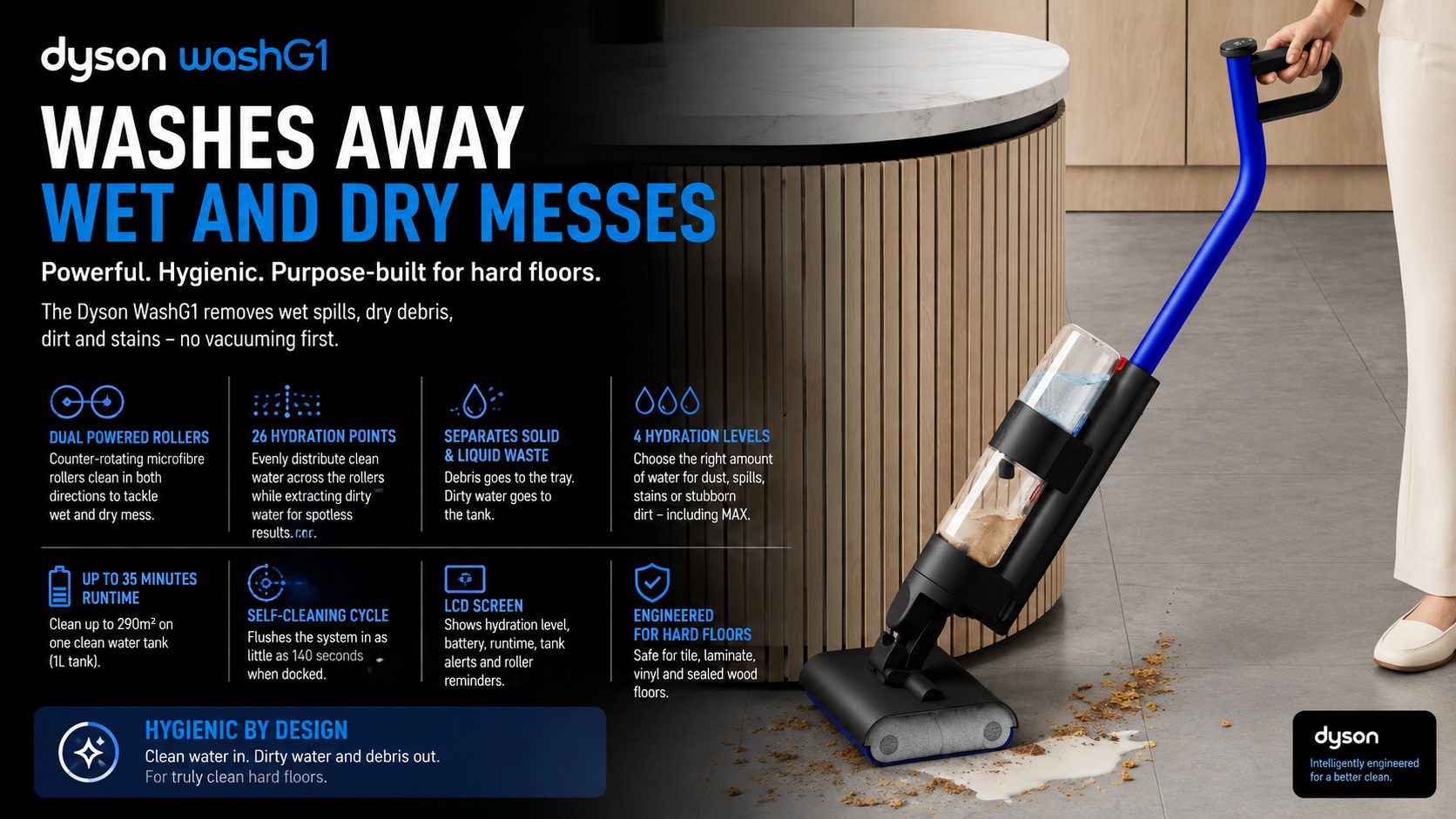
Two motorised microfibre rollers rotate in opposite directions to collect dry debris, hair, liquid spills and stains. Secondary brush bars remove debris from the rollers, while extraction plates pull dirty water away from the cleaning surface.
The machine then separates solid debris from dirty liquid. Solid waste moves into a removable debris tray, while dirty water flows into its own tank.
This means you do not necessarily need to vacuum a hard floor before using the WashG1 for the everyday debris Dyson specifies. However, it does not replace a normal vacuum cleaner throughout the home. Carpets, upholstery, mattresses and vehicles still require another cleaning tool.
Dyson WashG1 uses two rollers instead of suction
The central technology in the WashG1 is its pair of counter-rotating motorised rollers.
Both rollers contact the floor, allowing them to work on stains and spills from two directions during a cleaning pass. Dyson says the system can collect dry dust and debris alongside liquids without drawing the mixture through a vacuum motor.
This separates the WashG1 from Dyson models such as the V15s Detect Submarine and V12s Detect Slim Submarine.
Those products combine traditional vacuuming with dedicated wet-cleaning heads. By contrast, the WashG1 is a purpose-built hard-floor washer.
That design choice also creates one of its clearest limitations: there is no carpet-cleaning mode.
Clean water reaches the rollers through 26 hydration points
The WashG1 does not simply soak its rollers and leave them wet.
A pulse-modulated pump feeds clean water through 26 hydration points across the roller width. Dyson designed this system to spread water evenly while the rollers turn.
At the same time, the machine extracts dirty liquid from the rollers rather than returning it to the floor.
This separation between clean and dirty water is one of the main practical differences between a dedicated floor washer and a traditional mop-and-bucket setup.
The clean-water tank holds 1 litre, while the dirty-water tank holds 0.8 litres.
The Dyson WashG1 separates solid and liquid waste
Food spills and muddy footprints create more than dirty water.
Hair, crumbs and larger particles also need somewhere to go.
Secondary nylon-bristle bars remove larger particles and hair from the microfibre rollers before depositing the debris into a removable tray. The machine directs dirty liquid to a separate tank.
This arrangement should make disposal less unpleasant than emptying one container filled with dirty water, food debris and hair.
Owners still need to maintain the system, though.
The debris tray and dirty-water tank require regular cleaning, while the rollers themselves eventually need replacement.
Four hydration options adapt to different mess
The Dyson WashG1 wet cleaner provides three standard hydration levels plus a MAX option.
Level 1 targets dust, hair, small debris and light spills. Level 2 suits normal food mess, footprints and moderate spills. Level 3 increases hydration for sticky liquids, muddy marks and dried stains.
MAX sends additional water to the rollers when more stubborn dirt needs attention.
The LCD screen gives users access to these settings and displays information such as remaining runtime, battery status, dirty-water alerts and roller-replacement reminders.
Adjustable water flow matters because not every floor needs the same amount of moisture.
A lightly dusty kitchen requires less water than a section covered in dried food or muddy footprints.
The WashG1 works on common sealed hard-floor surfaces
Dyson specifies the WashG1 for tile, laminate, vinyl and sealed wood floors.
The word sealed matters.
Water can damage unsealed timber, so owners should confirm that the flooring manufacturer allows wet cleaning before using any powered floor washer.
Carpets remain off limits.
Even though the machine can collect dry debris, Dyson designed it specifically for hard floors.
Up to 35 minutes of cleaning
Dyson specifies up to 35 minutes of battery runtime for the WashG1.
The company also claims that one clean-water tank can cover up to 290m² under its internal test conditions. That calculation assumes no repeated passes and a cleaning speed of 0.5 metres per second.
Real homes will vary.
Furniture, dried stains and sections that need several passes can reduce actual coverage significantly.
The 290m² figure should therefore be treated as an upper test-condition estimate rather than a guaranteed result for every household.
A self-clean cycle takes as little as 140 seconds
Wet floor cleaners create an obvious problem: after cleaning the floor, the machine itself becomes dirty.
Dyson tackles this with a self-clean cycle.
Once the WashG1 returns to its charging dock, the system can flush itself in as little as 140 seconds.
Owners should not treat this as a substitute for all manual maintenance.
Dyson recommends running the self-clean function after every use and carrying out a deeper manual clean after every three uses.
That maintenance schedule matters because wet cleaners handle dirty water, food residue and other organic debris. Poor cleaning can lead to odours and residue building up inside the machine.
The rollers are replaceable consumables
The microfibre rollers will not last forever.
Dyson estimates their lifespan at around 25 hours of use, depending on conditions. The LCD tracks roller use and provides a replacement reminder.
That means long-term ownership includes a consumable cost.
Someone using the WashG1 frequently across a large tiled home will reach the replacement point sooner than a person cleaning a smaller apartment less often.
The MyDyson app can also provide support information and roller-replacement reminders. However, the WashG1 does not depend on the app for basic cleaning.
Hair and food debris can be cleaned with spills
One of the WashG1’s more useful abilities is that you do not always need a separate dry-cleaning pass before washing the floor.
Dyson says the machine can collect fine dust, hair and small debris together with liquid spills.
The company also lists everyday examples such as water, food mess, syrup, ketchup, dried food and toothpaste.
In a kitchen or dining area, this could reduce the usual sequence of sweeping or vacuuming before mopping.
However, the WashG1 still has sensible limits.
It is a household floor cleaner, not a workshop wet-and-dry vacuum. Owners should follow Dyson’s instructions rather than assume that every liquid or type of debris is suitable.
Dyson WashG1 does not replace a full vacuum cleaner
This is probably the most important buying consideration.
The Dyson WashG1 wet cleaner is not a vacuum cleaner.
It can take over part of the job that a broom or vacuum would normally perform immediately before mopping a hard floor, but it cannot clean carpets, sofas, mattresses, curtains or vehicle interiors.
Someone living in a fully tiled apartment may use the WashG1 for most routine floor cleaning.
A home with several carpeted rooms will still need a conventional vacuum.
For that reason, the WashG1 makes more sense as a specialist hard-floor appliance than as the only cleaning machine in a household.
The docking station handles storage and charging
Dyson includes a charging dock with the machine.
After cleaning, owners can return the WashG1 to the dock so that it recharges and remains ready for the next session.
The self-cleaning process also takes place on the dock.
This means buyers need a sensible storage point near a power outlet. The WashG1 cannot simply be pushed into any cupboard like a traditional mop.
Dyson also recommends fully charging the battery before first use so that the machine can estimate runtime accurately.
Dyson WashG1 specifications
| Specification | Dyson WashG1 |
|---|---|
| Product type | Dedicated wet hard-floor cleaner |
| Cleaning system | Dual counter-rotating motorised rollers |
| Vacuum suction | No |
| Dry debris pickup | Yes |
| Liquid pickup | Yes |
| Hair pickup | Yes |
| Clean-water tank | 1 litre |
| Dirty-water tank | 0.8 litres |
| Hydration settings | Levels 1, 2, 3 and MAX |
| Hydration points | 26 |
| Runtime | Up to 35 minutes |
| Claimed maximum coverage | Up to 290m² |
| Floor types | Tile, laminate, vinyl and sealed wood |
| Carpet cleaning | No |
| Waste separation | Solid debris and dirty water separated |
| Display | LCD |
| Self-cleaning cycle | As little as 140 seconds |
| Manual cleaning | Dyson recommends every three uses |
| Roller lifespan | Around 25 hours, depending on use |
| Charging dock | Included |
| MyDyson support | Yes |
| South African warranty | 2 years, parts and labour |
Where the Dyson WashG1 makes the most sense
The strongest case for the WashG1 is a home with a large amount of hard flooring.
Open-plan kitchens, dining rooms and living areas can collect dust, hair, food crumbs, muddy footprints and liquid spills. Dealing with those separately often means sweeping or vacuuming before mopping.
The WashG1 combines those steps for the everyday debris and spills Dyson specifies.
Pet owners may also appreciate being able to pick up hair and muddy paw prints during the same cleaning session.
Households dominated by carpet will get less value from a dedicated hard-floor washer because a separate vacuum remains essential.
Is the Dyson WashG1 worth considering?
The Dyson WashG1 wet cleaner is interesting because Dyson has not simply added another mop attachment to one of its cordless vacuums.
It is a dedicated floor washer built around two motorised rollers, controlled hydration and physical separation of solid debris from dirty water.
That design allows the machine to deal with dust, hair, food debris, spills and stains during the same cleaning session. Three hydration levels and MAX give users control over how much water reaches the floor, while the self-clean cycle reduces some of the maintenance afterwards.
Its limitations are equally clear.
The WashG1 cannot clean carpets, so many households will still need a vacuum. Owners must also empty the tanks, clean the debris tray, maintain the machine regularly and eventually replace the microfibre rollers.
For a South African household dominated by tile, laminate, vinyl or sealed wood, though, the Dyson WashG1 offers something more useful than another generic vacuum feature: a purpose-built way to combine dry-debris pickup and wet cleaning in one hard-floor routine.