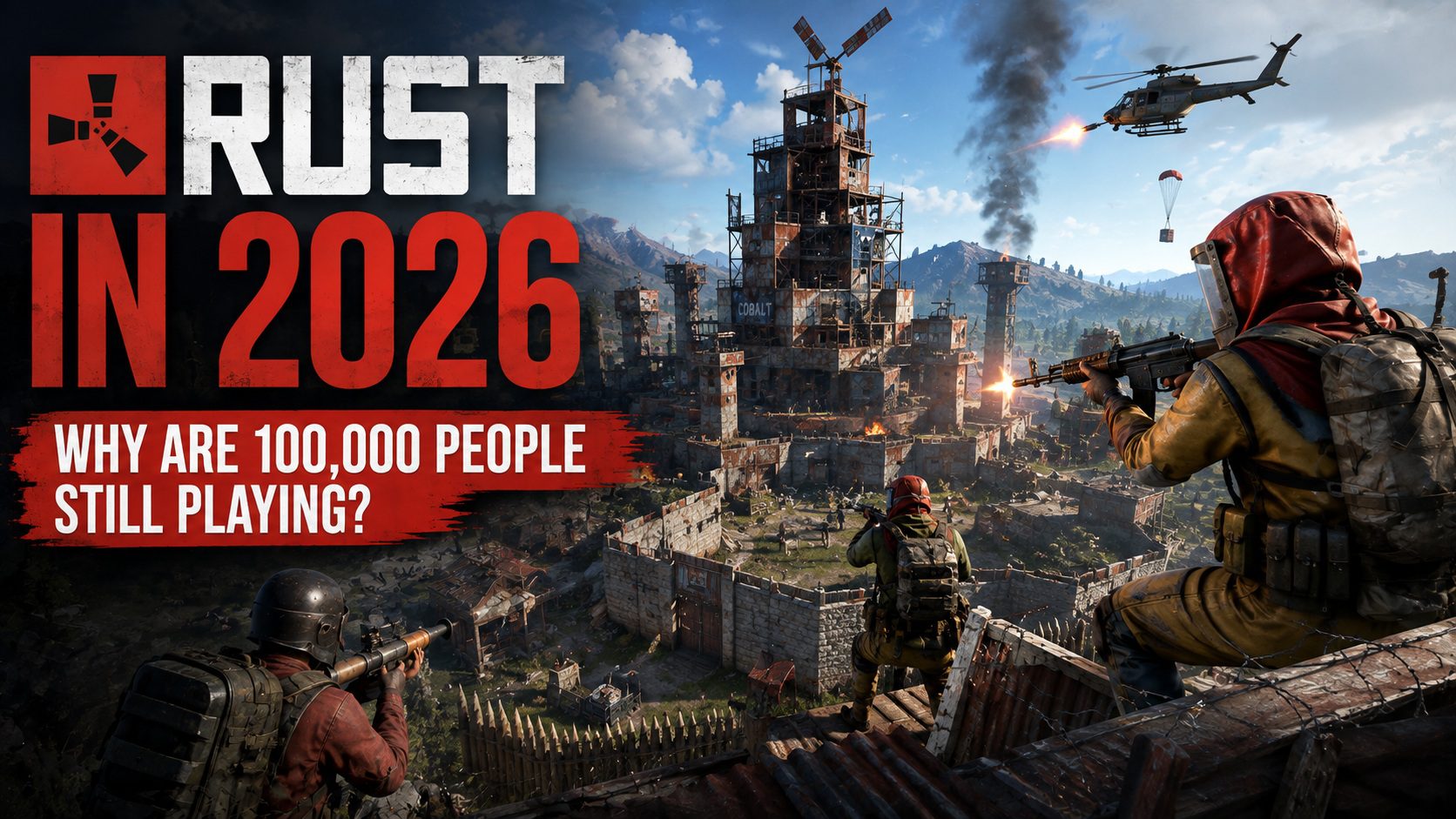
Rust is nearly 13 years old – so why are more than 100,000 people still playing it?
The Rust game first reached Steam Early Access in December 2013. Almost 13 years later, Facepunch Studios’ survival game can still attract more than 100,000 concurrent players during a daily peak.
That makes Rust one of Steam’s most unusual long-term success stories.
It is not free-to-play. It is not built around quick competitive rounds, and it does not protect the progress players make while they are offline.
In fact, Rust often does the opposite.
You can spend hours gathering resources, building a base and preparing weapons, then return later to discover another group has raided everything while you were away.
That level of punishment should drive players out.
Instead, it became part of what makes the Rust game work.
The Rust game started very differently in 2013
Facepunch began developing Rust in 2013 and originally released it for testing as a browser game.
A few months later, it reached Steam Early Access.
The original version was considerably rougher than the game players know today. Early builds even contained zombies while Facepunch was still deciding what Rust should become.
The studio eventually abandoned that direction and concentrated instead on survival, crafting and player interaction.
Rust then changed repeatedly.
Systems disappeared.
Others were rebuilt.
Graphics improved.
Weapons changed.
Construction became more complicated.
Entire new ways of playing appeared.
Four years later, Facepunch announced that Rust would finally leave Early Access on 8 February 2018.
The important part was what happened next.
Development did not stop.
Readers interested in how dramatically the game has changed can explore the official Rust website, where Facepunch continues to publish development updates.
The basic Rust game idea remains brutally simple
Facepunch describes Rust’s objective in one word:
Survive.
The environment can kill you.
Wildlife can kill you.
Other players can kill you.
Usually, other players are the biggest problem.
The Rust game drops players into a shared open world with very little protection.
You gather resources, craft equipment, construct bases, acquire weapons and decide who you trust.
Players can cooperate, form alliances, trade with strangers or attack someone else’s base and take what they have collected.
There are no permanent factions deciding who should be friendly.
Relationships develop between players themselves.
That means betrayal is always possible.
Someone helping you collect resources today could be breaking through your walls tomorrow.
This unpredictability is difficult for scripted games to reproduce.
Other players effectively create Rust’s story
This may be the biggest reason Rust has remained relevant.
Facepunch provides the systems.
Players create the drama.
A normal session can begin with someone collecting wood and end with a conflict involving several groups, stolen weapons, destroyed bases and a carefully planned revenge attack.
Players remember those moments because developers did not script them.
There is no cutscene deciding when the betrayal happens.
Another person simply makes a choice.
That turns Rust into something closer to a social experiment wrapped inside a survival game.
The crafting, weapons and construction systems matter.
The people using them matter even more.
Losing everything is part of the Rust game
Most games reward players with permanent progression.
Unlock a weapon and you expect to keep it.
Build something valuable and you expect it to remain there.
Rust refuses to offer that security.
Bases can be raided.
Equipment can be stolen.
Players can die and lose what they were carrying.
Servers also use wipes that periodically reset some or all progression.
At first, that sounds hostile to long-term players.
However, wipes solve an important survival-game problem.
Without resets, established groups could become almost impossible for newcomers to challenge.
A wipe creates another starting line.
Veteran players still have their knowledge, but their physical advantage disappears.
Suddenly, basic tools and scrap matter again.
Groups need to claim territory.
New alliances form.
Players race to establish themselves before their neighbours do.
Then the cycle begins again.
Knowledge becomes the real progression system
This creates an unusual form of long-term progression.
Your buildings disappear.
Your resources disappear.
Your weapons disappear.
Your understanding of Rust does not.
Experienced players know which resources matter first.
They understand monuments.
They recognise effective base designs.
They know how much equipment a raid might require.
They understand positioning, weapon behaviour and the pace at which rival groups may progress after a wipe.
That accumulated knowledge gives Rust enormous replayability.
A wipe does not truly return everyone to zero.
It removes possessions.
Experience remains.
Base building became a game inside the Rust game
For some players, shooting is not even the most interesting part of Rust.
Building is.
A basic shelter can gradually become a complicated defensive structure containing multiple walls, doors, traps, storage rooms and carefully planned routes.
The problem is that every defensive decision becomes a puzzle for somebody planning to raid the base.
Where is the loot?
Which route is cheapest?
Where is the tool cupboard?
Has the owner deliberately created an obvious entrance because the real defence lies somewhere else?
That creates an arms race between builders and raiders.
Successful designs spread through the community.
Raiders adapt.
Builders change their designs again.
Facepunch then changes mechanics and forces everyone to reconsider what works.
The community becomes part of the design process.
TechnologyBlog readers interested in another survival game with strong building and crafting systems can also read our coverage of Palworld, although the two games approach survival very differently.
Rust in 2026 is much bigger than the original game
The modern Rust game bears little resemblance to the relatively simple survival sandbox from 2013.
Facepunch says Rust has entered its 12th year of continued expansion and has received more than 380 content updates.
Those updates added far more than weapons.
Rust now includes vehicles, trains, electricity, farming, underwater areas, industrial systems, large monuments and increasingly complex ways to build and automate bases.
Facepunch also continues to promise regular content updates rather than treating Rust as a finished legacy product.
That is one of the clearest reasons players keep returning.
The Naval Update expanded Rust into the ocean
One of 2026’s biggest changes arrived with the Naval Update on 5 February.
Facepunch introduced a new Deep Sea region, tropical islands, ghost ships, floating cities and player-built modular boats.
Players can construct vessels using specialised boat pieces, then add engines, sails, anchors, ramps and cannons.
Boat design affects handling and performance.
The update also introduced naval missions, additional AI, a PT boat and changes to Oil Rig encounters.
You can read Facepunch’s full breakdown in the official Rust Naval Update notes.
This was not a small cosmetic addition.
The ocean became another place to live, travel, gather resources and fight.
For a game approaching its thirteenth year, that scale of expansion is significant.
Facepunch kept updating the Rust game throughout 2026
The Naval Update was only part of Rust’s 2026 development.
Later updates introduced changes to workbenches, terrain rendering, player models, weapons and other major systems.
June’s Built Different update delivered what Facepunch described as Rust’s biggest player overhaul in years.
It brought redesigned player models and animations, new armour and the M16A2 rifle.
Then August’s Power Trip update changed how several monuments interact.
Players can restore the Power Plant using Heavy Fuses, activating parts of the island’s electrical infrastructure.
Powered utility poles can provide electricity, while additional monuments gained new interactive systems.
The update also introduced a satellite crash event and further changes to locations including the supermarket, Water Treatment Plant and Airfield.
The official Rust roadmap shows how much development remains active.
Facepunch warns that roadmap items can change, but it still provides a useful indication of where the studio wants Rust to go next.
Rust still has a genuine development roadmap
Games this old often enter maintenance mode.
Rust has not.
Facepunch’s roadmap continues to cover new gameplay systems, weapons, infrastructure improvements and technical work.
Its 2026 development has already included naval expansion, new islands, Deep Sea content, anti-cheat work, player-model changes and substantial infrastructure improvements.
That does not mean every planned feature will arrive exactly as originally described.
Facepunch itself cautions that development priorities can change.
However, the existence of an active roadmap is important.
Players know the game is still moving.
The Rust game player count remains remarkable
The strongest evidence of Rust’s longevity comes from Steam activity.
When TechnologyBlog checked SteamDB on 1 September 2026, Rust had more than 54,000 concurrent players at that moment and a 24-hour peak above 106,000.
Its all-time peak sits above 262,000 concurrent players.
Even more remarkably, Rust reached that record in January 2025.
The game therefore achieved its highest Steam concurrency more than a decade after its original Early Access launch.
That is extremely unusual.
Players can follow the changing figures on the Rust SteamDB charts.
The exact numbers naturally move throughout each day, but the wider point remains clear.
Rust is not surviving with a tiny group of nostalgic players.
It remains one of Steam’s major multiplayer games.
More than a decade of player reviews
Rust has also accumulated an enormous volume of user feedback.
Its official Steam page carries a Very Positive rating overall.
That does not mean the community agrees about everything.
Rust players regularly debate recoil, weapon balance, cheating, progression, raiding and the advantages large groups can have over solo players.
The game can produce strong reactions precisely because players invest so much time into its systems.
Disagreement is not the same as irrelevance.
People still care enough about Rust to argue about how it should work.
The Rust game can be brutal for solo players
None of this means Rust is automatically an easy recommendation.
It can be unforgiving.
Large organised groups can gather resources far faster than individual players.
A solo player can spend hours constructing a base and lose it overnight.
New players also enter servers populated by veterans with thousands of hours of experience.
That knowledge gap can be punishing.
Community servers can help.
Some restrict team sizes.
Others increase gathering rates or use different wipe schedules.
There are also communities specifically aimed at solo players or smaller groups.
Finding the correct server can therefore matter almost as much as learning the game.
A player who dislikes one Rust server may have a completely different experience on another.
The server becomes part of the experience
This is another major difference between Rust and conventional multiplayer games.
Server choice can substantially change how Rust feels.
Population matters.
Group-size limits matter.
Wipe schedules matter.
Rules matter.
Administrators matter.
Community culture matters.
A busy server dominated by large clans produces a completely different experience from a quieter solo-only server.
That variation helps Rust appeal to different types of players.
Facepunch supplies the framework.
Individual communities shape much of what happens inside it.
What South African Rust players should consider
For South African gamers, server choice deserves more attention than the game’s raw hardware requirements.
Rust is a persistent online survival game. Therefore, latency can materially affect combat.
A stable internet connection does not automatically guarantee low latency.
Players should check the measured ping of available servers before investing large amounts of time into a particular community.
That does not mean South Africans cannot enjoy Rust.
It means the quality of the experience can depend heavily on the selected server.
Rust’s community-server system may actually help here because players are not limited to one matchmaking environment.
You can search for a combination of latency, rules, population and wipe schedule that suits how you want to play.
TechnologyBlog readers interested in how server populations affect another long-running Steam game can also read our feature on PUBG: Battlegrounds in 2026.
Rust game PC requirements in 2026
Constant development means Rust has become more demanding than its early versions.
The current Steam minimum specification requires Windows 11 64-bit, an AMD Ryzen 5 1400 or Intel Core i5-6600, 12GB of RAM and either an AMD Radeon RX 470, Nvidia GeForce GTX 1060 or Intel Arc A580.
Steam strongly recommends an SSD because loading times can be significantly longer from a traditional hard drive.
Rust PC requirements
| Specification | Minimum | Recommended |
|---|---|---|
| OS | Windows 11 64-bit | Windows 11 64-bit |
| CPU | Ryzen 5 1400 / Core i5-6600 | Ryzen 7 3700X / Core i7-6700K |
| RAM | 12GB | 16GB |
| GPU | RX 470 / GTX 1060 / Arc A580 | RX 6600 XT / RTX 3060 / Arc B580 |
| DirectX | 11 | 12 |
| Storage | 45GB | 45GB |
| Drive | SSD highly recommended | SSD required |
| Network | Broadband internet | Broadband internet |
TechnologyBlog has not independently benchmarked Rust on these configurations. These are Facepunch’s published requirements rather than our own performance findings.
Why Rust remains different from newer survival games
The survival genre is much more crowded today than it was in 2013.
Players now have alternatives such as ARK, DayZ, SCUM, Valheim, Enshrouded and Palworld.
Rust survives because its identity remains unusually clear.
It is not primarily about completing a story.
It does not revolve around defeating a final boss.
It does not promise permanent safety.
Instead, it creates systems that encourage players to compete, cooperate, negotiate and betray one another.
Then a wipe removes much of what they created and asks them to begin again.
That may sound repetitive.
The human element prevents two wipes from developing exactly the same way.
Streaming helped make Rust entertainment as well as a game
Rust also works unusually well as something to watch.
The unpredictability that produces memorable player experiences translates naturally to streams and videos.
Viewers do not need to understand every crafting recipe to follow the important part.
One group owns something valuable.
Another group wants it.
Someone is lying.
Someone is planning revenge.
Creator-driven servers and Twitch events have exposed Rust to audiences who might never have considered playing an unforgiving survival game.
More importantly, those events repeatedly reminded people that Rust still exists.
For a multiplayer game approaching its thirteenth year, visibility matters.
Facepunch never allowed the Rust game to become truly finished
Perhaps the most important reason Rust remains successful is how Facepunch approaches development.
The studio officially released Rust in 2018.
It did not treat that moment as the end.
Instead, Rust continued changing.
More than 380 content updates later, the game still receives new mechanics, locations, weapons and technical improvements.
That means someone returning after several years encounters something recognisable but not completely familiar.
The fundamentals remain the same.
Gather.
Build.
Fight.
Survive.
Everything surrounding those fundamentals keeps evolving.
Why the Rust game remains relevant in 2026
Rust now occupies an unusual position.
It is old enough for players to feel nostalgic about versions of the game that no longer exist.
At the same time, it remains active enough to receive major expansions.
Its Steam player record came in 2025, more than 11 years after its Early Access debut.
Its 2026 updates have added modular ships, Deep Sea exploration, floating settlements, new weapons, redesigned player models and significant changes to major monuments.
Daily peaks can still exceed 100,000 concurrent players.
That is not a game surviving purely on nostalgia.
Rust found something far more durable.
Facepunch created a world where the developers provide the tools, but other players provide the threat.
As long as people remain willing to build something knowing another player may destroy it, the Rust game still has a reason to exist.


