Polar H10 sensor: Why the chest strap still matters in 2026
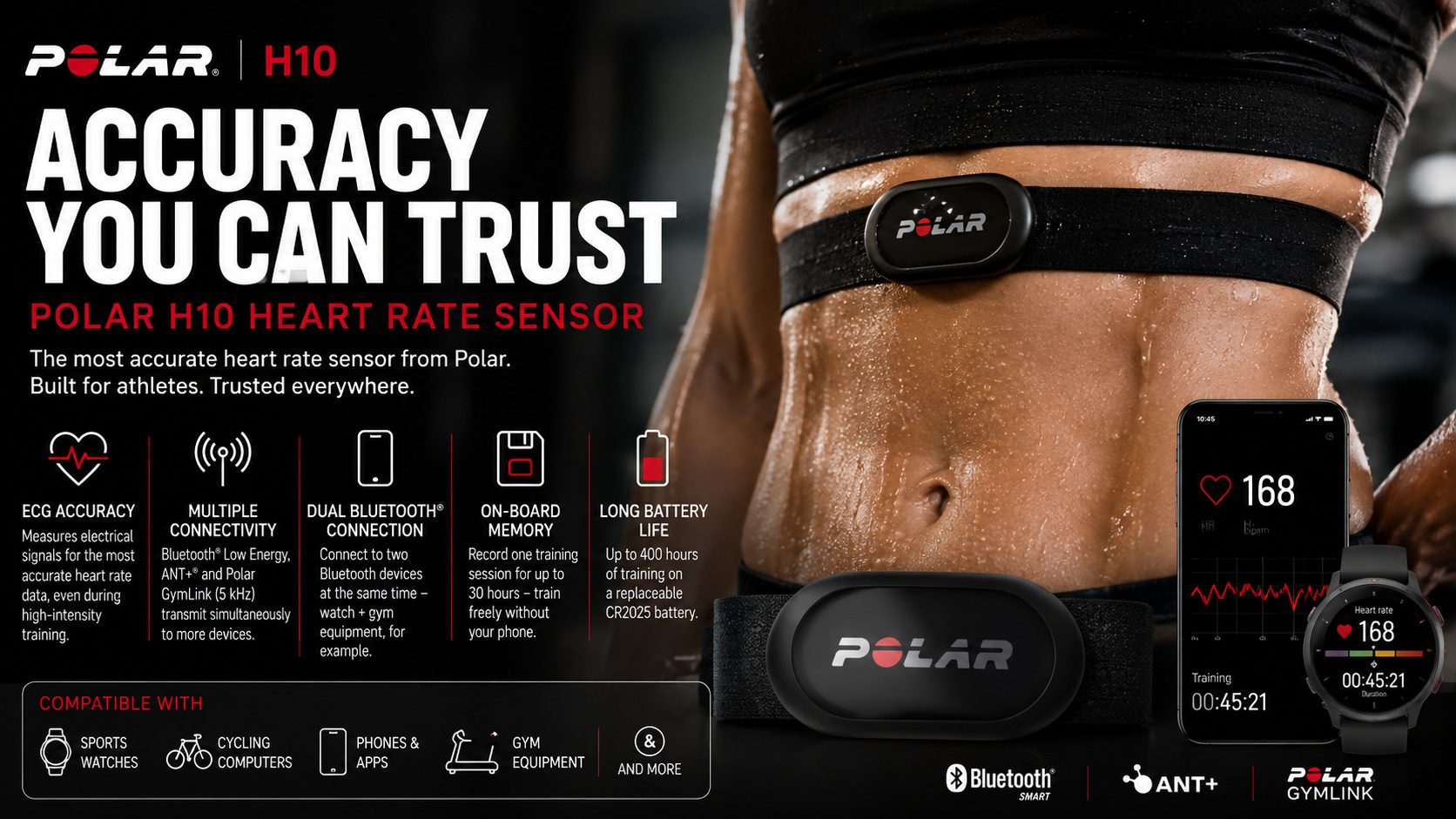
The Polar H10 sensor remains one of the most focused ways to track heart rate during exercise in 2026. Instead of using the optical heart-rate technology found in most smartwatches, the H10 measures electrical signals from the chest and sends that data to compatible watches, phones, cycling computers, fitness apps and gym equipment.
Polar has kept the H10 remarkably simple. There is no display, GPS receiver or collection of smartwatch features. Its job is to measure heart rate, record or transmit that information and work across a wide range of training equipment.
That focused approach has also given the H10 unusual longevity. Polar still officially supports the sensor and released firmware version 4.2.0 on 4 March 2026, addressing offline recording and pairing issues.
For runners, cyclists, gym users and other athletes who actively train using heart-rate data, a dedicated chest strap can therefore still make sense alongside a much newer smartwatch.
Polar H10 sensor uses electrical heart-rate measurement
The biggest difference between the Polar H10 sensor and most sports watches is how they measure heart rate.
Wrist-based wearables normally rely on optical heart-rate monitoring. LEDs shine light into the skin, while sensors analyse changes in the reflected light to estimate blood flow and calculate heart rate.
The H10 takes a different approach.
Electrodes built into the chest strap detect the electrical activity associated with each heartbeat. Polar describes this as ECG-based heart-rate measurement.
That direct electrical measurement is one reason chest straps remain popular for structured training, particularly when heart rate changes quickly.
Intervals, sprinting, cycling and high-intensity workouts can involve rapid changes in effort. They can also introduce arm movement and other conditions that make wrist-based optical measurement more challenging.
A chest strap does not automatically guarantee a perfect measurement. Correct placement, moisture on the electrodes and a secure fit still matter. However, the H10’s electrical approach gives it a clear reason to exist alongside optical wearables.
ECG-based does not mean medical ECG
The word ECG needs some explanation.
The H10 detects electrical signals produced by the heart, but it should not be confused with a clinical electrocardiogram used to investigate heart conditions.
Polar explicitly states that the H10 is intended to measure heart rate and is not intended for medical purposes.
That distinction is important.
The H10 is a sports and fitness sensor. It can provide heart-rate information that athletes use for training, but TechnologyBlog would not describe it as a medical diagnostic device.
Anyone concerned about an abnormal heart rhythm, chest pain or other medical symptoms should use appropriate medical services rather than relying on a consumer training sensor.
Bluetooth, ANT+ and GymLink give the H10 broad compatibility
Connectivity is one of the strongest features of the Polar H10 sensor.
It supports:
- Bluetooth Low Energy
- ANT+
- Polar 5kHz GymLink
These connections allow the H10 to work with far more than Polar’s own watches.
A runner can pair it with a compatible sports watch. Cyclists can transmit heart rate to supported bike computers, while gym users can connect to compatible fitness equipment.
Apps that support external Bluetooth heart-rate sensors can also use its live data.
This cross-platform support makes the H10 particularly useful for someone whose training equipment comes from several manufacturers.
You do not need to build an entirely Polar-based fitness setup simply because the heart-rate sensor carries the Polar name.
Polar H10 can connect to two Bluetooth devices at once
The H10 supports two simultaneous Bluetooth connections when this option is enabled.
That can be surprisingly useful.
A user could, for example, send live heart-rate data to a sports watch while also transmitting it to compatible gym equipment.
Cyclists may want heart-rate information displayed on a bike computer while another device records the same workout.
ANT+ provides further flexibility because compatible receivers can obtain the broadcast heart-rate information without occupying one of the Bluetooth connections.
For someone who uses only one watch, these options may sound excessive. For athletes combining indoor trainers, cycling computers, watches and training applications, they make the sensor considerably more versatile.
The Polar H10 sensor can record without your phone
One of the H10’s most useful features is easy to overlook: internal workout recording.
The sensor can store one training session in its onboard memory.
Polar lists recording capacity of up to 30 hours for that session.
This allows someone to begin a compatible recording through Polar’s software and then train without carrying a smartphone throughout the activity.
Afterwards, the stored information can be transferred back to the phone.
It is particularly useful during activities where a phone would be inconvenient.
However, the H10 should not be mistaken for a smartwatch with extensive onboard workout history. Its memory is intentionally limited to one recording at a time.
The feature is there to free you from carrying another device during a particular workout, not to replace a complete fitness platform.
Polar is still supporting the H10 in 2026
Age can be a concern when buying an established piece of technology, but Polar continues to officially support the H10.
On 4 March 2026, the company released firmware version 4.2.0.
The update addressed an offline recording problem and pairing issues involving the Polar M460 and M430.
This ongoing support is significant because the H10 does not need annual hardware redesigns to remain useful.
Its central job has not changed: detect heartbeats accurately enough for training and reliably send that information to another device.
A functioning chest sensor does not become obsolete simply because a newer smartwatch gains a brighter display.
Up to 400 hours from a replaceable battery
Polar rates the H10 for up to 400 hours of training from its battery.
Instead of using a built-in rechargeable cell, it takes a replaceable CR2025 coin battery.
This approach has several advantages.
You do not need another charging cable, and there is no need to remember to recharge the sensor every few workouts. Once the battery is depleted, it can be replaced.
Polar specifically identifies CR2025 as the correct battery type, so users should follow the manufacturer’s instructions rather than substituting a different coin cell simply because it fits.
Battery life also depends on how the sensor is stored.
Polar recommends removing the transmitter from the strap after training. Leaving it connected to damp electrodes can keep the system active and shorten battery life.
The Polar Pro Strap matters too
The electronics are only half of the system.
The H10 sensor clips onto Polar’s Pro Strap, which places the electrodes against the wearer’s chest.
Polar uses silicone dots to reduce movement, together with a buckle designed to keep the strap securely positioned during exercise.
Before training, the electrode areas should be moistened. The strap should then sit snugly against the chest.
That contact is important.
A chest strap that moves excessively or loses contact with the skin can undermine the advantage of using electrical heart-rate measurement in the first place.
After exercise, Polar recommends detaching the transmitter and rinsing the strap. Regular cleaning helps remove sweat and salt that accumulate during training.
The textile strap can also be washed according to Polar’s care instructions.
Choose the correct strap size
Polar currently offers different H10 strap sizes.
The smaller XS–S option is intended for approximately 62–82cm chest measurements, while M–XXL covers approximately 71–118cm.
Getting the size right affects more than comfort.
A loose strap can move during intense exercise and reduce electrode contact. An excessively tight strap may become uncomfortable during longer sessions.
The best fit is secure enough to stay in place without restricting normal breathing.
Polar H10 sensor weighs only 60g with the strap
The complete H10 setup weighs approximately 60g, while the sensor module itself weighs around 21g.
The module measures roughly 65 × 34 × 10mm.
Its simplicity helps keep both weight and size down.
There is no screen, GPS hardware or large rechargeable battery to accommodate.
Once correctly fitted beneath training clothing, the H10 is designed to remain largely out of the way while another device handles the display and workout interface.
Water resistance is useful, but swimming has limitations
Polar rates the H10 to WR30.
However, water resistance should not be confused with uninterrupted underwater wireless connectivity.
Bluetooth and ANT+ signals do not operate normally underwater.
Polar’s 5kHz GymLink technology can work with compatible equipment in water, although conditions in swimming pools and seawater can affect electrical heart-rate measurement.
Therefore, someone buying the H10 specifically for swimming should check compatibility with the receiving device.
The WR30 rating tells you about the sensor’s resistance to water. It does not guarantee that every wireless connection available on dry land will continue working beneath the surface.
Polar H10 versus a smartwatch
For general health and activity monitoring, a smartwatch is far more convenient.
A watch can remain on the wrist throughout the day and may track heart rate alongside sleep, steps, GPS, notifications and many other metrics.
The H10 does not try to compete with that.
It is designed around training sessions.
For someone taking a casual walk, the heart-rate sensor already built into a watch may provide everything required.
The equation changes for athletes who structure training around heart-rate zones or who want responsive measurements during intervals and other demanding sessions.
In that situation, wearing both devices can make more sense than choosing one or the other.
TechnologyBlog’s Fitbit Charge 6 coverage also illustrates how capable modern wrist-based trackers have become. The Charge 6 combines optical heart-rate monitoring with built-in GPS, ECG functionality and more than 40 exercise modes.
The Polar takes the opposite approach. It concentrates almost entirely on measuring and transmitting heart rate during training.
Polar H10 versus Polar Verity Sense
Polar itself offers another alternative.
The Verity Sense is an optical heart-rate sensor worn on the upper arm or forearm rather than around the chest.
That design can be more comfortable for people who dislike chest straps.
The H10, however, retains chest-based electrical measurement.
The two products therefore solve the same basic problem in different ways.
Choosing between them is less about which product has the longer feature list and more about where you want to wear the sensor and which measurement method you prefer.