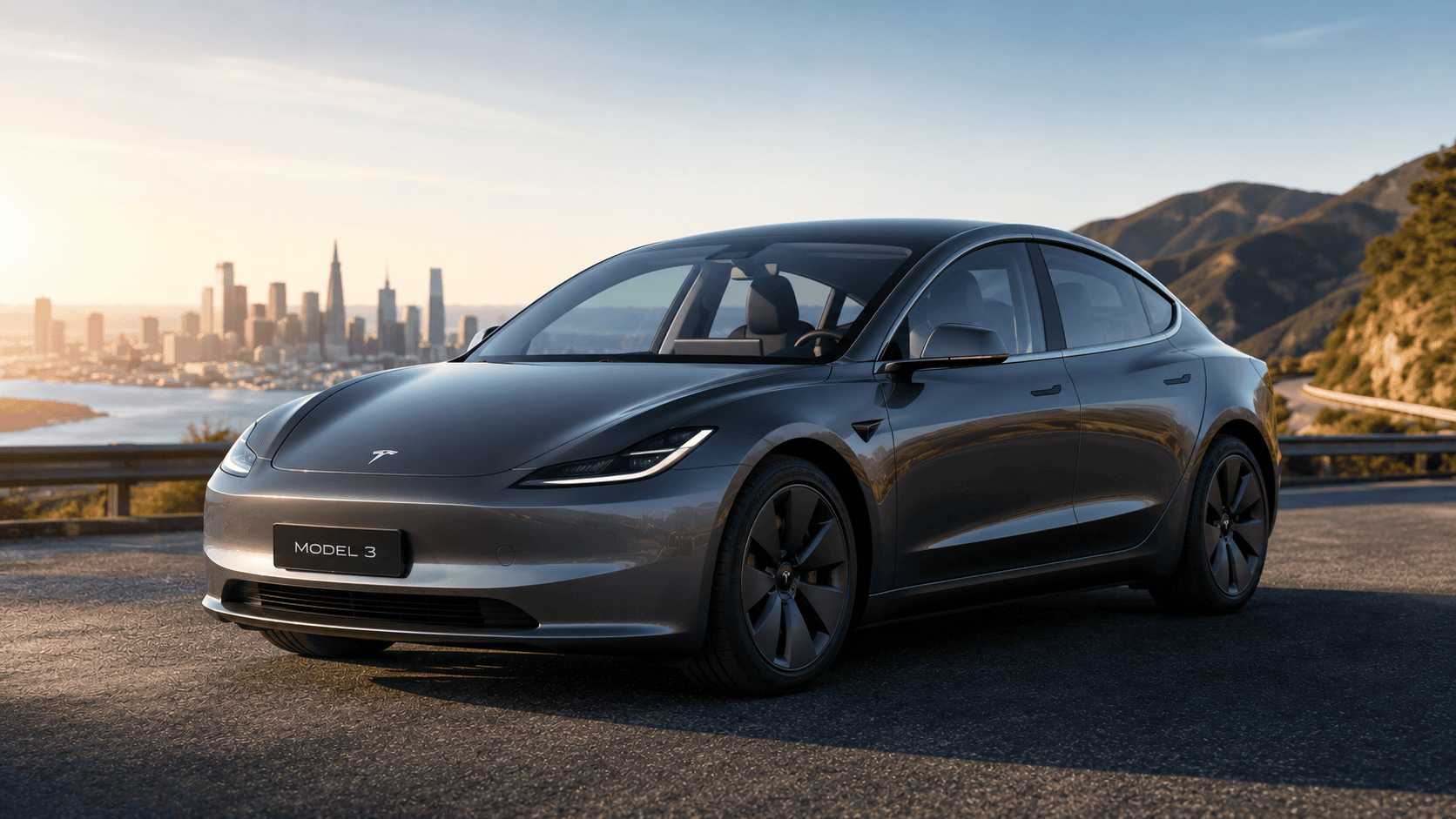
Tesla Model 3: specs, features and who it is for
Tesla’s Model 3 remains the company’s compact electric saloon, but the 2026 range is broader than the single Model 3 name suggests. In the United States, Tesla currently separates the line-up into the entry-level Model 3, two Model 3 Premium configurations and the range-topping Model 3 Performance.
The entry model uses rear-wheel drive and carries a 321-mile EPA range estimate, while the Premium Long Range Rear-Wheel Drive extends that figure to 363 miles. Premium All-Wheel Drive trades some range for dual-motor traction, and the Performance version prioritises acceleration and chassis hardware.
Tesla also simplified the name of its cheapest version during 2026. The car initially launched as the Model 3 Standard before Tesla renamed it simply Model 3 in June.
TechnologyBlog.co.za has not tested the current Tesla Model 3. This article therefore focuses on verified specifications, features and independent reporting rather than providing a driving or battery-life review.
Four versions cover efficiency, range and performance
The current US line-up starts with a rear-wheel-drive Model 3 rated for 321 miles, or about 517km, of EPA-estimated range. Tesla lists a 0–60mph time of 5.8 seconds and a maximum Supercharging rate of 225kW.
Above it sits the Model 3 Premium Long Range Rear-Wheel Drive. Its EPA range rises to 363 miles, approximately 584km, while the claimed 0–60mph time drops to 4.9 seconds. It also supports up to 250kW Supercharging.
The Premium Long Range All-Wheel Drive uses two motors and carries a 346-mile, or roughly 557km, EPA estimate. Tesla quotes 4.2 seconds from 0–60mph.
At the top, the Model 3 Performance has dual-motor all-wheel drive, 510hp, a 2.9-second 0–60mph figure and a top speed of 163mph, or about 262km/h. Its EPA range falls to 309 miles, around 497km, reflecting the different performance priorities and 20-inch wheels.
These EPA figures apply to the US configurations. Buyers comparing international Model 3 specifications should not mix EPA and WLTP ratings because the two test procedures produce different results.
Tesla Model 3 specifications
| Specification | Model 3 RWD | Premium LR RWD | Premium LR AWD | Performance |
|---|---|---|---|---|
| Drive | Rear-wheel drive | Rear-wheel drive | Dual-motor AWD | Dual-motor AWD |
| EPA range | 321 miles / ~517km | 363 miles / ~584km | 346 miles / ~557km | 309 miles / ~497km |
| 0–60mph | 5.8 sec | 4.9 sec | 4.2 sec | 2.9 sec |
| Peak power | Not published | Not published | Not published | 510hp |
| Max Supercharging | 225kW | 250kW | 250kW | 250kW |
| Range added in 15 min | Up to 170 miles | Up to 195 miles | Up to 185 miles | Up to 162 miles |
| Wheels | 18 or 19-inch | 18 or 19-inch | 18 or 19-inch | 20-inch Warp |
| Centre display | 15.4-inch | 15.4-inch | 15.4-inch | 15.4-inch |
| Rear display | No | 8-inch | 8-inch | 8-inch |
| Seating | 5 | 5 | 5 | 5 |
| Cargo | 24 cu ft | 24 cu ft | 24 cu ft | 24 cu ft |
Tesla quotes the fast-charging figures under specific constant-speed test conditions. Actual charging speed and range gained depend on battery temperature, state of charge, vehicle configuration, weather and the Supercharger being used.
Tesla does not publish a simple battery-capacity figure
One specification buyers will not find prominently displayed on Tesla’s current US Model 3 page is usable battery capacity in kilowatt-hours.
Tesla identifies the entry version as using a Standard Range battery and the higher variants as Long Range models, but its consumer specifications focus on vehicle range and charging performance instead of publishing a simple battery-capacity figure.
That makes it worth treating unofficial battery-capacity figures carefully. Independent publications may estimate the usable capacity, but those numbers should not be presented as Tesla specifications unless the manufacturer confirms them.
For most buyers, the official range and charging figures are more useful when comparing different Model 3 versions anyway.
Premium models add more cabin equipment
The entry-level Model 3 is not simply the Premium model with less range.
Tesla positions it as its more affordable specification and gives it a 15.4-inch central touchscreen, heated front textile seats, a heated steering wheel and a seven-speaker audio system.
Premium versions add more comfort and entertainment equipment. Tesla lists an 8-inch rear touchscreen, ventilated front seats, wireless charging for two phones and acoustic glass as part of the upgraded cabin.
The audio system also differs within the range. Comparison information lists seven speakers for the entry Model 3 and Premium rear-wheel-drive version, while Premium AWD and Performance receive 15 speakers and two subwoofers.
That makes the jump between versions about more than battery range or the number of driven wheels. Buyers should compare the interior equipment they actually want rather than assuming every Model 3 carries identical features.
Rear passengers get their own display on higher versions
The 8-inch rear touchscreen gives passengers access to entertainment and climate controls. Tesla also lists Bluetooth connectivity through the rear display on Performance configurations.
The main interface remains the 15.4-inch central screen. Tesla continues its minimalist approach by moving many conventional vehicle controls into the touchscreen rather than filling the dashboard with physical switches.
Whether that layout is preferable to traditional controls is subjective. Buyers considering a Model 3 should spend time with the interface rather than assuming a large touchscreen automatically makes the vehicle easier to operate.
Performance gets more than extra motor power
The Model 3 Performance is mechanically more specialised than the other variants.
Tesla equips it with an adaptive damping system that can alter the suspension response in real time. Drivers can select Standard or Sport ride and handling settings, while Track Mode changes the adaptive damping behaviour for circuit use.
Tesla also fits larger brake rotors, performance brake pads, revised springs, dampers, bushings and stabiliser bars. The exterior receives performance-specific aerodynamic components, including revised front and rear sections, a diffuser and carbon-fibre spoiler.
Inside, the Performance uses more heavily bolstered ventilated sport seats and carbon-fibre trim.
Those changes make the Performance model more than a software-unlocked acceleration upgrade. Buyers who mainly want long range may actually be better served by one of the Premium versions.
Supercharging reaches 250kW on the higher models
The Premium and Performance versions support maximum Supercharging rates of 250kW. The entry-level rear-wheel-drive model is rated at up to 225kW in the United States.
Tesla says the Premium Long Range RWD can add up to 195 miles, about 314km, of range in 15 minutes under its stated test conditions. Premium AWD reaches up to 185 miles, while Performance is rated at up to 162 miles in the same period.
Charging does not remain at its peak rate for an entire session. Battery temperature and state of charge influence the power the car can accept, and fast charging normally slows as the battery fills. Tesla’s navigation system can precondition the battery when routing to compatible fast chargers to prepare it for charging.
Home charging remains important for everyday EV ownership. Drivers who can regularly charge where they live or work will generally depend less heavily on public fast chargers.
The current Model 3 is 4.72 metres long
The standard and Premium versions measure approximately 4,720mm long, 1,850mm wide without mirrors and 1,440mm high, depending on configuration. The wheelbase measures 2,875mm and ground clearance is about 138mm.
Performance sits slightly lower at about 128mm of ground clearance and uses its own chassis setup.
Tesla lists seating for five adults and around 24 cubic feet of cargo capacity in the US specifications. International Tesla documentation lists cargo volume at approximately 682 litres.
The Model 3 therefore remains closer to a conventional compact executive saloon than an SUV. Buyers who need a higher seating position or more flexible family cargo space will probably find the Model Y more appropriate.
Driver assistance is not autonomous driving
Tesla equips the Model 3 with active safety features including Forward Collision Warning, Automatic Emergency Braking and Lane Departure Avoidance.
Traffic-Aware Cruise Control can maintain a selected speed and following distance from the vehicle ahead. Tesla’s current owner documentation states that all Tesla vehicles include this feature.
Autosteer can assist with keeping the car within a detected lane, although availability depends on model configuration, software, region and purchased options. Tesla explicitly describes Autosteer as a hands-on assistance feature and requires the driver to remain ready to take control.
The same distinction applies to Full Self-Driving (Supervised). Tesla describes it as an advanced driver-assistance system and states that none of these features makes the Model 3 fully autonomous or replaces the driver.
That qualification matters when discussing Tesla vehicles. “Full Self-Driving” is a product name, not evidence that the car can legally or safely operate as a completely autonomous vehicle without human supervision.
Software remains a major part of the Tesla experience
Model 3 owners can use Tesla’s mobile app for functions including remote access and climate control. Phone Key can unlock the vehicle when an authorised phone approaches, while Sentry Mode uses the vehicle’s cameras as part of its parked security system.
Tesla also distributes vehicle software updates remotely. As a result, available functions can change after purchase.
That flexibility also creates an important buying consideration. Some features depend on software version, vehicle hardware, subscriptions, market regulations or connectivity. Tesla notes that access to certain cellular-data features and third-party services can change.
Buyers should therefore verify the functions available on the exact car and in their country rather than relying on videos or specifications from another Tesla market.
What changed with the entry-level 2026 Model 3?
One of the biggest 2026 changes was Tesla’s introduction of a lower-specification entry variant.
Independent testing from Car and Driver found that the new rear-wheel-drive version removed or simplified some equipment to reduce its cost. Tesla subsequently dropped the “Standard” name and now markets it simply as Model 3.
The underlying strategy is straightforward: buyers can enter the Model 3 range without paying for all the Premium equipment, while the more expensive versions retain longer-range and higher-specification options.
That also makes trim selection more important than before. A generic reference to a “2026 Model 3” no longer tells a buyer enough about the car’s range, drive system, charging rate or cabin equipment.
What about the Tesla Model 3 in South Africa?
Tesla still does not appear to have established a conventional South African retail network comparable with its established vehicle markets.
Tesla’s current global locations list identifies Morocco as its African vehicle-market presence but does not list South Africa among countries with Tesla stores, service centres or Superchargers.
Tesla does maintain South African web infrastructure, including an en_ZA callback page, and it has also hosted a South African Model 3 Performance promotional contest. Those pages show ongoing local activity, but they do not by themselves establish nationwide retail availability, service coverage or a full vehicle launch.
Local reporting in March and April 2026 said Tesla had considered entering South Africa during 2026 but that those plans had been put on hold.
South African buyers should therefore verify official sales, servicing, warranty support and charging compatibility before considering an independently imported vehicle.
Who is the Tesla Model 3 for?
The entry Model 3 makes the most sense for drivers who want Tesla’s core electric-car and software experience without paying for every Premium cabin feature. Its 321-mile EPA estimate also means the entry specification is not necessarily a short-range city-only EV.
The Premium Long Range Rear-Wheel Drive is the range-focused option. Its 363-mile EPA estimate is the highest published figure in the current US Model 3 family.
The Premium Long Range AWD suits buyers who want extra traction and stronger acceleration while retaining more comfort equipment.
The Performance is for buyers who specifically want substantially quicker acceleration, adaptive suspension, upgraded brakes and the more aggressive chassis package. Its lower 309-mile EPA estimate means it is not automatically the best Model 3 simply because it sits at the top of the range.
For most buyers, choosing a Model 3 should therefore start with three questions: how much range is actually required, is all-wheel drive necessary, and are the Premium cabin features worth having? The most expensive version is not necessarily the one that best answers those questions.


