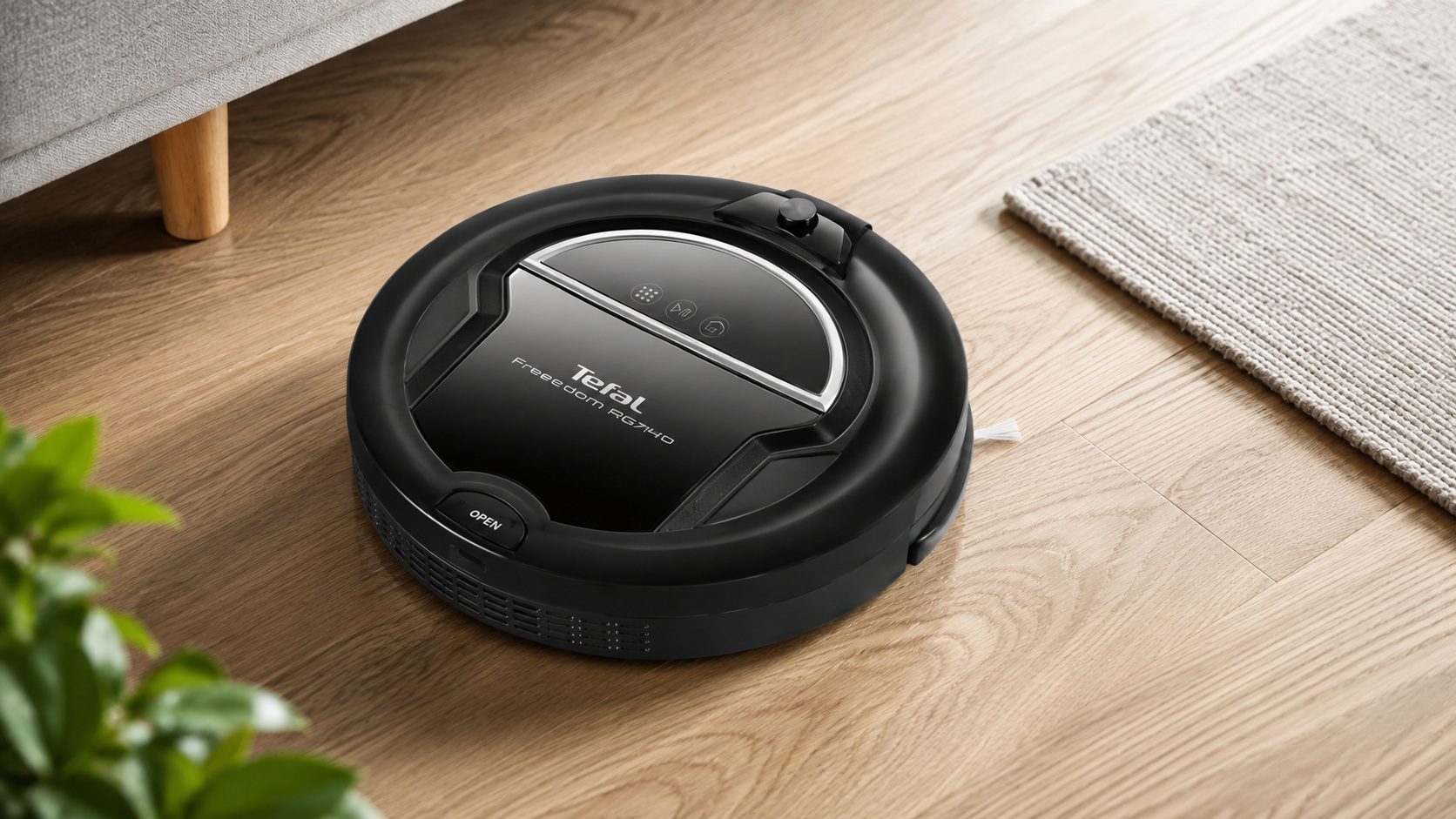
Tefal Freedom RG7140 keeps everyday floor cleaning simple
Robot vacuums increasingly arrive with cameras, LiDAR, artificial intelligence and elaborate mapping systems, but the Tefal Freedom RG7140 takes a much simpler approach.
Its job is straightforward: move around the home, collect everyday dust and debris, avoid common obstacles and return to its charging station when the battery runs low.
Tefal gives the robot four cleaning modes, infrared navigation, six drop sensors, a rotating central brush and a side brush for edges and corners.
It also offers up to 100 minutes of runtime.
For someone who wants a robot vacuum primarily for regular maintenance rather than advanced room mapping, that simplicity may be part of the appeal.
Tefal Freedom RG7140 uses a rotating central brush
The Tefal Freedom RG7140 uses a motorised rotating central brush as its main cleaning mechanism.
Tefal describes the brush as suitable for multiple floor surfaces, including carpet.
A lateral side brush works alongside it by sweeping dust and debris away from edges and corners towards the main cleaning path.
This is a familiar robot-vacuum design.
The central brush handles the bulk of the debris, while the side brush reaches areas that the round body cannot directly pass over.
The approach should suit everyday maintenance on surfaces such as tiles, laminate, parquet and vinyl, as well as compatible carpets.
Tefal advises that carpet thickness should remain below approximately 1.5cm for normal operation.
Four cleaning modes cover different situations
Tefal provides four cleaning modes.
Rather than relying on one general cleaning pattern for every situation, the modes allow the robot to adapt its movement according to the task.
Tefal positions them around general room cleaning, edge cleaning and more targeted cleaning around localised dirt or spills.
That gives users more control over how the robot approaches a room without turning the RG7140 into a complex mapping platform.
For quick everyday cleaning, the standard mode can handle general floor coverage.
A more focused mode can then be used when one area needs additional attention.
Infrared sensors handle navigation
The Tefal Freedom RG7140 uses infrared technology and frontal sensors to navigate around the home.
A physical bumper provides another layer of protection when the robot approaches walls, furniture or other objects.
This is a more traditional approach than the LiDAR and camera-based systems used on many newer premium robot vacuums.
The benefit is simplicity.
The drawback is that owners should not expect the same detailed room mapping or object recognition offered by more sophisticated navigation systems.
Tefal still recommends preparing the room before cleaning.
Cables, clothing and other items that could obstruct the robot should be removed from the floor.
Six drop sensors help protect it around stairs
The RG7140 includes six drop sensors designed to detect stairs and changes in floor level.
These sensors help prevent the robot from driving over an exposed edge.
Tefal does warn that drop sensors are not infallible.
Curved stair edges, rugs near stairs, slippery surfaces or objects blocking the sensors can reduce their effectiveness.
That is an important practical limitation.
Robot vacuums can automate part of the cleaning process, but owners should still inspect the environment before allowing them to operate unattended.
Up to 100 minutes of runtime
Tefal rates the Freedom RG7140 for up to 100 minutes of runtime.
The robot uses a lithium-ion battery.
A full charge takes approximately 4 hours and 30 minutes, according to Tefal.
That runtime should be enough for regular maintenance in many smaller and medium-sized homes, although the amount of floor actually covered will depend on the layout, obstacles and cleaning mode.
As with most battery-powered appliances, real-world runtime can also vary as the battery ages.
It returns to the charging dock automatically
The RG7140 uses a dedicated docking station for charging.
When battery power becomes low during a cleaning session, the robot can return to its base automatically.
Tefal also says the robot can resume cleaning once charging has been completed.
That reduces the need for owners to manually locate the vacuum and plug it in after every cleaning cycle.
Correct docking-station placement remains important.
Tefal recommends putting the charging base against a wall on a flat surface with enough clear space around it so that the robot can approach without obstruction.
The dust container holds 0.25 litres
The Tefal Freedom RG7140 has a 0.25-litre dust container.
That is relatively compact, which suits the robot’s low-profile design but also means regular emptying will be necessary.
Tefal recommends emptying the dust container after each use.
This is particularly important in homes with pets, hair or higher levels of dust.
A full container can reduce cleaning performance.
The filters also need regular attention.
Tefal recommends cleaning them at least once a week and replacing the fine-dust and foam filters approximately every six months.
Brush maintenance matters too
Like most robot vacuums, the RG7140 requires more maintenance than simply emptying the bin.
Hair and threads can wrap around the central brush and wheels.
Tefal recommends cleaning the central brush weekly and replacing side brushes approximately every six months.
The sensors and charging contacts should also be wiped regularly.
This is worth remembering when considering any robot vacuum.
Automation reduces the amount of floor cleaning you need to do manually, but it does not eliminate appliance maintenance.
Keeping brushes, sensors, filters and wheels clean is essential if the robot is expected to keep working reliably.
A Virtual Wall Sensor creates a cleaning boundary
Tefal includes support for a Virtual Wall Sensor.
This allows users to create a boundary that keeps the robot away from a particular area.
That could be useful near delicate furniture, cables, pet bowls or spaces where the vacuum regularly becomes trapped.
It also provides a basic alternative to the digital no-go zones available on robot vacuums with advanced mapping.
Instead of drawing a restricted zone inside an app, the user creates a physical or sensor-defined boundary.
It is a simpler system, but it achieves the same general goal: telling the robot where not to go.
Weekly scheduling reduces manual intervention
Tefal says the Freedom RG7140 can store seven cleaning programmes, allowing cleaning to be scheduled across the week.
This is one of the features that makes a robot vacuum useful rather than simply novel.
A household can schedule routine cleaning and allow the robot to run without needing to start it manually every day.
Regular cleaning can also prevent dust and hair from accumulating to the point where a much heavier manual clean becomes necessary.
The RG7140 is therefore best understood as a maintenance tool.
Tefal itself notes that robot vacuums do not completely replace conventional vacuum cleaners because some areas remain difficult for a robot to reach.
App information on Tefal’s documentation is unclear
There is one area where Tefal’s current documentation deserves caution.
The RG7140 product page focuses on onboard controls, scheduling and the Virtual Wall Sensor.
However, Tefal’s FAQ also refers to scheduling through a mobile application.
The product specification table does not clearly identify Wi-Fi, Bluetooth or another connectivity standard for this model.
TechnologyBlog therefore does not consider app connectivity confirmed from the available product documentation.
Until Tefal provides a clear model-specific connectivity specification, buyers should not assume the RG7140 includes app control simply because the FAQ mentions it.
It is intended for indoor dry vacuuming
The Tefal Freedom RG7140 is designed for indoor use.
It should not be used to vacuum liquids, wet surfaces, hot debris, fine construction dust, broken glass or flammable substances.
This also means it is a vacuum-only cleaning device.
There is no confirmed mopping system in the product specification.
That keeps its role straightforward.
It removes dry dust, hair and everyday debris from compatible indoor floors.
It works best as a maintenance cleaner
The strongest use case for the RG7140 is regular automated upkeep.
A robot vacuum can run frequently enough to collect dust, crumbs and hair before they accumulate.
That can make manual cleaning less frequent and less intensive.
However, Tefal explicitly recommends keeping another vacuum cleaner for surfaces or areas where the robot cannot clean effectively.
Stairs are the obvious example.
Upholstery, narrow gaps and areas blocked by furniture may also require manual cleaning.
The RG7140 should therefore complement conventional cleaning rather than replace it entirely.
Tefal Freedom RG7140 specifications
| Specification | Tefal Freedom RG7140 |
|---|---|
| Product type | Robot vacuum cleaner |
| Reference | RG7145RH |
| Cleaning modes | 4 |
| Main brush | Rotating central hair brush |
| Side brush | Yes |
| Navigation | Infrared / frontal sensors |
| Drop protection | 6 drop sensors |
| Runtime | Up to 100 minutes |
| Battery | Lithium-ion |
| Charging time | Approx. 4h30 |
| Charging | Docking station |
| Automatic return to dock | Yes |
| Dust container | 0.25L |
| Sound level | 70dB(A) |
| Virtual Wall Sensor | Supported |
| Weekly programmes | Up to 7 |
| Approximate diameter | 33.5cm |
| Approximate height | 9.6cm |
| Indoor use | Yes |
| Wet cleaning | No confirmed mopping function |
Who is the Tefal Freedom RG7140 for?
The Tefal Freedom RG7140 suits someone who wants regular automated floor cleaning without needing advanced mapping or artificial intelligence.
Its four cleaning modes, infrared navigation and automatic charging provide the core functions expected from a robot vacuum.
It may work particularly well in relatively uncomplicated home layouts where the robot can move freely between rooms.
The 9.6cm height also allows it to pass beneath some furniture that would be awkward to clean underneath manually.
However, homes with many cables, cluttered floors or complicated layouts may require more preparation before each cleaning cycle.
Is the Tefal Freedom RG7140 still worth considering?
The Tefal Freedom RG7140 represents a simpler generation of robot vacuum technology.
It does not advertise sophisticated LiDAR mapping, object recognition or AI navigation.
Instead, Tefal concentrates on the essentials: automatic vacuuming, four cleaning modes, obstacle sensing, stair detection, weekly scheduling and up to 100 minutes of battery life.
That simplicity can still work well when the goal is everyday maintenance.
The RG7140 will not remove the need for manual cleaning entirely, and its 0.25-litre dust bin requires regular attention.
However, for households that want a robot to keep everyday dust and hair under control between deeper cleans, the Freedom RG7140 still covers the fundamentals.


