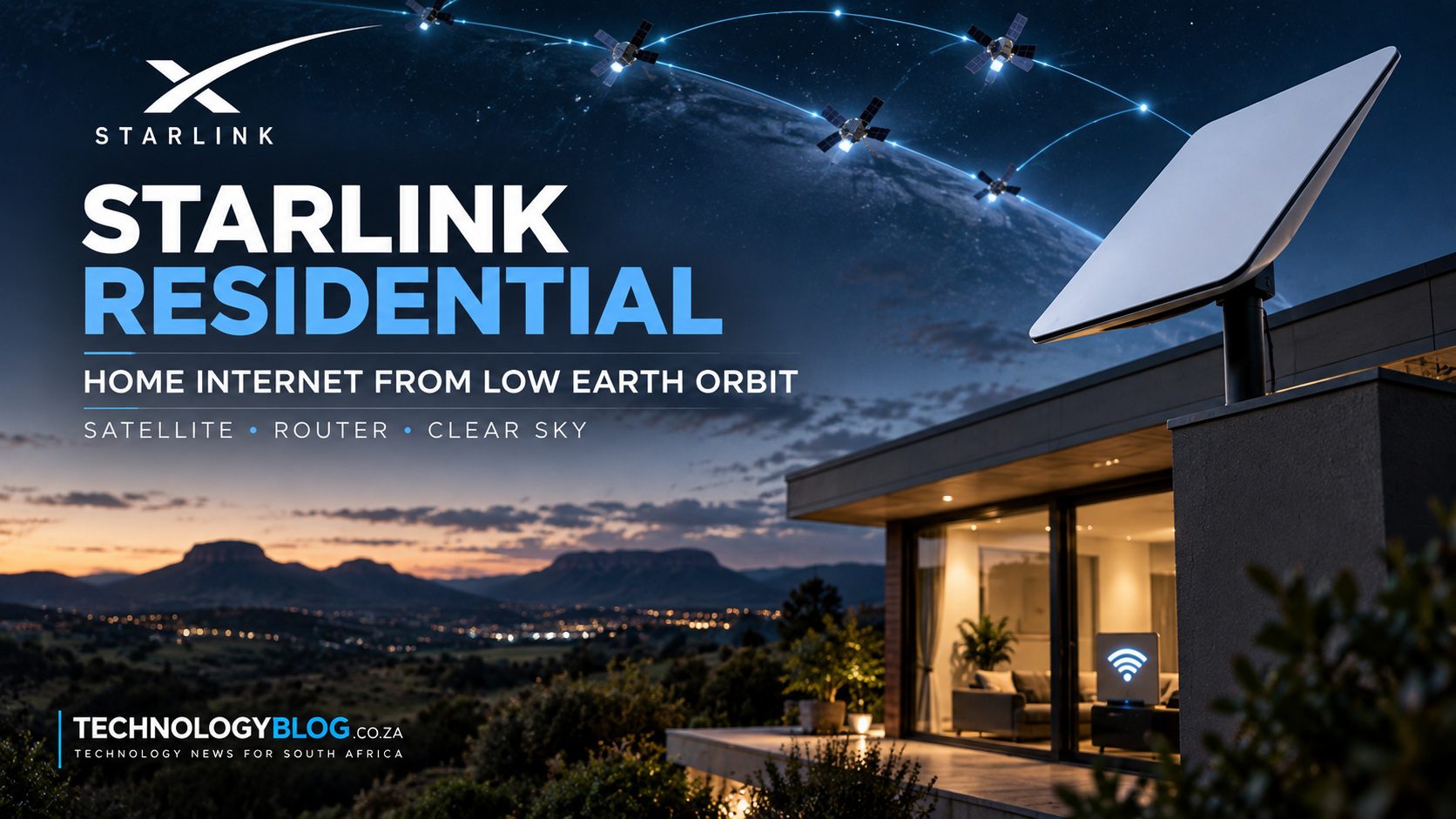
Starlink Residential brings low-Earth-orbit broadband to homes fibre cannot easily reach
Starlink Residential is SpaceX’s fixed-location satellite broadband service for households. The kit combines a satellite terminal, router and power equipment, while the network uses a large constellation of satellites in low Earth orbit.
Low orbit helps reduce the propagation delay associated with traditional geostationary satellite internet, but it does not remove latency or congestion. Starlink’s own specifications describe expected performance ranges rather than guaranteed fixed speeds.
TechnologyBlog.co.za has not independently tested the current Starlink Residential service. This article therefore focuses on Starlink’s published service characteristics and limitations rather than a performance review.
Residential is a fixed service, not the same as Roam
Residential is intended for use at a registered service location. Starlink offers separate mobility-oriented products for people who want to travel with a terminal or operate in supported mobile scenarios.
That distinction affects network priority, terms of service and hardware choices. Users should not assume a Residential subscription automatically provides the same rights as a mobile plan.
Plan names also differ across markets. Some countries use Residential and Residential Lite, while others have introduced tiers such as Residential Max.
What speeds should households expect?
Starlink’s legal performance documents list fixed Residential service with expected download speeds that can fall broadly in the tens to low hundreds of megabits per second, with uploads lower and latency typically measured in tens of milliseconds.
Selected markets now advertise higher-priority Residential Max service with typical download speeds reaching 400Mbps or more. That does not make 400Mbps a universal Starlink Residential specification.
Location, time of day, network load, obstruction and the plan’s traffic priority can all affect performance. Starlink explicitly states that speeds and uninterrupted service are not guaranteed.
The dish needs sky, power and careful placement
The terminal needs a sufficiently clear view of the sky. Trees, buildings and other obstructions can interrupt the path to satellites and cause short service dropouts.
Unlike passive fibre entering a home, the satellite terminal also consumes electrical power. That matters during load-shedding or off-grid use because maintaining internet requires backup power for both the dish and router.
The router experience depends on the hardware generation supplied in a particular market. Starlink has continued revising its terminals and Wi-Fi equipment, so buyers should check the exact kit included with their order.
South African availability needs regulatory verification
South African readers should verify current official availability rather than relying on reports from neighbouring countries or imported kits. Satellite service requires the appropriate local authorisations and spectrum arrangements.
Starlink has publicly expressed interest in the South African market, while local satellite regulations have continued to develop. An official service launch should be confirmed through Starlink’s own ordering system and South African regulatory notices.
Using a foreign account or imported terminal is not the same thing as an officially supported South African Residential service.
Who is Starlink Residential for?
The clearest use case is a home outside practical fibre or high-quality fixed-wireless coverage. It can also provide a second connectivity path for households that value resilience and can justify the extra equipment and power requirements.
Where reliable fibre is already available, fibre can still offer advantages in consistency, latency, local support and power consumption. Starlink’s appeal is strongest where terrestrial infrastructure is the problem it solves.
Starlink Residential overview
| Specification | Details |
|---|---|
| Service type | Fixed satellite broadband |
| Network | Low-Earth-orbit satellite constellation |
| Typical latency | Usually tens of milliseconds on land; varies by region |
| Download performance | Varies by plan and market |
| Upload performance | Lower than download and plan-dependent |
| Data | Often unlimited on current Residential tiers, subject to local terms |
| Required hardware | Starlink terminal, router and power equipment |
| Installation requirement | Clear view of the sky |
| Mobility | Residential is intended for a fixed service location |
How to decide whether it fits
A household should compare official availability, installation position, backup-power needs, latency-sensitive use, local support and the quality of any terrestrial alternative. It is usually better to judge the service against a real scenario than against a long list of features. Ask what happens when a booking changes, a connection drops, a seller disappoints, an account is locked or a household needs support. Edge cases reveal the quality of a service more clearly than the sign-up flow.
The South African context
South African readers should confirm official local service status and regulatory support through Starlink and local authorities rather than relying on imported kits or neighbouring-country accounts. Local availability, payments, consumer-protection rules, connectivity and support routes can differ markedly from the market where a global company is headquartered. TechnologyBlog.co.za therefore treats regional information as part of the product rather than an afterthought.
What could change next
The broader trend around Starlink Residential is convergence: platforms keep adding AI, payments, identity, discovery or adjacent services. That can make the product more useful, but it can also increase lock-in. Users should periodically review permissions, subscriptions and alternatives instead of assuming the service they joined years ago is still the same product.
The service is more than the app screen
a fixed satellite-broadband service built around a low-Earth-orbit constellation and a user terminal with a clear view of the sky. Its significance is that geography matters less than it does for fibre trenching, although satellite capacity, obstruction and power remain physical constraints. Platform services sit between users and a network of infrastructure, content, suppliers or other participants, which means the experience can change by location and by transaction. Speeds are variable, outages can occur when the sky view is obstructed, and the terminal and router need continuous electricity. That is why a feature seen in one country or account should not automatically be described as universal.
Availability and terms are part of the product
Digital services can change more quickly than hardware. Plans are renamed, entitlements move between tiers, catalogue rights expire and local regulations alter what can be offered. Readers should therefore check the current terms at the moment of purchase or booking. A useful technology article can explain the model and the important trade-offs, but it should not freeze a dynamic service into a permanent specification.
Trust, identity and recovery deserve attention
A platform that holds bookings, messages, payments or personal history becomes important infrastructure for the user. Strong passwords, multi-factor authentication where available, device security and account-recovery details are therefore practical product features, not administrative chores. Users should also understand what information is public, what is shared with transaction partners and which actions are reversible.
