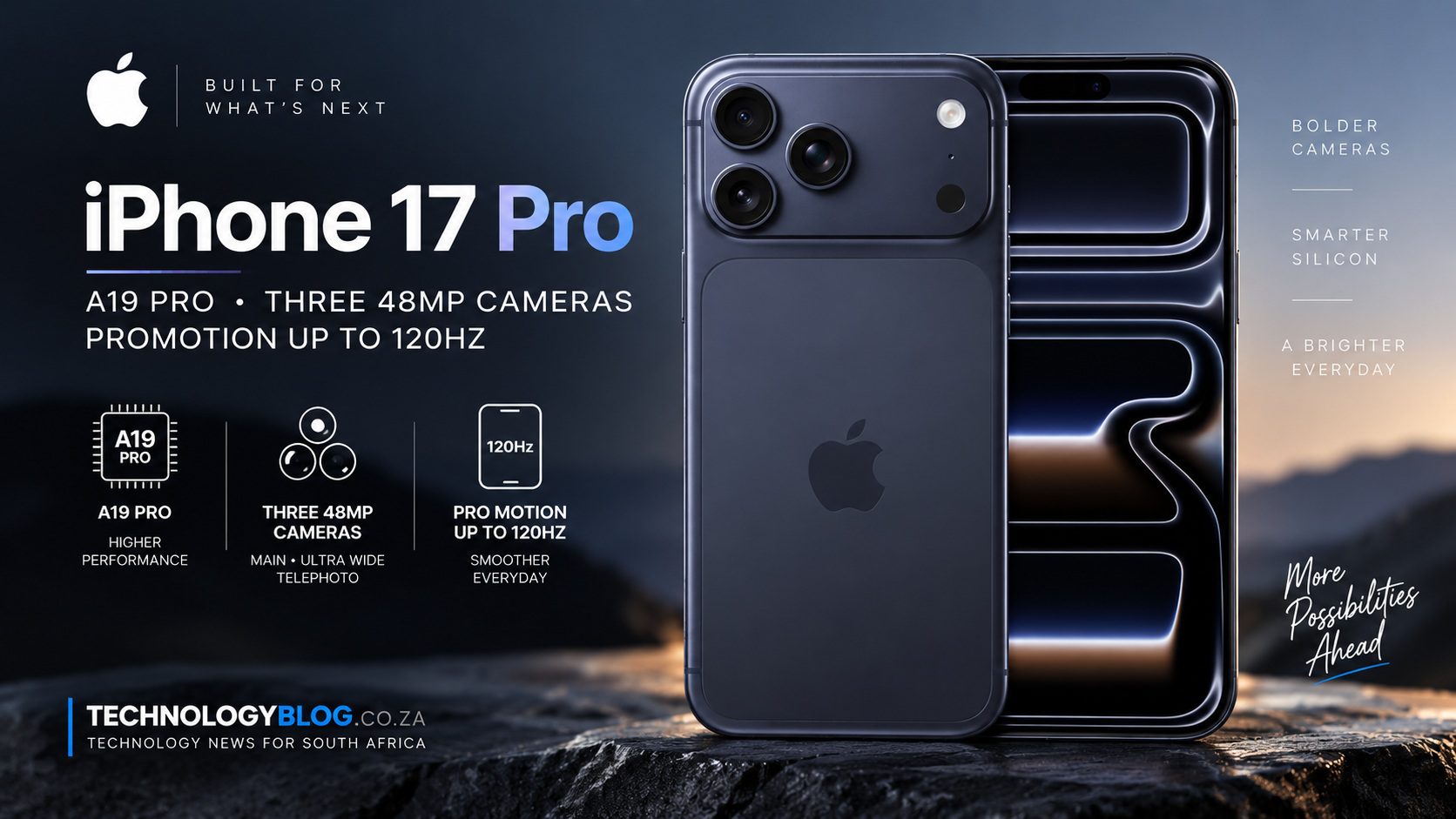
iPhone 17 Pro puts three 48MP cameras and A19 Pro into Apple’s smaller flagship
Apple’s iPhone 17 Pro is the smaller of the company’s two Pro smartphones, but its hardware is anything but cut down. It combines a 6.3-inch ProMotion OLED display with the A19 Pro processor, three 48MP rear cameras and storage options reaching 1TB.
Apple introduced the iPhone 17 Pro on 9 September 2025, with availability beginning on 19 September 2025. The generation also changed the physical construction: Apple moved to a heat-forged aluminium unibody and integrated a vapour chamber to improve heat transfer during sustained workloads.
TechnologyBlog.co.za has not independently tested the iPhone 17 Pro. This article therefore focuses on Apple’s verified specifications rather than making conclusions about camera quality, battery endurance or sustained performance.
A19 Pro combines CPU, GPU and on-device AI hardware
The iPhone 17 Pro uses Apple’s A19 Pro system-on-chip. It includes a six-core CPU with two performance cores and four efficiency cores, a six-core GPU with Neural Accelerators and a 16-core Neural Engine.
Hardware-accelerated ray tracing is also supported. That gives game developers more graphics capability to work with, although the final experience still depends on how individual titles are built and optimised.
The Neural Engine and GPU accelerators also support machine-learning workloads and Apple Intelligence features. Availability can still vary according to software version, language and region.
The 6.3-inch display reaches 120Hz
The phone uses a 6.3-inch Super Retina XDR OLED display with a resolution of 2622 × 1206 pixels at 460 pixels per inch.
ProMotion provides adaptive refresh rates up to 120Hz. Apple lists 1,000 nits of typical maximum brightness, 1,600 nits for HDR highlights and up to 3,000 nits outdoors.
Ceramic Shield 2 protects the front, while Ceramic Shield also covers the rear. Apple rates the phone at IP68 under IEC 60529.
All three rear cameras use 48MP sensors
The rear camera array combines a 48MP Fusion Main camera, a 48MP Fusion Ultra Wide and a 48MP Fusion Telephoto.
The telephoto lens provides a 100mm-equivalent 4x view. Apple also offers a 12MP, 200mm-equivalent 8x “optical-quality” mode using the 48MP telephoto sensor and its image-processing pipeline.
That wording matters. The 8x mode should not be confused with a second native 8x optical lens. It is an optical-quality crop derived from the telephoto sensor.
Video features include ProRes RAW, Apple Log 2 and genlock support, which target more advanced production workflows rather than ordinary casual recording.
iPhone 17 Pro specifications
| Specification | iPhone 17 Pro |
|---|---|
| Display | 6.3-inch Super Retina XDR OLED |
| Resolution | 2622 × 1206 |
| Refresh rate | Adaptive up to 120Hz |
| Processor | Apple A19 Pro |
| CPU | 6-core |
| GPU | 6-core with Neural Accelerators |
| Neural Engine | 16-core |
| Main camera | 48MP Fusion Main |
| Ultra-wide camera | 48MP Fusion Ultra Wide |
| Telephoto camera | 48MP Fusion Telephoto, 4x |
| Optical-quality telephoto option | 8x / 200mm equivalent |
| Storage | 256GB, 512GB, 1TB |
| Wireless | 5G, Wi-Fi 7, Bluetooth 6 |
| Water and dust resistance | IP68 |
| Weight | 204g |
The smaller Pro still targets demanding users
Apple rates the iPhone 17 Pro for up to 31 hours of video playback and up to 28 hours of streamed video playback. Those are controlled manufacturer figures rather than a TechnologyBlog.co.za battery test.
Apple says a compatible 40W or higher USB-C adapter can charge the battery to 50% in about 20 minutes. MagSafe can reach 50% in about 30 minutes with a suitable 30W or higher adapter and MagSafe Charger.
A useful internal step-down exists in Apple’s own range
Readers who do not need the full Pro camera system can also read TechnologyBlog.co.za’s coverage of the iPhone 17e. The point is not to declare a winner, but to show where Apple separates its mainstream and Pro hardware.
Who is the iPhone 17 Pro for?
The iPhone 17 Pro is aimed at buyers who want Apple’s higher-end camera, display and graphics features without moving to the larger Pro Max chassis.
Photographers and video creators are the obvious audience for the expanded camera system and ProRes tools. Gamers may value the A19 Pro GPU and thermal design, while long-term buyers may care more about Wi-Fi 7, Bluetooth 6 and higher storage options.
Primary sources: Apple iPhone 17 Pro technical specifications and Apple’s launch announcement.
What South African users should consider
South African users should also verify local carrier features, eSIM support where relevant, repair options and storage needs before committing to a device likely to be kept for several years. Electricity, network quality, repair logistics and importer support can all change the practical ownership experience. That context does not make a global specification less relevant; it changes which parts of the specification deserve the most weight.
Who gets the most value
The best customer for Apple iPhone 17 Pro is the person or team that can use its distinctive capabilities repeatedly. Premium features are easiest to justify when they remove a recurring bottleneck, improve a professional workflow or meaningfully extend useful life. If those features are only impressive on paper, a simpler product can be the more rational choice without being technically superior.
A specification only matters inside the complete product
a compact flagship phone that combines Apple’s Pro camera stack, A19 Pro silicon and a high-refresh display. Its appeal comes from the interaction between camera hardware, computational photography, video formats, thermal design and long-term software support rather than from megapixels alone. A good buying decision starts by asking how the specification changes the user’s actual workflow rather than whether it is the largest number on a comparison sheet. Camera results depend on lens choice, light, processing and user technique, while sustained performance depends on heat and battery state. This is especially important for premium hardware because compromises often move from raw performance into heat, battery, acoustics, dimensions or upgradeability.
Real-world performance is a system property
The same processor, storage device, battery chemistry or radio can behave differently depending on firmware, cooling and workload. Short benchmarks can favour burst performance, while long tasks expose thermal limits. Wireless results depend on the network. Camera results depend on processing and conditions. For that reason, manufacturer specifications are useful boundaries, not substitutes for independent testing. TechnologyBlog.co.za has not treated those published numbers as a performance review.
The ecosystem can matter as much as the hardware
Ports, accessories, repair options, software updates, cloud services and compatibility all affect the useful life of a device. A product that looks strong on launch day can become frustrating if replacement parts are scarce or a required accessory is proprietary. Conversely, mature software and broad peripheral support can make modest-looking hardware much easier to live with. That surrounding ecosystem belongs in the buying decision.
What to verify before buying
A buyer should decide whether ProRes workflows, telephoto reach, 120Hz display behaviour and higher storage capacities justify the Pro model for their own use. Buyers should also check the exact regional configuration because storage, memory, radios, displays or included accessories can differ between markets. Retail listings often shorten model names, so the model code is the safer reference where available.