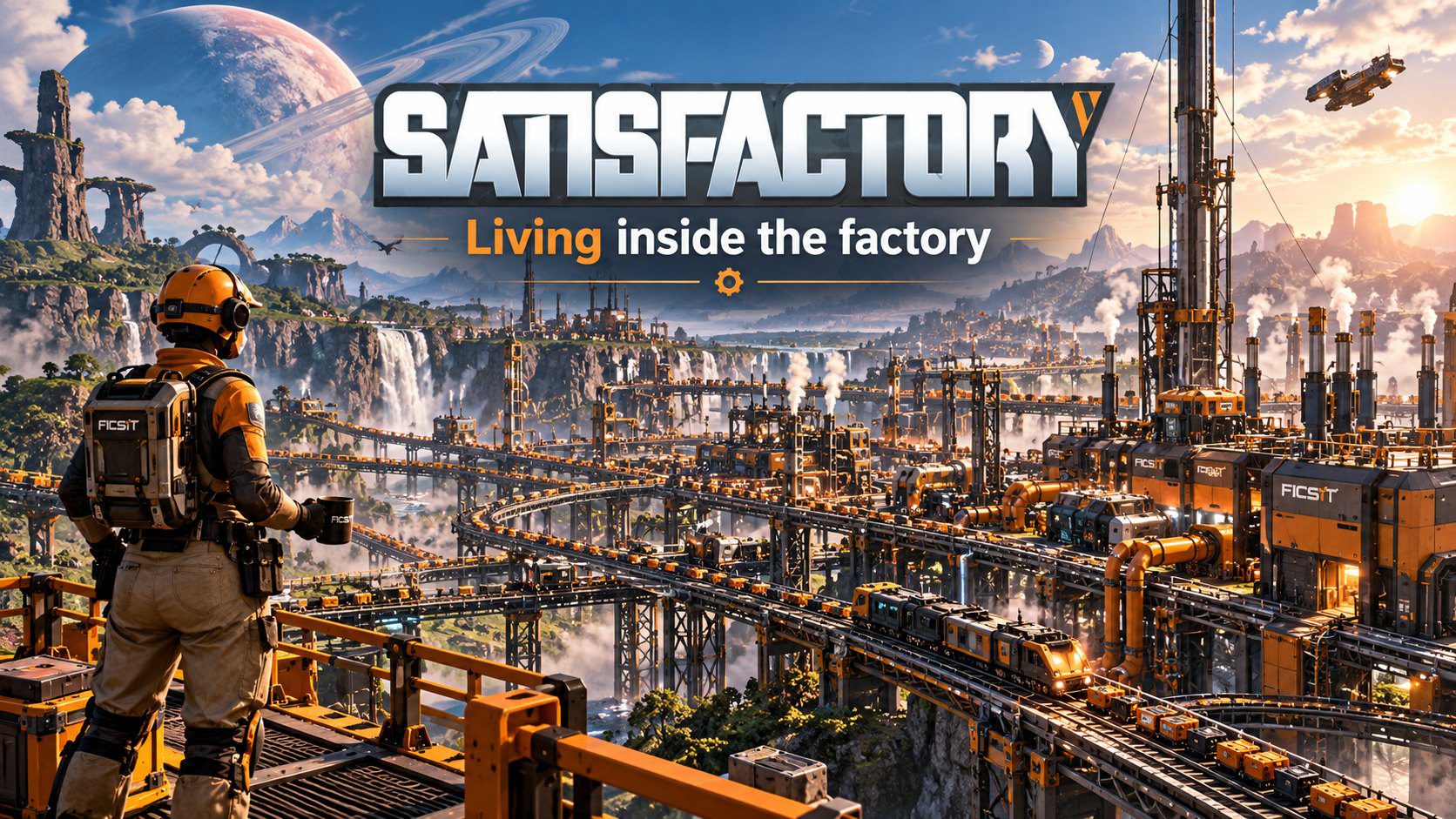
Satisfactory makes you live inside the factory you build
There comes a moment in Satisfactory when you stop seeing individual machines.
You see a factory.
Conveyor belts cross overhead.
Smelters glow somewhere below.
Pipes disappear through walls.
Trains move resources between distant industrial sites.
Power lines stretch towards another section of the complex.
Somewhere inside all of it, thousands of components are moving between machines without the player touching them.
Then you notice one conveyor belt carrying almost nothing.
Something is wrong.
Now you need to find it.
Coffee Stain Studios’ Satisfactory takes the familiar satisfaction of factory automation and places the player directly inside the machine.
You do not watch the factory from above.
You walk through it.
That changes everything.
Satisfactory begins with an empty alien world
The player arrives on the alien planet MASSAGE-2(A-B)b as a Pioneer working for FICSIT.
The corporate objective is straightforward enough.
Exploit the planet’s natural resources, build increasingly sophisticated production infrastructure and contribute components towards Project Assembly.
The reality quickly becomes more complicated.
At first, the landscape is largely untouched.
Then the machines arrive.
A miner appears over a resource node.
A smelter follows.
Then constructors.
Conveyor belts connect them.
Power infrastructure spreads.
Another production line appears.
Eventually, the natural landscape contains an enormous industrial complex.
You built all of it.
First-person factory building changes the scale
Satisfactory’s perspective is one of its defining characteristics.
A factory viewed from above can appear organised and manageable.
A factory viewed from the ground feels enormous.
Machines tower over the player.
Conveyor belts stretch into the distance.
Multi-storey industrial buildings can become large enough that navigating them becomes a challenge of its own.
That physical scale makes construction feel different.
Players need to think about where they will walk.
How will they reach another floor?
Where should belts cross?
Should production expand horizontally across the landscape or vertically into another level?
Suddenly architecture matters alongside efficiency.
Conveyor belts become part of the landscape
The conveyor belt is one of Satisfactory’s most important tools.
Resources need to move between machines.
Miners feed raw materials into production.
Smelters create processed resources.
Constructors and assemblers turn those materials into increasingly complicated components.
Every step needs logistics.
Initially, that might involve a simple belt connecting two machines.
Later, factories can contain enormous networks carrying different materials between floors, buildings and production areas.
Belts split.
They merge.
They climb.
They cross.
Some disappear through walls.
Others stretch across the landscape.
Eventually, the conveyor system becomes part of the architecture.
Every new product creates another production problem
Satisfactory’s progression continually introduces more complicated manufacturing requirements.
Early components need relatively straightforward resources.
Later products require materials produced through several previous manufacturing stages.
That means a shortage at the beginning of a production chain can affect something much further down the line.
Perhaps the final assembler is not receiving enough components.
The assembler itself may be fine.
The problem could be several production stages away.
Maybe a constructor is underfed.
Perhaps the miner cannot provide enough ore.
Maybe the belt lacks sufficient capacity.
The player follows the chain backwards until the bottleneck appears.
Then comes the satisfying part.
Fix it.
Power becomes another production chain
Machines need electricity.
As the factory grows, power consumption rises.
That makes electricity another infrastructure problem.
Expanding production without expanding power generation can eventually push the electrical system beyond its limits.
The factory stops.
Everything goes quiet.
That is rarely convenient.
Players therefore need to think about power before the next industrial expansion rather than after it.
As additional technologies become available, power generation itself becomes increasingly sophisticated.
Eventually, the energy network supporting the factory can become an enormous project in its own right.
Vertical construction changes factory design
Satisfactory does not require factories to remain on one flat level.
Players can build upwards.
That sounds like a simple feature.
In practice, it transforms factory planning.
One floor can handle smelting.
Another might produce basic components.
Higher levels can assemble increasingly complicated products.
Conveyor lifts move resources vertically.
Walkways and stairs connect player spaces.
Walls and foundations turn collections of machines into actual industrial buildings.
The result can resemble a functioning piece of architecture rather than machinery scattered across the landscape.
Of course, players are equally free to create complete industrial chaos.
Both approaches can work.
FICSIT appears considerably more concerned about productivity than aesthetics.
Exploration remains part of the factory
Satisfactory is not played entirely inside an industrial complex.
The world itself needs exploring.
Resource nodes are spread across a roughly 30km² alien environment containing different landscapes, creatures and useful materials. Steam Store
That forces players away from the safety of established production areas.
New resources might exist kilometres away.
Hard drives found at crash sites can provide valuable alternate recipes.
Other materials contribute towards research.
The world therefore creates reasons to leave the factory.
Then those discoveries create reasons to expand it.
Exploration and automation continually feed each other.
Distance eventually becomes a logistics problem
A nearby iron deposit is easy to connect.
A valuable resource on the other side of the map is not.
Satisfactory gradually introduces transportation options capable of supporting larger production networks.
Trucks can automate routes.
Trains can move large quantities of material between distant stations.
Drones provide another logistics option later in progression.
Pipes move fluids between production systems.
Each transportation method creates different planning challenges.
A remote mining operation can eventually become one node in a factory network spanning enormous sections of the world.
The factory stops being one building.
It becomes infrastructure.
Trains can transform the industrial network
Railways are particularly effective at changing how players think about distance.
Instead of running conveyor belts across kilometres of terrain, resources can move between specialised industrial locations.
One region might concentrate on extracting and processing a particular material.
Another can handle advanced manufacturing.
Trains connect them.
That encourages players to think about the world as an industrial network.
Railways also become physical structures that need space.
Stations need planning.
Tracks cross difficult terrain.
Routes need to connect.
Suddenly, logistics and architecture intersect again.
Blueprints make repeating good ideas easier
Large factories require repeated structures.
Satisfactory’s blueprint system allows players to create reusable designs.
That changes the scale of construction.
Instead of manually rebuilding the same arrangement repeatedly, players can develop a useful module and reproduce it.
Blueprints do not remove planning.
They reward it.
A poorly designed production block becomes a poorly designed production block that can now be duplicated very quickly.
A good design becomes infrastructure.
The player gradually develops their own construction language.
The factory does not have to be beautiful
There is no requirement that a Satisfactory factory looks good.
Machines can sit outside.
Belts can travel everywhere.
Production lines can cross one another in ways that would make an industrial engineer reconsider their career.
If the components arrive where they need to go, the system works.
However, Satisfactory provides enough building tools to make architecture another objective.
Walls, foundations, windows and decorative elements allow players to turn industrial systems into carefully designed structures.
That creates two different optimisation problems.
Make the factory efficient.
Then make it look intentional.
Some players will care about both.
Others will construct an enormous conveyor-belt nightmare and proudly call it finished.
Project Assembly gives the factory a purpose
The 1.0 release gave Satisfactory’s progression a more complete objective through Project Assembly.
Players produce increasingly advanced components and send them through the Space Elevator.
Each phase pushes production requirements further.
Eventually, the factory needs increasingly advanced technologies and manufacturing chains.
Version 1.0 added the final Project Assembly phase alongside Tier 9 technology.
It also introduced advanced systems including Portals, the Converter, Quantum Encoder and Dimensional Depot. coffeestain.com
That gives the enormous production network an ultimate purpose beyond simply producing larger quantities for their own sake.
Although, realistically, producing larger quantities for their own sake remains remarkably entertaining.
The Dimensional Depot removes some logistical frustration
One particularly useful 1.0 addition was the Dimensional Depot.
The system allows resources placed into the depot to become accessible remotely for construction purposes, reducing some of the need to repeatedly return to storage locations while building elsewhere. coffeestain.com
That addresses a specific problem created by Satisfactory’s scale.
Building an enormous factory requires enormous quantities of materials.
Forcing players to repeatedly travel across the map simply because they ran out of concrete can interrupt the construction process.
The Dimensional Depot helps the player concentrate on building.
It is another example of automation eventually extending into the player’s own workflow.
Multiplayer makes the factory a shared problem
Satisfactory supports cooperative multiplayer and cross-platform multiplayer on its current Steam listing. Steam Store
That changes factory construction substantially.
One player can work on power.
Another can expand resource extraction.
Someone else can build railway infrastructure.
Another player can spend several hours making one building unnecessarily attractive.
Eventually, those projects connect.
The result can become significantly larger than something one person would reasonably construct alone.
It can also become harder to understand.
Finding an inexplicable conveyor belt and asking who built it becomes another form of factory archaeology.
Satisfactory did not stop at 1.0
Version 1.0 launched on 10 September 2024 after more than five years of Early Access development. Coffee Stain said the game had already sold more than six million copies during that period. coffeestain.com
Development continued afterwards.
Update 1.1 arrived in June 2025 with controller support, Photo Mode, crash-site dismantling and other additions. update4.satisfactorygame.com
Then Update 1.2 launched on 2 June 2026.
The update introduced rain, vehicle reworks, fluid stations and trucks, resource-node randomisation and multipliers alongside additional changes. coffeestain.com
Satisfactory therefore remains an actively developed factory platform in 2026 rather than a game Coffee Stain abandoned once the 1.0 milestone arrived.
Satisfactory makes inefficiency visible
One of the pleasures of Satisfactory comes from simply looking at something you built.
A production line begins with raw material.
You can physically follow it.
Ore moves along a belt.
Machines process it.
Components travel somewhere else.
Another machine consumes them.
The final product emerges.
When everything operates smoothly, the movement itself communicates that the system works.
When something stops moving, the problem becomes visible.
A stationary belt is suspicious.
An empty machine means something upstream is wrong.
A container overflowing with resources suggests something downstream cannot consume them quickly enough.
The factory talks through movement.
Players learn to read it.
Why Satisfactory remains so satisfying
Satisfactory turns automation into a physical place.
The player does not simply design production.
They inhabit it.
You walk through the factory.
You climb it.
You travel between distant industrial sites.
You ride the trains.
You watch components move through machines you placed yourself.
Eventually, the landscape becomes a record of hundreds of decisions.
Some were carefully planned.
Others were temporary solutions that somehow became permanent infrastructure.
TechnologyBlog’s Factorio profile explores another approach to the endless problem of factory optimisation.
Satisfactory’s particular strength comes from making industrial scale tangible.
A production network that once existed in your head now stretches across the horizon.
Then you notice something.
One belt is empty.
One machine has stopped.
One production line needs more resources.
You were going to stop playing.
But the factory needs fixing first.


