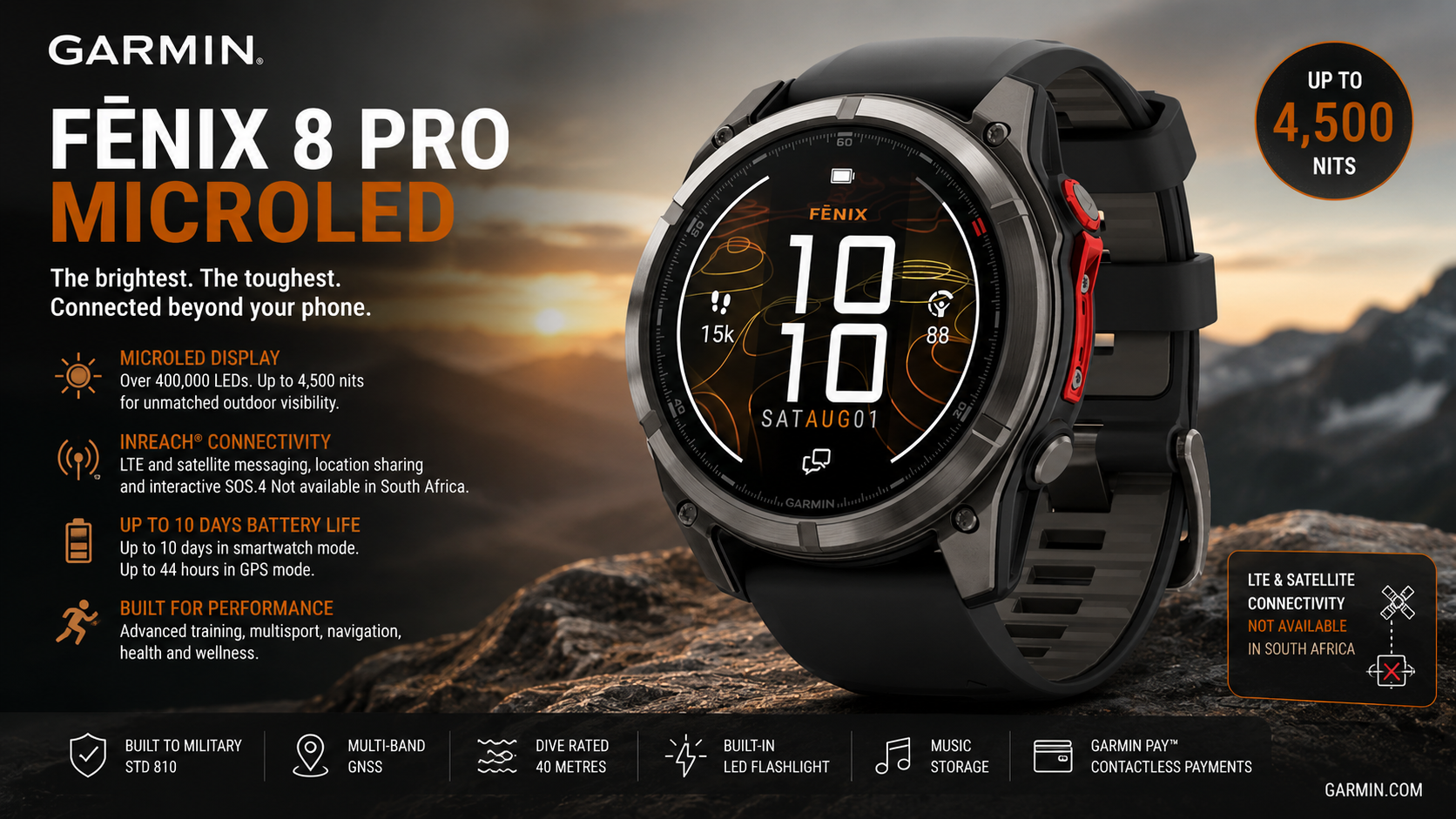
Garmin fenix 8 Pro MicroLED brings a brighter display, but South Africa misses a major feature
The Garmin fenix 8 Pro MicroLED takes Garmin’s flagship outdoor smartwatch in two new directions: a MicroLED display capable of reaching a claimed 4,500 nits and built-in inReach connectivity designed to keep users connected without their phones.
The 51mm watch combines more than 400,000 individual LEDs in its MicroLED touchscreen with Garmin’s established multisport, navigation, training, health and diving features.
There is a significant catch for South African users.
Garmin states that the fēnix 8 Pro’s LTE network coverage and satellite connectivity are not available in South Africa. That means one of the biggest differences between the Pro and standard fēnix 8 cannot currently be used locally.
Garmin fenix 8 Pro MicroLED introduces a new display
The Garmin fenix 8 Pro MicroLED uses a 1.4-inch MicroLED touchscreen rather than the AMOLED display found on other versions of the fēnix 8 Pro.
Garmin says the screen contains more than 400,000 individual LEDs and can reach 4,500 nits of brightness.
The company introduced it in September 2025 as its first smartwatch with a MicroLED display.
MicroLED differs from a conventional LCD because individual pixels produce their own light rather than relying on a separate backlight.
That makes it conceptually closer to OLED. However, MicroLED uses microscopic inorganic LEDs rather than OLED’s organic light-emitting materials.
For a watch designed to spend significant time outdoors, Garmin is primarily using the technology to deliver high brightness, wide viewing angles and improved visibility in direct sunlight.
Outbound link: Link “Garmin” or “MicroLED display” above to the official Garmin fēnix 8 Pro product page supplied for this article.
That brightness comes at a battery-life cost
A brighter display does not come for free.
Garmin rates the fēnix 8 Pro MicroLED for up to 10 days in smartwatch mode when using gesture activation. Keeping the display always on reduces that figure to up to four days.
GPS-only operation is rated for up to 44 hours with gesture display behaviour or 18 hours with the display always on.
| Mode | Garmin-rated battery life |
|---|---|
| Smartwatch, gesture | Up to 10 days |
| Smartwatch, always-on | Up to 4 days |
| Battery Saver | Up to 14 days |
| GPS only, gesture | Up to 44 hours |
| GPS only, always-on | Up to 18 hours |
| All satellite systems | Up to 37 hours |
| All satellite systems + multi-band | Up to 34 hours |
| Multi-band + LTE LiveTrack | Up to 17 hours |
| Maximum battery GPS | Up to 53 hours |
| Expedition GPS | Up to 8 days |
Those figures are Garmin estimates rather than TechnologyBlog test results. Actual battery life will vary according to display settings, GPS use, connectivity, sensors and other features.
There is also a notable difference within Garmin’s own range.
The 51mm AMOLED fēnix 8 Pro is rated for up to 27 days in smartwatch mode with gesture activation. Choosing MicroLED therefore prioritises display technology over maximum battery endurance.
inReach comes directly to the fēnix 8 Pro
The other major change is Garmin’s integration of inReach technology.
Previously, Garmin users wanting satellite communication typically needed a separate inReach communicator or compatible device.
The fēnix 8 Pro brings LTE and satellite connectivity directly to the watch.
Where supported, Garmin says users can send messages, share their location and trigger an interactive SOS without relying on a nearby smartphone.
When LTE is available, the watch can also support Garmin Messenger voice calls and LiveTrack.
Satellite connectivity provides more limited communication when cellular coverage disappears. Text messages, check-ins and interactive SOS communication are among the features supported through the satellite connection.
An active inReach service plan is required for the connected functionality.
Outbound link: Link “inReach technology” to Garmin’s official fēnix 8 Pro connectivity requirements page.
Garmin fenix 8 Pro MicroLED has a major South African limitation
This is where the Garmin fenix 8 Pro MicroLED becomes more complicated for South African buyers.
Garmin’s South African product pages explicitly state that LTE network coverage and satellite connectivity are not available in South Africa.
That is an unusually important limitation because inReach connectivity is one of the main reasons the watch carries the Pro designation.
A South African buying the watch for its MicroLED display, navigation, sports tracking and other fēnix features can still use those capabilities.
Someone buying it specifically because they want to leave their phone at home and rely on the watch’s LTE connection cannot currently do that in South Africa.
Likewise, South African hikers should not buy the fēnix 8 Pro expecting its built-in satellite SOS capability to replace an existing satellite communicator locally.
Garmin says coverage varies by country. Users should check the company’s current coverage information before relying on the service.
This limitation could change if Garmin expands coverage in future. Buyers should, however, make decisions based on what is supported now rather than what may become available later.
Satellite communication is not the same as satellite GPS
The lack of inReach satellite communication in South Africa does not mean the watch cannot use satellite positioning here.
GNSS positioning and satellite messaging perform different jobs.
The fēnix platform uses satellite navigation systems to calculate the wearer’s position for activities, routes and mapping. The inReach feature adds a communications layer that can send information through a supported satellite network.
It is that communications service that Garmin says is unavailable in South Africa.
For a South African trail runner or hiker, the distinction is important. GPS navigation remains useful, but the watch should not be treated as an operational satellite messaging or SOS device locally.
It remains a serious multisport watch
Connectivity is only one part of the fēnix platform.
Garmin includes extensive performance and training features covering running, cycling, swimming, hiking, skiing and numerous other activities.
Features include endurance score, hill score, daily suggested workouts and advanced training metrics.
Garmin also provides preloaded TopoActive maps and navigation tools. Dynamic round-trip routing can adjust a route so that a user can aim to return to the starting point within a target distance.
That combination is where the fēnix range differs from a general-purpose smartwatch.
The device is designed as an outdoor navigation and training tool first, while still providing smartwatch functions.
Internal link: If TechnologyBlog already has a Garmin, sports-watch or wearable buying-guide article, link “multisport watch” or “wearable” here to that article.
Health and recovery data are part of the package
The fēnix 8 Pro also collects a broad range of health and wellness information.
Garmin lists features covering heart rate, sleep, Pulse Ox, stress and respiration alongside its training and recovery tools.
The watch can use that information to provide features such as sleep coaching and other readiness or recovery insights.
As with other consumer wearables, these features should not automatically be interpreted as medical diagnoses.
A smartwatch can provide useful trends and measurements, but unusual readings or health concerns should be assessed through appropriate medical care rather than diagnosed from the watch alone.
It is built for diving as well as the mountains
Garmin has also expanded the fēnix beyond traditional running, cycling and hiking.
The fēnix 8 Pro is dive-rated and uses leakproof metal buttons, a metal sensor guard and a sapphire lens on this model.
Garmin says the watch has been tested to US military standards for thermal, shock and water resistance.
There is also a built-in LED flashlight.
A flashlight may sound like a small addition to a premium GPS watch, but it can be surprisingly useful during early-morning runs, camping, power outages or simply finding something in the dark without reaching for a phone.
Garmin fenix 8 Pro MicroLED specifications
| Specification | Garmin fēnix 8 Pro MicroLED |
| Model | fēnix 8 Pro |
| Part number | 010-03380-02 |
| Case size | 51mm |
| Display | MicroLED touchscreen |
| Display size | 1.4 inches |
| Maximum claimed brightness | Up to 4,500 nits |
| Individual LEDs | More than 400,000 |
| Lens | Sapphire |
| Bezel | Titanium |
| Smartwatch battery | Up to 10 days |
| Always-on smartwatch battery | Up to 4 days |
| GPS-only battery | Up to 44 hours |
| Multi-band GNSS | Yes |
| inReach | Yes |
| LTE | Yes, where supported |
| Satellite messaging | Yes, where supported |
| Interactive SOS | Yes, where supported |
| Built-in LED flashlight | Yes |
| Dive-rated | Yes |
| Mapping | Yes |
| South African LTE/inReach satellite connectivity | Not currently available |
The MicroLED display creates an unusual choice
Normally, moving to the most advanced model in a smartwatch family means gaining features without sacrificing much elsewhere.
MicroLED changes that calculation.
The fēnix 8 Pro MicroLED provides Garmin’s most advanced display technology, but the 51mm AMOLED Pro offers substantially longer rated battery life.
The AMOLED model reaches up to 27 days in smartwatch mode with gesture activation, compared with 10 days for MicroLED.
That makes the choice less straightforward than simply buying the flagship.
An athlete preparing for long expeditions may value battery endurance more than extreme display brightness. Someone regularly exercising under harsh sunlight may place greater value on the MicroLED screen.
Internal link: This would be a good location for an existing TechnologyBlog article about AMOLED, smartwatch displays or wearable technology.
South African buyers should consider the standard fēnix 8 as well
The connectivity limitation makes comparison with the standard fēnix 8 particularly important in South Africa.
Garmin describes the standard fēnix 8 as already providing premium outdoor features including an LED flashlight, voice functionality, diving capabilities and AMOLED or solar display options.
The Pro adds inReach LTE and satellite communication while introducing the MicroLED display option.
If those communication features cannot currently operate in South Africa, a local buyer needs to decide whether the MicroLED screen itself provides enough additional value to justify choosing this particular model.
For someone specifically attracted to MicroLED, there is no equivalent standard fēnix 8 option.
For someone primarily interested in Garmin’s training, navigation and outdoor capabilities, the comparison becomes considerably more important.
Garmin fenix 8 Pro MicroLED makes the most sense here for its display
The Garmin fenix 8 Pro MicroLED is technically one of Garmin’s most interesting watches.
Putting more than 400,000 individual LEDs and up to 4,500 nits of claimed brightness into a 1.4-inch wearable display demonstrates where premium smartwatch screens could be heading.
Garmin combines that display with the navigation, training, health, diving and outdoor functionality expected from the fēnix range.
The problem for South Africans is that the other major technological advance — built-in LTE and satellite communication — cannot currently be used locally.
That changes the buying proposition considerably.
For South African users, the strongest reason to choose this specific fēnix 8 Pro is therefore MicroLED, rather than inReach.
Anyone primarily interested in Garmin’s phone-free satellite messaging and emergency features should wait until Garmin confirms South African coverage before treating those capabilities as part of the watch’s local value proposition.


