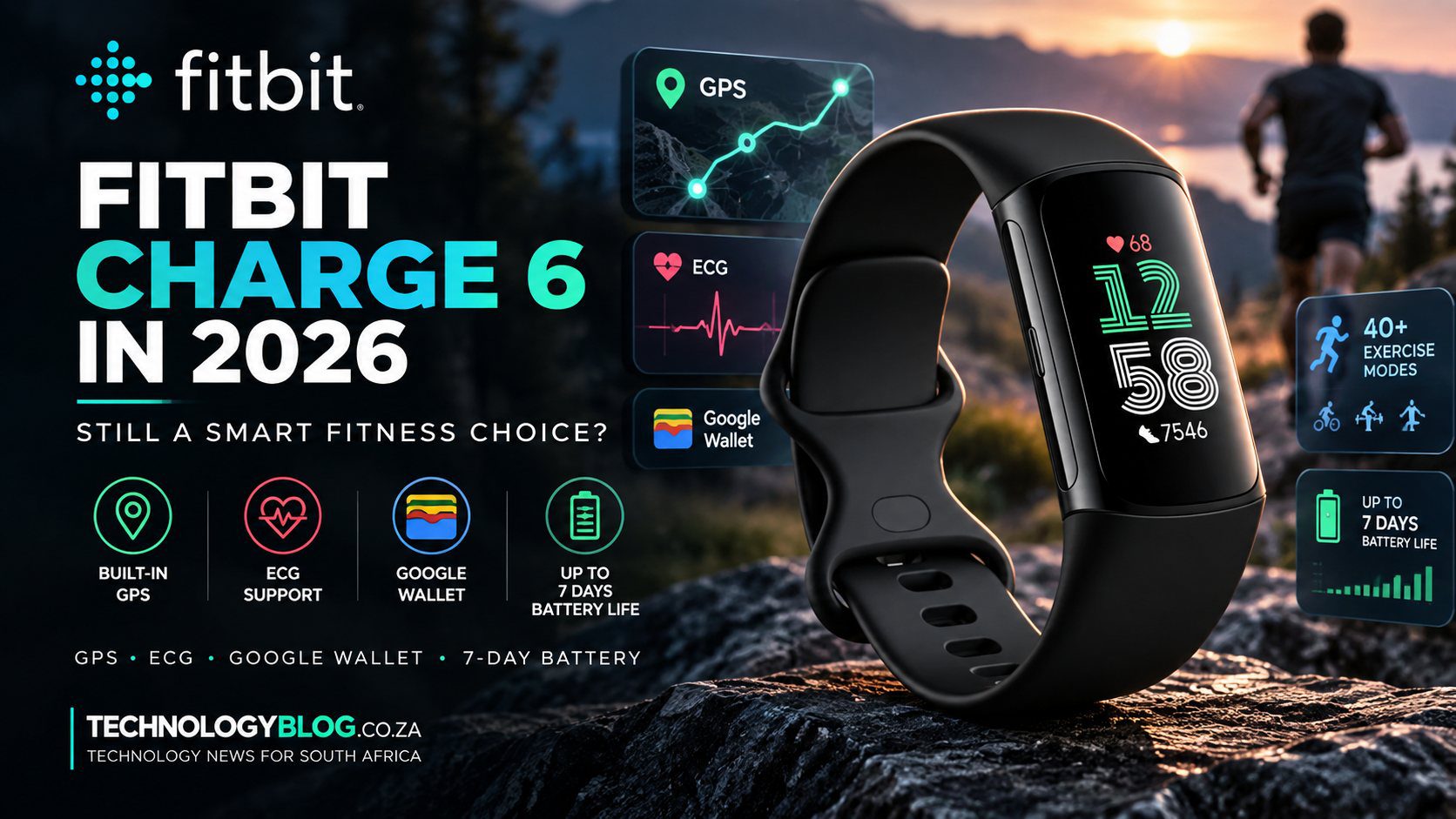
Fitbit Charge 6 still makes a strong case for fitness tracking in 2026
The Fitbit Charge 6 is no longer Google’s newest fitness tracker, but its combination of built-in GPS, ECG support, Google Wallet, Google Maps, an AMOLED display and up to seven days of battery life means it still fills an important gap in Google’s wearable line-up.
Google introduced the Charge 6 in September 2023. In 2026, it remains on the company’s current wearable store alongside the newer screenless Fitbit Air and Pixel Watch 4.
That matters because the Charge 6 now sits in an interesting position.
The Fitbit Air is aimed at users who want passive health tracking without a screen. The Pixel Watch is a full smartwatch. The Charge 6 sits between them, providing a display and several smartwatch-style functions while remaining much smaller and lighter than a conventional watch.
Fitbit Charge 6 still has one of Fitbit’s more complete feature sets
The Charge 6 uses a colour AMOLED touchscreen protected by Corning Gorilla Glass 3.
It weighs 30g and measures 36.73 × 23.09 × 11.20mm, making it considerably more compact than most full-sized smartwatches.
Inside are sensors for optical heart-rate monitoring, blood oxygen measurements, skin-temperature variation and electrical measurements used by the ECG and EDA Scan apps.
The tracker also includes built-in GPS and GLONASS, meaning users can record compatible outdoor activities without relying entirely on the phone for location data.
That combination gives the Charge 6 more independence than a simple step tracker.
More than 40 exercise modes
Google lists more than 40 exercise modes on the Fitbit Charge 6.
These cover activities including running, cycling, strength training and yoga, while the tracker also records steps, distance, calorie estimates and Active Zone Minutes.
Active Zone Minutes use heart-rate zones to show how much time the wearer spends exercising at different intensities.
The Charge 6 also provides Cardio Load and Daily Readiness features through Google’s current health ecosystem.
Daily Readiness is designed to help users decide whether their body appears ready for a harder training session or whether recovery may be more appropriate.
That information should be treated as guidance rather than a medical assessment.
Heart-rate tracking was a major upgrade from the Charge 5
When Google introduced the Charge 6, it described the device as offering its most accurate heart-rate tracking on a Fitbit tracker at the time.
Google said its new algorithm could deliver up to 60% more accurate heart-rate tracking during vigorous activities such as HIIT compared with the Charge 5.
That figure is a manufacturer claim rather than an independent TechnologyBlog measurement.
Heart-rate accuracy can vary according to exercise type, fit, skin contact and movement. Anyone requiring medically accurate heart monitoring should not treat a consumer fitness tracker as a replacement for clinical equipment.
It can send heart rate to compatible gym equipment
One of the Charge 6’s more unusual fitness features is the ability to broadcast real-time heart-rate information to compatible exercise machines.
Google says it can connect to selected treadmills, elliptical trainers, rowing machines and exercise bikes using the Bluetooth Heart Rate Profile.
This means the heart-rate reading collected by the tracker can appear directly on supported gym equipment.
Compatibility varies by manufacturer and model, so users should not assume that every Bluetooth-enabled exercise machine will work with the feature.
Still, it is a useful capability for people who regularly train indoors.
Built-in GPS means your phone can stay behind on some workouts
The Charge 6 includes built-in GPS and GLONASS.
That allows the tracker to record location, pace and distance during supported outdoor activities without needing a phone to supply GPS information.
For runners and cyclists, this is one of the biggest differences between the Charge 6 and simpler fitness bands.
A phone may still be useful for communication, music and safety, but it is not required purely for GPS tracking.
Battery life will decrease more quickly when GPS is used regularly.
ECG works in South Africa
The Charge 6 includes electrical sensors that support Google’s ECG app.
The feature can assess a heart rhythm and indicate whether the result appears consistent with normal sinus rhythm or possible atrial fibrillation. It is not capable of detecting every heart condition.
Importantly for local buyers, South Africa is officially included in Google’s list of countries where the ECG app is available on the Fitbit Charge 6.
That gives South African users access to one of the tracker’s more advanced health features rather than receiving a device with ECG hardware that cannot be used locally.
The result should still not be treated as a diagnosis.
Google itself notes that the feature is not equivalent to the 12-lead ECG typically used in a medical setting.
SpO2 and skin-temperature tracking add more health data
The Charge 6 includes red and infrared sensors for blood oxygen measurements.
Google describes SpO2 tracking as a wellness feature rather than a medical diagnostic tool. Availability can also vary by country.
There is also a skin-temperature sensor.
Google says the accompanying software shows variation in skin temperature rather than presenting the tracker as a clinical thermometer. Ambient temperature can also influence measurements.
These readings are most useful as trends over time rather than individual numbers that users attempt to diagnose themselves.
Google Wallet works on the Charge 6 in South Africa
The Charge 6 includes NFC and supports Google Wallet for contactless payments.
Google explicitly lists the Charge 6 as a compatible Fitbit device for Wallet.
More importantly, Google also provides a South African list of supported banks for Google Wallet on Fitbit.
The current list includes institutions such as Absa, Capitec, Discovery Bank, FirstRand, Investec, Nedbank and Standard Bank, although supported card types vary by bank.
That gives Google Wallet genuine local relevance rather than merely being a feature advertised on an international product page.
Users should still check whether their particular bank and card are supported before relying on the tracker for payments.
Google Maps puts directions on your wrist
Google Maps is another Google service integrated directly into the Charge 6.
The tracker can show turn-by-turn directions on its display, reducing the need to repeatedly take a phone out while walking or navigating.
The phone still plays an important role in the broader Maps experience, so this should not be interpreted as a fully independent offline navigation system.
For urban walking and everyday navigation, however, directions on the wrist are a practical addition.
YouTube Music controls are useful, but they are not offline music
The Charge 6 also includes YouTube Music controls.
Users can pause or resume playback, skip tracks, browse recent music and adjust volume from the tracker.
There is an important limitation.
The Charge 6 does not store YouTube Music for offline playback.
Google says the paired phone must remain nearby, connected to the internet, with the Google Health app running in the background. A YouTube Music Premium subscription is also required in most locations.
This means the Charge 6 acts as a remote control for music playing from the phone rather than replacing the phone as a music player.
Up to seven days of battery life
Google rates the Fitbit Charge 6 for up to seven days of battery life.
Charging from empty to full takes approximately two hours.
That figure is based on Google testing and will vary according to use.
Features such as the always-on display, SpO2 measurements and GPS can reduce battery life. Google itself recommends charging every few days to ensure the tracker remains available for continuous monitoring.
Seven days remains one of the Charge 6’s practical advantages over many full smartwatches.
Instead of charging every night or every second day, users can potentially wear it through several days of exercise and sleep tracking.
Google’s official Charge 6 technical specifications confirm built-in GPS, ECG-compatible electrical sensors, NFC, 5 ATM water resistance and battery life of up to seven days under stated test conditions. Readers comparing health-focused wearables can also see our Huawei Watch GT 7 guide and WHOOP 5.0 guide.
Fitbit Charge 6 specifications
| Specification | Fitbit Charge 6 |
|---|---|
| Display | AMOLED touchscreen |
| Glass | Corning Gorilla Glass 3 |
| Dimensions | 36.73 × 23.09 × 11.20mm |
| Weight | 30g |
| Battery life | Up to 7 days |
| Charging time | Around 2 hours |
| GPS | Built-in GPS + GLONASS |
| Heart-rate sensor | Yes |
| ECG | Yes |
| EDA Scan | Yes |
| SpO2 | Yes |
| Skin-temperature variation | Yes |
| NFC | Yes |
| Google Wallet | Yes |
| Google Maps | Yes |
| YouTube Music controls | Yes |
| Exercise modes | 40+ |
| Water resistance | 50m / 5 ATM |
| Phone compatibility | Android 11+ / iOS 16.4+ |
| Google account required | Yes |
Specifications are based on Google’s current Charge 6 documentation.
Water resistance is useful, but it is not waterproof
Google rates the Charge 6 as water-resistant to 50 metres, corresponding to a 5 ATM rating under ISO 22810:2010 when manufactured.
Google specifically states that the device is not waterproof.
Water resistance can also decline over time due to normal wear, damage or repair.
The Charge 6 is designed for shallow-water use rather than high-speed or high-temperature water activities.
That distinction matters because a 50m rating does not mean the tracker can be used indiscriminately at 50 metres underwater.
The Google Health app is now part of the experience
One of the biggest differences between buying a Charge 6 now and buying one when it launched in 2023 is the software around it.
Google’s current documentation refers to the Google Health app for device setup, tracking and coaching rather than positioning the experience solely around the old Fitbit branding.
A Google account is required.
Google currently lists support for smartphones running Android 11 or newer and iOS 16.4 or newer.
This reflects the broader integration of Fitbit into Google’s health and wearable ecosystem.
The newer Fitbit Air changes the comparison
Google introduced the Fitbit Air in May 2026.
The Air is a screenless fitness tracker designed for continuous health monitoring and works closely with Google Health and Gemini-powered coaching.
That might initially make the Charge 6 look outdated.
In practice, the two products have different priorities.
The Fitbit Air removes the screen and focuses on passive tracking. The Charge 6 retains a display and provides features such as built-in GPS, Google Maps, Google Wallet and direct workout information on the wrist.
For someone who wants as little interaction with a wearable as possible, the Air may make more sense.
For someone who wants a fitness tracker that can still show useful information without becoming a full smartwatch, the Charge 6 remains the more conventional choice.
Fitbit Charge 6 still occupies a useful middle ground
The Fitbit Charge 6 is showing its age in one sense: it first arrived in 2023 and Google now has newer wearable hardware.
Its feature set, however, remains unusually complete for a compact tracker.
Built-in GPS means runners can record routes without relying entirely on their phones. ECG works in South Africa. Google Wallet supports multiple South African banks. Maps can provide directions on the wrist, while the AMOLED display lets users interact with their information without moving up to a full smartwatch.
The seven-day battery rating also gives it an advantage over devices that require much more frequent charging.
The strongest reason to consider the Fitbit Charge 6 in 2026 is therefore not that it is the newest tracker.
It is that Google has continued to sell it because it still occupies a useful space between a basic health band and a full smartwatch.


Pingback: Huawei Watch GT 7 brings up to 21-day battery life