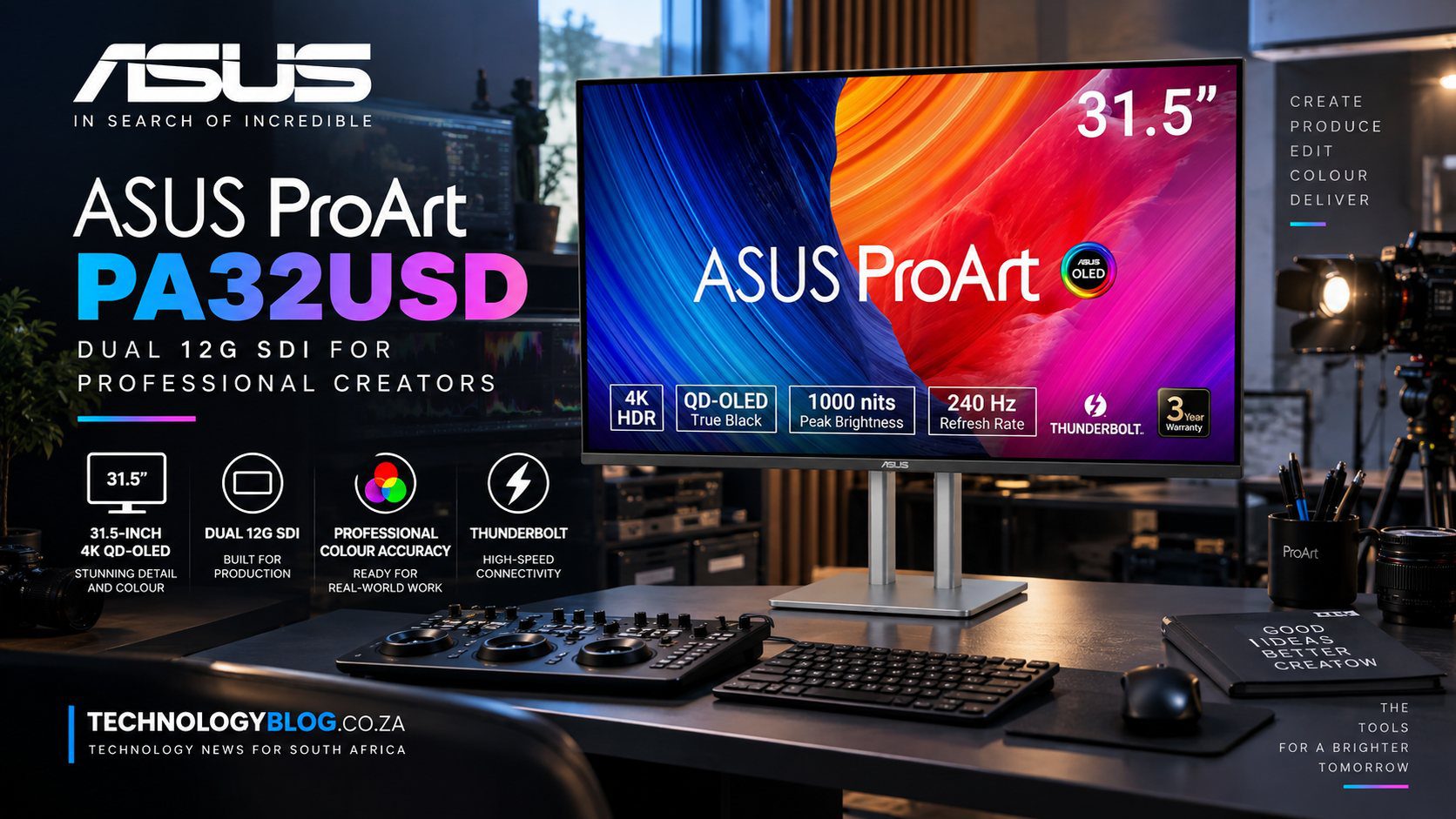
ASUS ProArt PA32USD adds dual 12G-SDI to a 31.5-inch 4K QD-OLED production monitor
The ProArt Display OLED PA32USD is not simply a bigger PA27USD. ASUS uses the 31.5-inch chassis to position the monitor deeper inside professional video workflows, giving it two 12G-SDI inputs rather than one while keeping a 4K QD-OLED panel, 240Hz refresh and a built-in motorised calibration probe.
The dual SDI connections matter to studios that need to switch or compare professional video sources without routing everything through a computer. ASUS says the inputs support uncompressed 4K signals up to 60Hz, while the display itself can refresh at 240Hz when driven through its computer-oriented interfaces.
Dual SDI is about workflow flexibility, not image quality by itself
SDI does not make a picture more accurate merely because it is a professional connector. Its value lies in robust transport, standardised production formats and integration with cameras, switchers, recorders and I/O devices.
Having two 12G-SDI inputs can reduce external switching hardware and allow the display to sit at the end of more than one signal path. A studio might connect a grading output and a separate camera or playback source and switch between them as part of quality control.
The interface also supports embedded audio and production-oriented metadata depending on the signal chain. Those capabilities are one reason broadcast environments continue to use SDI even while consumer devices move toward HDMI.
31.5 inches gives 4K pixels more physical room
A 3840 x 2160 image on a 31.5-inch panel has lower pixel density than on a 26.5-inch screen, making interface elements physically larger at the same scaling setting. That can be comfortable for editing timelines and scopes viewed from farther away.
The larger surface also makes side-by-side windows more useful. A creator can keep a full-resolution preview beside controls without text becoming microscopic.
For close viewing, the smaller PA27USD will look slightly finer because the same number of pixels occupies a smaller area. Neither choice is universally better; viewing distance and desk layout determine which size fits the workflow.
QD-OLED gives grading work exceptional blacks — with OLED caveats
The PA32USD uses QD-OLED, combining self-emissive pixels with quantum-dot colour conversion. ASUS specifies 99% DCI-P3 coverage, true 10-bit colour and factory calibration below Delta E 1.
Self-emissive pixels can switch completely off, producing black levels that LCD panels need sophisticated local dimming to approach. That makes dark-scene evaluation particularly compelling.
OLED still has brightness and ageing characteristics that studios need to understand. The 1,000-nit figure is a peak value over a limited area, not a promise that the entire 31.5-inch panel can remain at that luminance. Static editing interfaces can also contribute to differential wear over long periods.
The built-in probe turns calibration into routine maintenance
ASUS’s motorised colorimeter flips into view when calibration is required. The monitor supports automated and self-calibration workflows as well as integration with professional software.
That can be valuable in shared studios where several displays need regular checks. A scheduled calibration routine is easier to maintain when the measurement device is permanently attached and cannot disappear into another edit suite.
Calibration is not the same as repair. It can compensate for certain changes in colour response, but it cannot restore a worn OLED emitter or correct every uniformity issue. Periodic measurement is part of maintaining confidence, not a guarantee of indefinite reference performance.
240Hz lets the same screen leave the broadcast world
Traditional reference displays prioritise accuracy and video standards, often with modest refresh rates. A 240Hz panel makes the PA32USD more versatile as a workstation monitor for animation, game development and high-frame-rate preview.
That matters in studios where one desk handles several disciplines. An artist can work in a 3D viewport during the day and monitor a 4K SDI feed later without moving to another screen.
The high refresh also reduces visible blur during fast UI motion. It does not mean a 60Hz SDI signal becomes genuine 240fps content; the display still shows the temporal information present in the source.
Thunderbolt and USB make the monitor an I/O hub
The PA32USD includes dual Thunderbolt 4, one port providing up to 96W Power Delivery, plus HDMI 2.1, DisplayPort 2.1 and a USB 3.2 hub. That array reflects a workstation where laptops, desktop GPUs and professional video I/O coexist.
A single Thunderbolt cable can connect and charge many creator laptops while carrying peripherals. High-power mobile workstations may still require their own charger, and shared Thunderbolt bandwidth needs consideration when several fast devices are active.
For a studio, consolidation is valuable because fewer external docks and converters mean fewer points of failure. The monitor effectively becomes part of the desk’s I/O architecture.
The September showcase is not the original launch
ASUS first announced the PA32USD in May 2026 and said it was expected to go on sale in June for $2,699 in the US. Its appearance at IBC on 11 September is a renewed professional-video showcase rather than the product’s first announcement.
That lifecycle detail changes the story. The monitor is part of ASUS’s current production ecosystem and can be evaluated as an existing model, while the IBC demonstration highlights how the company wants it used with SDI and post-production tools.
We did not verify an official South African price or retail channel. Any local value judgement should wait for local distribution, warranty and support information rather than converting the US price.
Dual SDI defines who should choose the 32-inch model
A general creator who never touches professional video infrastructure may get little benefit from two SDI ports. A post-production studio can use them immediately.
That is the clearest way to understand the PA32USD. Its size is useful, its QD-OLED panel is premium and its 240Hz refresh is unusually fast, but the dual 12G-SDI inputs are what turn it from a high-end computer monitor into production equipment.
The dual-SDI arrangement is most valuable in rooms where two professional video feeds need to be monitored, switched or compared without first passing through a capture device. It does not mean the SDI inputs can drive the panel at its full 240Hz refresh rate: the professional inputs are intended for uncompressed video signals up to 4K at 60Hz, while the higher refresh capability is used through the computer-oriented interfaces. Keeping those two numbers separate matters because the PA32USD serves both production-video and high-refresh workstation roles on the same panel.
The monitor succeeds if that convergence removes hardware from the desk without compromising colour confidence. Calibration stability, OLED longevity and SDI interoperability are therefore the tests that matter after the impressive specification sheet.