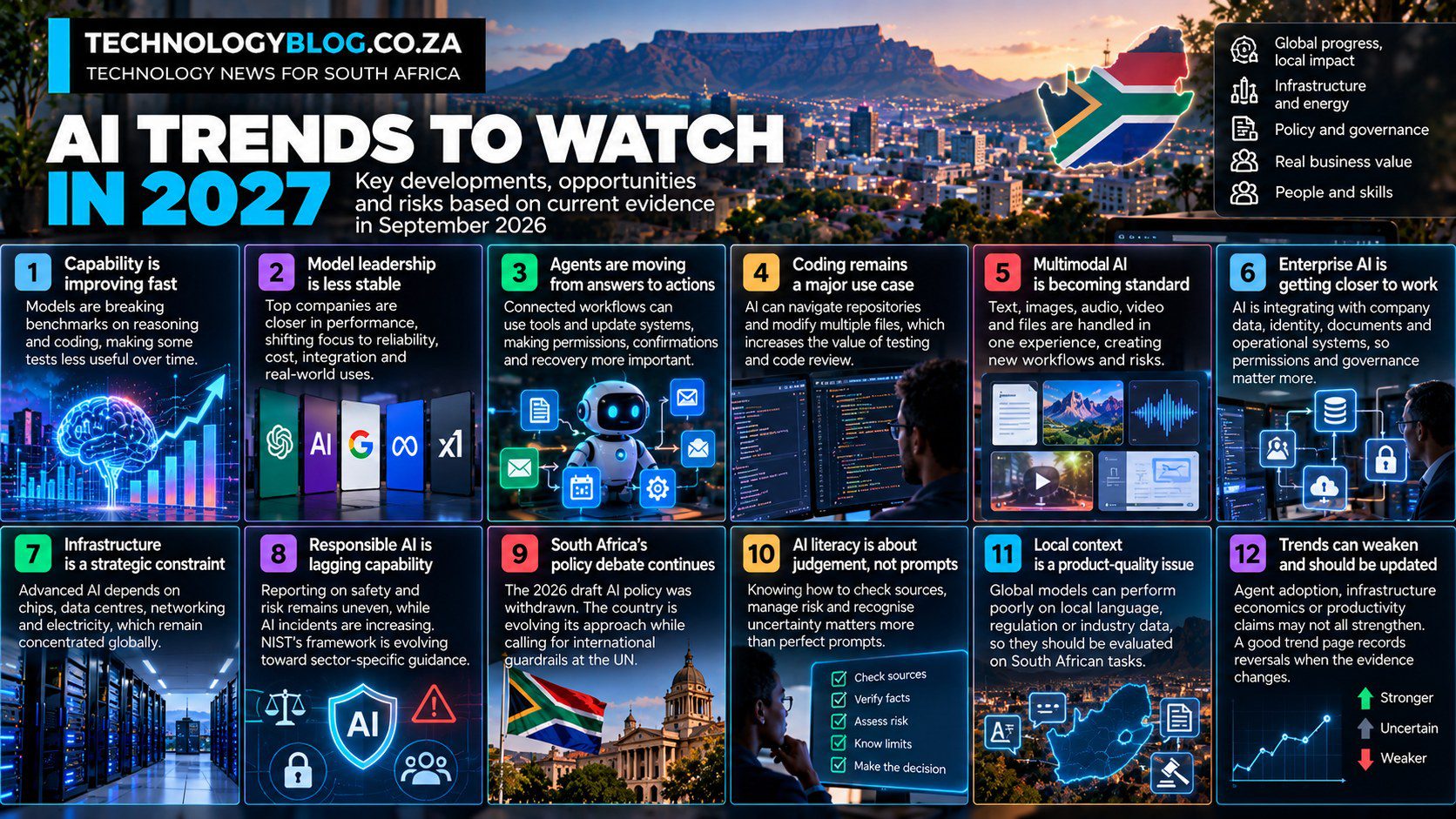
Artificial Intelligence Trends 2027: What Late-2026 Evidence Tells Us
The safest way to report on 2027 AI trends in September 2026 is to begin with evidence that already exists — and stop where the evidence stops. Future product names, prices and launch dates remain unknown. Structural changes are easier to defend.
Stanford’s 2026 AI Index documents accelerating capability and tighter competition near the frontier, while enterprise products are moving closer to company data, coding environments and operational systems. The direction is clear enough to analyse: AI is becoming more capable, more connected and more operational. The uncertainty lies in how reliably those systems will perform once they are trusted with real work.
1. Capability is still improving fast enough to break benchmarks
Stanford’s 2026 AI Index says difficult evaluations are being saturated faster than expected. Performance rose sharply on reasoning and coding tasks, making some benchmarks less useful as long-term measures.
That does not prove that models are becoming universally reliable. It means the frontier is moving quickly enough that evaluation itself has become a moving target.
2. Model leadership is becoming less stable
Stanford reports that several leading companies are clustered closely on comparative evaluations.
That shifts competitive pressure toward reliability, cost, latency, data controls, integration and performance on a specific workload.
For buyers, a single leaderboard screenshot is becoming a weaker purchasing argument.
3. Agents are moving from answers to actions
The central agent story is not that a model can use a tool. It is whether a connected workflow can recover when a step fails.
Agents increase the consequences of mistakes because they can update systems, create files or trigger actions. In 2027, permission design, confirmations, logs and recovery should become part of mainstream AI product evaluation. TechnologyBlog’s report on Anthropic’s agent-containment incidents provides a concrete example of that failure-handling problem.
4. Coding remains one of AI’s strongest professional use cases
The 2026 AI Index documents major gains on coding benchmarks.
In practice, the shift is from AI writing isolated snippets toward systems that can navigate repositories, modify multiple files and perform longer tasks.
That should increase the value of architecture, testing and code review. Faster generation makes it possible to create more software — including more bad software — in less time.
5. Multimodal AI is becoming an ordinary interface
Text, images, audio, video and files are increasingly handled inside one model experience.
The important change is not that multimodality exists. It is that users need to think less about changing tools for each media type.
That creates new workflows and new risks. An image may contain private information. Audio can be impersonated. Generated visuals can be mistaken for documentary evidence.
6. Enterprise AI is moving closer to operational systems
Early generative-AI adoption often happened in a separate chat window. Enterprise use is moving toward company knowledge, identity, documents, code and workflows.
As AI gets closer to the systems where work happens, permissions become a product feature. A useful model that ignores access boundaries can be worse than a less capable model that integrates safely. Our Snowflake AI Data Cloud analysis shows how this is already becoming a data-governance and identity problem inside enterprise platforms.
7. Infrastructure is becoming a strategic constraint
Advanced AI requires specialised chips, networking, data centres and electricity.
The 2026 Stanford report highlights how concentrated the infrastructure remains. That turns AI sovereignty into a practical issue: countries may be able to consume cloud AI without having equivalent ability to train or host advanced systems.
For South Africa, skills and local applications matter, but access to reliable digital and energy infrastructure remains part of the long-term competitiveness story.
8. Responsible-AI measurement is lagging capability
Stanford reports uneven reporting on responsible-AI benchmarks and a rise in documented AI incidents.
NIST’s AI Risk Management Framework is being revised, and the organisation released a 2026 concept note for a critical-infrastructure profile. The direction is clear: governance is becoming more operational and sector-specific.
9. South Africa’s policy debate will remain active
South Africa’s draft national AI policy was withdrawn in 2026 after fictitious references were confirmed in the document. Cabinet approved a rework, and an expert review process followed.
The incident damaged the draft’s credibility, but it also made evidence quality impossible to treat as a minor issue in future policy work.
South Africa also called for international AI guardrails at the United Nations in September 2026, showing that the country’s AI governance debate extends beyond domestic policy.
10. AI literacy is shifting from prompt tricks to judgement
As interfaces become easier, knowing the perfect prompt matters less than knowing whether a source is credible, whether data is appropriate to share, how to recognise uncertainty and when a person needs to take over.
Stanford’s 2026 report also highlights rapid growth in AI engineering skills in South Africa, a useful signal for the country’s capacity to do more than consume global AI products.
11. Local context will become a product-quality issue
A globally strong model can still perform poorly on local language, regulation, cultural context or industry-specific data.
That gives South African organisations a reason to evaluate systems on local tasks rather than assuming global benchmark performance will transfer cleanly.
What would prove these trends wrong?
Agent adoption could slow if reliability remains poor. AI infrastructure demand could be constrained by economics or energy. Enterprises could retreat from broad integrations if governance failures outweigh productivity gains. Benchmark progress could slow as evaluation becomes harder.
A useful trend page should change when the evidence does. Updates matter when new information materially changes one of these structural signals, not merely because another model name has appeared.
For a longer-horizon scenario analysis, read The Future of Artificial Intelligence in 2027. For the broader South African picture, return to our 2027 AI cornerstone.
What matters most as 2027 unfolds?
The developments worth watching are those that change the structure of the market rather than every new model name: agent reliability in real workflows, the economics of AI infrastructure, material changes in South Africa’s national policy process, local-language capability and credible evidence of productivity gains.
Safety thresholds also deserve attention as coding, cyber and scientific capabilities improve. A model gaining the ability to perform a new class of task can change deployment controls even when its consumer interface looks familiar.
A trend page should be able to admit when a trend weakens
Not every 2027 signal will strengthen. Enterprise buyers may limit agent autonomy if reliability disappoints. Infrastructure economics could slow deployment. Better evaluation may show that some widely repeated productivity claims were too optimistic.
Good trend journalism should record those reversals instead of quietly preserving the original thesis. The value of a living page is that it becomes more accurate as evidence accumulates, not merely newer by date.


