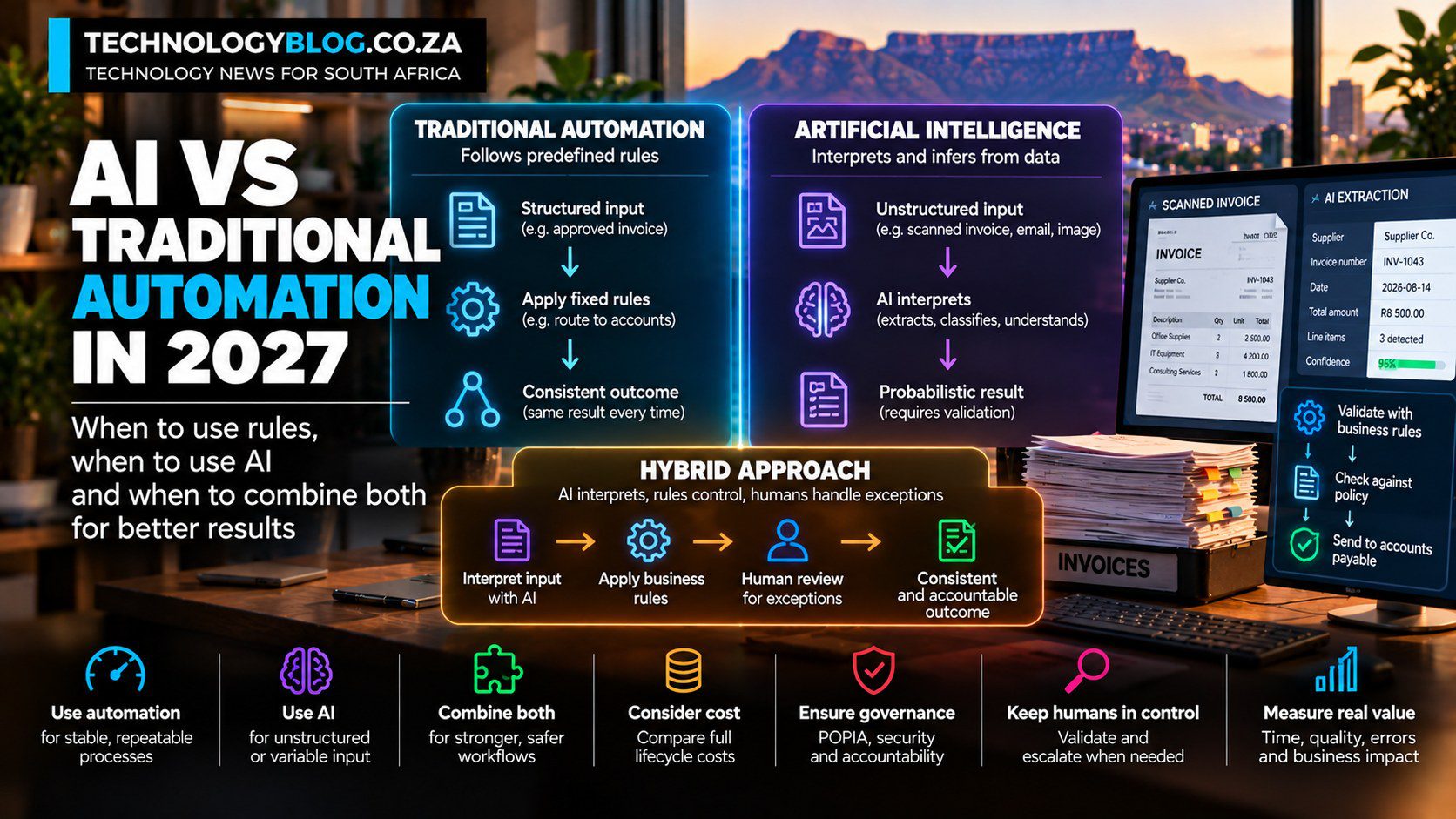
Artificial Intelligence vs Traditional Automation: Where Each One Fits
An invoice does not become an AI problem just because the company has an AI strategy. If every approved invoice should follow the same route, conventional automation can do the job predictably and cheaply.
AI earns its place when the input becomes less predictable: scanned invoices, inconsistent layouts, free-form emails, images or other information that must be interpreted before a rule can run. That boundary — between inference and predefined logic — is the real architecture decision.
That distinction is the centre of the AI-versus-automation decision. One is built around inference. The other is built around predefined logic.
Traditional automation is explicit by design
Traditional automation follows rules created in advance.
A workflow can say: when an invoice receives approval, send it to accounts payable. When a customer selects “technical support”, route the ticket to the technical queue. At midnight, copy a file to another system.
The strength is predictability. If the input and rules are stable, the same condition should trigger the same result.
AI adds interpretation
AI is useful when the system needs to infer something from messy input.
A model can read an email and classify intent, inspect an image, extract fields from an inconsistent document, estimate risk or generate a flexible response.
That flexibility is valuable because developers do not need to write an explicit rule for every variation. It also means the output can be probabilistic rather than guaranteed.
The architectural difference is visible in one support ticket
A rule-based support system may route a ticket according to a form selection.
An AI-enabled system can read a free-form message, infer what the customer needs and summarise the issue. Deterministic software can then apply policy and send the ticket to the correct queue.
That hybrid design often makes more sense than asking the model to interpret the problem, decide policy and send a final response without control.
Invoice processing shows why “AI everywhere” is wasteful
If all suppliers submit a structured electronic format, deterministic extraction is easier to audit.
If documents arrive as photographs, scans and different layouts, computer vision or document AI can identify fields. Rules can validate totals and required data. A person can review low-confidence cases.
The AI is valuable because it handles variation. The rules remain valuable because they handle control.
Fraud detection shows where prediction adds value
A simple rule can flag every transaction above a fixed amount. A machine-learning system can consider many variables and identify unusual combinations that do not match normal behaviour.
The model may catch subtler fraud patterns, but it introduces false positives, false negatives and questions about how the score was produced.
The organisation therefore needs evaluation and monitoring in addition to rule testing.
Where deterministic automation is usually stronger
- the inputs are structured;
- the business rules are stable;
- the same condition should always produce the same action;
- auditability is a priority;
- the cost of AI infrastructure is not justified;
- there is no useful data for model inference.
These are not “old-fashioned” systems. They are often the correct engineering choice.
Where AI earns its complexity
- the input is natural language, images, speech or other unstructured information;
- the number of variations makes hand-written rules brittle;
- prediction or anomaly detection is part of the job;
- the system must generate flexible content;
- uncertain outputs can be reviewed or safely escalated;
- the organisation can monitor model behaviour over time.
Hybrid architecture is often the real answer
AI and traditional automation are not competing religions.
AI can interpret. Rules can constrain. Humans can approve exceptions.
A contract model may identify a clause, while a deterministic rule decides which approval level is required. A language model may draft a customer reply, while the billing platform remains the source of truth for the account.
This separation makes failures easier to contain.
Auditability can decide the architecture before capability does
A regulator, auditor or customer may need to know why a process produced an outcome.
Fixed rules are usually easier to explain because the logic is explicit. AI systems can still be used, but high-impact workflows may deliberately keep the final decision inside a transparent rule or human approval step.
That is not a concession to weaker technology. It is a design choice about accountability.
Costs also behave differently
Traditional automation can require more upfront work to define rules and integrations, but stable processes can run cheaply and predictably.
AI may reduce rule-writing for variable input while adding model usage, evaluation, monitoring and exception-handling costs.
Compare lifecycle cost: setup, model use, human review, failures, maintenance and any vendor dependency.
For South African organisations, simpler can also mean easier governance
When sensitive personal or business information is involved, a deterministic workflow may be easier to control under POPIA and internal security rules. The South African AI cornerstone provides the broader governance picture.
AI can still extend automation into areas that previously required human reading or classification. The business case should compare the full workflow rather than assuming the newer technology is automatically better.
TechnologyBlog’s How to Use AI in 2027 provides the implementation process, while AI for Business covers organisation-level governance.
The cheapest architecture may be the one with less AI
Model usage introduces costs that ordinary workflow software may not have: inference, evaluation, monitoring and human review. Those costs can be justified when AI removes a genuinely difficult interpretation step. They are harder to justify when a stable rule already solves the problem.
Lifecycle cost is therefore more useful than comparing setup effort alone. Count integration, model calls, exception handling, review, maintenance and the cost of incorrect output.
Confidence scores do not remove the need for escalation
Some AI systems expose confidence or related quality signals, but a number on its own does not decide what the business should do next. The organisation still needs an escalation rule for uncertain, contradictory or high-impact cases.
A safe hybrid system can stop rather than guess. That ability is especially important when automation touches financial commitments, customer rights, employee decisions or security-sensitive systems.
Audit questions can decide the design before the model is chosen
Ask what evidence an auditor, regulator, customer or internal reviewer would need after an outcome. If the answer requires a transparent sequence of fixed rules, keep the final decision there and use AI only for interpretation or preparation.
This bounded role can preserve the flexibility of AI without forcing the organisation to explain an opaque model as though it were a deterministic rule engine.


