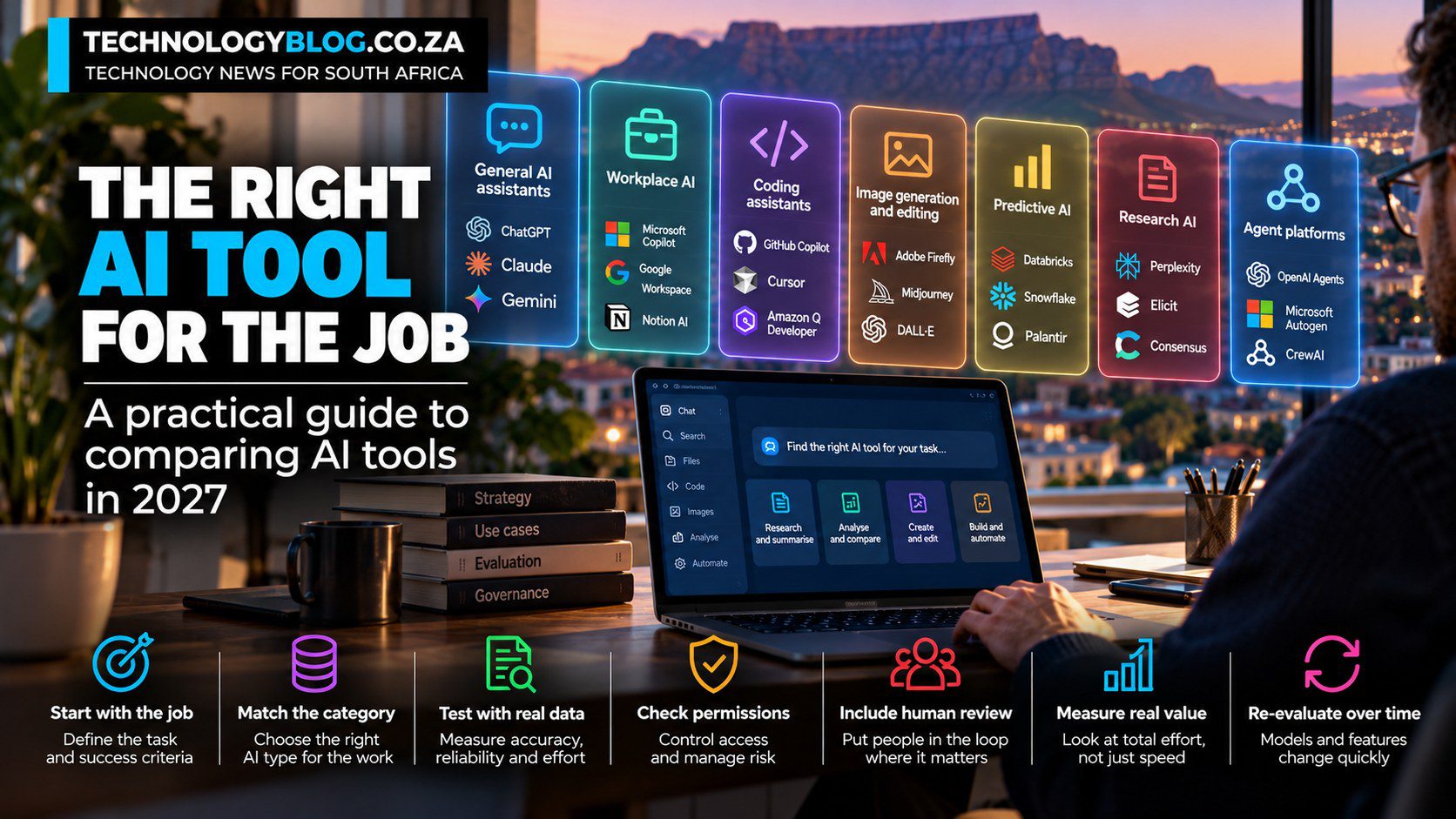
AI Tools by Use Case in 2027: Match the Tool to the Job
“What is the best AI tool?” sounds like a useful buying question. It usually is not. A coding assistant and an image generator are not competitors, a fraud model should not be judged by how well it writes, and a general-purpose chatbot can be excellent at research while still being the wrong architecture for a deterministic business process.
The more useful comparison starts with the work. In 2027, brands and benchmark headlines will keep changing quickly; the underlying job, evidence requirements, permissions and cost of failure are much more stable.
This 2027 guide takes the opposite approach. It starts with the job, then looks at the category of AI that fits. TechnologyBlog’s Artificial Intelligence in South Africa guide covers the broader policy and technology picture.
General AI assistants: one interface, many jobs
Products such as ChatGPT, Claude and Gemini are general-purpose assistants. Their strength is breadth: writing, document work, coding, research, files and increasingly connected tools can live in one conversational interface.
That breadth makes them useful for individuals who switch between tasks. It can also hide an architectural mistake. A general assistant should not automatically replace specialised software where reliability, deterministic control or domain-specific evaluation matters more than flexibility.
When testing a general assistant, measure source quality, instruction following, file handling, edit time and how easily the user can verify the result.
Workplace AI: integration can matter more than the model
Microsoft Copilot and similar workplace products compete partly on where the AI sits, not only on raw model quality.
An assistant that understands the permissions, documents, meetings and identity system inside an organisation can be more useful than a slightly stronger standalone model that requires employees to copy information between systems.
The trade-off is governance. Deeper integration means more context and more permissions, so administrators need clear controls over what the AI can access and how actions are logged.
Coding assistants should be tested inside real repositories
AI coding tools can explain code, propose functions, generate tests, navigate a repository and help debug problems. The best evaluation is not a clever coding benchmark shown on a launch slide.
Give competing tools the same real codebase. Ask them to fix representative bugs, write tests and explain unfamiliar modules. Then measure correctness, security issues, review burden and whether the generated changes fit the project architecture.
The 2026 Stanford AI Index shows rapid improvement in coding capability. That makes engineering judgement more important, not less, because teams can generate more code faster.
Image AI is increasingly an editing problem
Generative image systems are easy to demonstrate: type a prompt and produce a picture. Professional use is harder.
Creators need selective editing, consistent characters or products, predictable composition, rights workflows and the ability to preserve parts of an image while changing others. Adobe Firefly is built around creative-tool integration, while general assistants and specialist image systems take different approaches.
For publishers, the most important test is not visual spectacle. It is whether the tool fits the editorial workflow without confusing generated illustration with documentary evidence.
Predictive AI solves different problems from generative AI
Some of the most commercially important AI systems never generate a paragraph.
Predictive models can forecast demand, score risk, detect anomalies, estimate equipment failure or recommend products. Their evaluation depends on data quality, false positives, false negatives, drift and whether the historical data represents the environment in which the model will be used.
A language model may help an analyst explain those results, but it is not automatically the model that should produce them.
Research AI should shorten the path to primary evidence
Research tools are useful when they help a user find, read and compare evidence faster.
The strongest systems expose sources clearly enough that the user can open them. The weakest encourage the reader to accept a polished synthesis without understanding what supports it.
For journalism, regulation, science and procurement, traceability is part of the product quality.
Enterprise AI platforms are about control as much as capability
Large organisations may need model access, retrieval from internal knowledge, identity controls, audit logs, data boundaries, deployment options and integration with operational systems.
That is why enterprise platforms from major cloud and software companies cannot be compared only by asking which model writes the best paragraph. The surrounding system may matter more than the model in production.
TechnologyBlog’s Palantir Foundry coverage and Snowflake AI Data Cloud analysis show how enterprise AI increasingly sits inside governed data, identity and workflow environments rather than operating as a standalone chatbot.
Agents should be judged by failure handling
Agents are one of the most important AI categories heading into 2027 because they can combine models with tools and actions.
The impressive demo is easy: an agent researches, drafts and updates several systems. The harder question is what happens when one step is wrong.
A serious agent platform needs permission boundaries, confirmation points, recovery, logs and a clear way to stop or escalate. The more actions a model can take, the more valuable those controls become.
A useful 2027 comparison table
| Job | AI category to test | What should decide the result |
|---|---|---|
| Writing, files and broad knowledge work | General AI assistant | Accuracy, source access, edit time and workflow fit |
| Software development | Coding assistant | Repository understanding, test quality, security and review burden |
| Creative image work | Image generation/editing system | Editing control, consistency, provenance and rights workflow |
| Forecasting or risk scoring | Predictive ML platform | Error, bias, drift, data quality and explainability |
| Internal knowledge | Enterprise retrieval/assistant platform | Permissions, retrieval quality, identity and auditability |
| Multi-step connected work | Agent platform | Permissions, reliability, recovery, confirmations and logs |
Do not let a free tier choose an enterprise platform
AI products increasingly separate models, context, integrations and controls by plan. A free account can be useful for exploration, but it may tell you very little about the permissions, administration, support and integrations an organisation would actually deploy.
Test the version you intend to use.
The best tool is the one that survives a real evaluation
Build a small set of representative tasks. Use the same inputs across the tools being considered. Score factual accuracy, source traceability, reliability, correction time, permissions and cost.
Then repeat the evaluation after a material product change. The 2026 Stanford AI Index shows how quickly the leading model landscape is moving. A comparison can become stale within months.
If you first need the decision process rather than the product categories, read How to Use Artificial Intelligence in 2027.