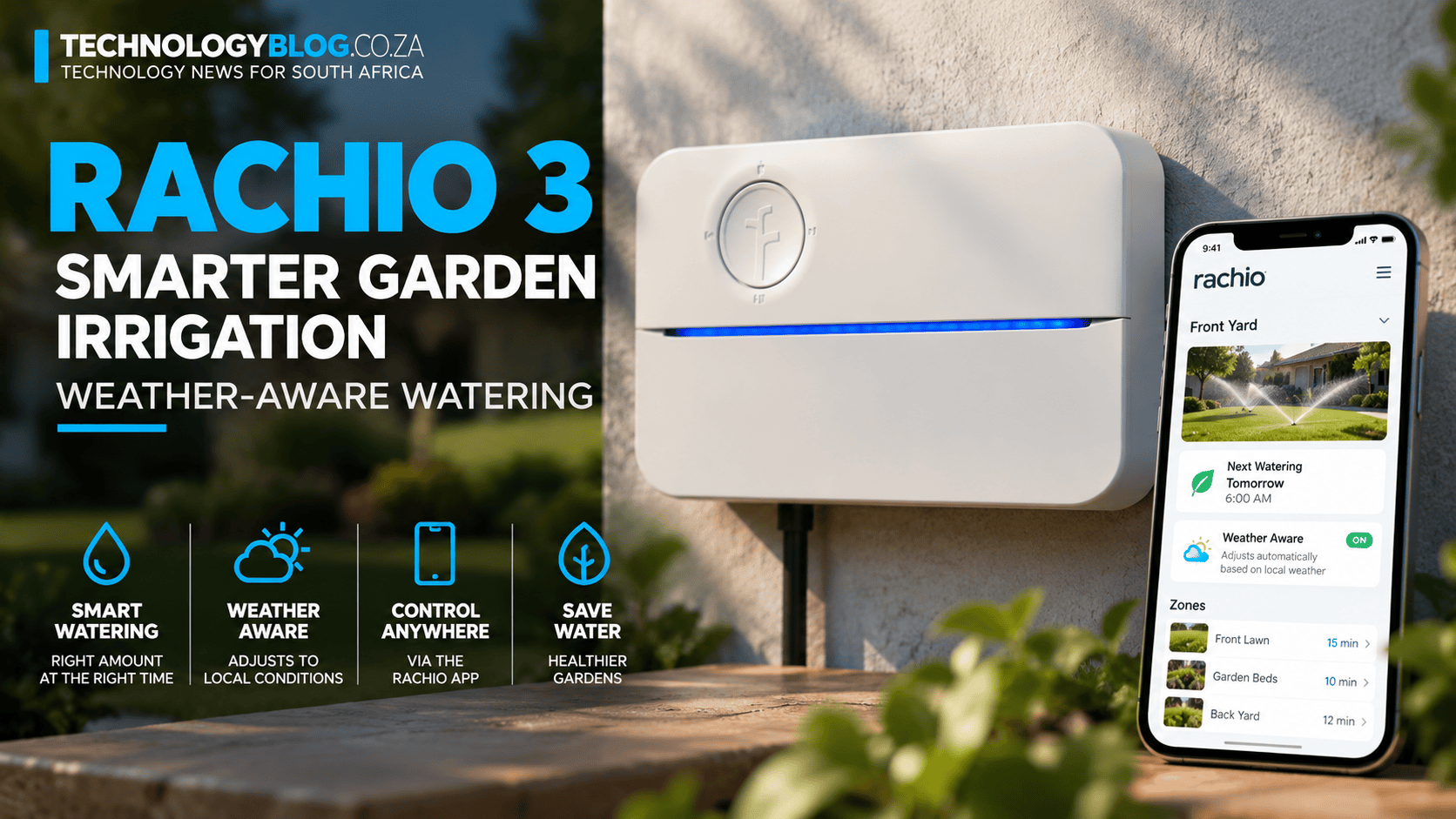
Rachio 3 brings weather-aware intelligence to garden irrigation
The Rachio 3 Smart Sprinkler Controller tackles a familiar problem with automatic garden irrigation.
A timer knows what time it is.
It does not necessarily know whether the garden actually needs water.
Rachio adds another layer to that process by connecting an existing in-ground irrigation system to Wi-Fi, weather information and an app. Instead of simply opening the same valves for the same number of minutes every Tuesday, the system can adjust or skip watering according to the schedule, weather and configured characteristics of individual zones.
That creates an interesting proposition for water-conscious gardens.
However, South African buyers have an important issue to investigate before importing one.
Rachio’s current technical documentation specifies a 120V/60Hz input for its supplied transformer. That is not the standard South African electricity supply.
So while the technology behind the Rachio 3 is relevant to South African gardens, electrical compatibility cannot be assumed.
The Rachio 3 replaces a conventional irrigation controller
The Rachio 3 is not itself a sprinkler.
Instead, it replaces the controller operating an existing compatible in-ground irrigation system.
Those systems typically divide a garden into several watering zones.
One zone might cover a lawn. Another could handle flower beds. A third might irrigate shrubs.
Traditional controllers generally open each zone’s valve according to a predetermined timetable.
Rachio retains that fundamental arrangement but moves scheduling and control into software.
Users can identify individual zones, give them meaningful names and images, configure their characteristics and control them from the Rachio app.
Different gardens can use different numbers of zones
Rachio documents several zone configurations for the Rachio 3 platform.
Current technical documentation identifies 4-, 6-, 8-, 12- and 16-zone models, although retail availability can vary by market and sales channel.
The company’s main consumer store currently emphasises the 8-zone and 16-zone versions.
The correct size therefore depends on the existing irrigation installation.
Someone with six active irrigation zones does not gain anything simply because a controller supports 16.
However, additional capacity can provide room if an irrigation system is expanded later.
Fixed schedules remain available
Smart irrigation does not mean users must hand every decision to an algorithm.
Rachio still supports Fixed Schedules.
These allow users to specify watering days and times in a more conventional way.
That can be important where watering restrictions limit irrigation to particular days or hours.
It is also useful for zones that need predictable treatment.
The difference is that even a fixed schedule can work alongside selected Weather Intelligence features.
Flex Monthly adjusts as conditions change through the year
The next option is Flex Monthly.
These schedules adjust watering according to historical climate information.
Rather than running exactly the same way throughout the year, watering duration and frequency can change as seasonal conditions change.
That makes sense because a garden’s water requirements are not static.
Hot summer conditions can create very different demand from cooler periods.
Automating those adjustments reduces the need to keep revisiting a traditional irrigation timer every few weeks.
Flex Daily takes the automation further
Flex Daily is Rachio’s more dynamic scheduling option.
Instead of simply making monthly adjustments, it tracks estimated soil moisture on a zone-by-zone basis and updates watering accordingly.
That does not mean the Rachio 3 physically measures every patch of soil.
Its decisions depend on configured zone information, weather data and its watering model.
Accurate setup therefore matters.
Vegetation, shade and other zone characteristics influence the calculations.
Smart scheduling can only work with the information available to it.
Weather Intelligence can skip unnecessary watering
One of Rachio’s defining features is Weather Intelligence Plus.
The system uses current and forecast weather information to decide whether scheduled irrigation should be modified or skipped.
Its weather-related functions include Rain Skip, Wind Skip, Freeze Skip and Saturation Skip.
These address different forms of unnecessary or inappropriate watering.
If sufficient rain has fallen or is forecast, watering can be skipped.
Strong wind can make sprinklers inefficient because water may be blown away from its intended area.
Very low temperatures can make irrigation inappropriate.
Estimated soil saturation introduces another reason not to add water when the ground already has enough.
Rain Skip looks backwards and forwards
Rain Skip does more than react after rain has already fallen.
Rachio’s current documentation says the system considers observed rainfall from the previous 24 hours alongside forecast rain over the following 24 hours.
That creates a rolling 48-hour picture around the watering event.
If the combined precipitation reaches the configured threshold, the schedule can be skipped.
The approach is fundamentally different from blindly running irrigation because the clock says it is Tuesday morning.
However, it still depends on weather information being accurate for the property.
A forecast can be wrong.
Weather data is not the same as a sensor in the garden
This distinction is important.
Weather Intelligence does not mean the Rachio 3 magically knows exactly what is happening in every square metre of soil.
The platform can use Rachio’s weather network, a selected weather station or compatible personal weather-station data.
Weather conditions can vary significantly over surprisingly short distances.
One neighbourhood can receive rain while another nearby remains dry.
Rachio therefore allows users to change their weather source when local conditions do not match the information being received.
Saturation Skip estimates whether the soil already has enough water
Saturation Skip tackles a different problem.
Rather than looking only at rainfall, Rachio uses evapotranspiration information and weather data to estimate the moisture balance for configured zones.
The system then considers whether sufficient moisture should remain until the next scheduled watering.
If the relevant conditions are satisfied, irrigation can be skipped.
This highlights why correct zone configuration matters.
Software cannot make a useful soil-moisture estimate if the user has described the garden incorrectly.
Seasonal Shift changes watering duration through the year
Rachio also provides Seasonal Shift for Fixed Schedules.
This adjusts watering duration as seasonal conditions change.
Rachio says the feature uses historical weather information to calculate those changes.
As conditions become hotter, watering duration can increase.
As they become cooler, it can decrease.
Flex schedules already make comparable dynamic adjustments, so Seasonal Shift is particularly relevant to users who prefer a more predictable Fixed Schedule while still wanting some seasonal automation.
The app provides remote control
The Rachio app is central to the controller.
Users can start, pause and cancel irrigation without standing next to the physical control box.
Quick Run can manually activate selected sprinklers.
That can be useful when testing an irrigation system.
Anyone who has adjusted sprinklers alone knows the routine: turn on a zone, walk across the garden, inspect the sprinkler, return to the controller, change the zone and repeat.
Remote control reduces that back-and-forth.
Shared Access can include a gardener or irrigation professional
Remote access is not limited to the primary account holder.
Rachio provides Shared Access, allowing different levels of access to be given to other people.
That could include family members, a gardener or an irrigation professional.
For larger gardens, that can be more useful than sharing an account password or requiring the homeowner to make every adjustment personally.
It also reinforces the idea that the irrigation controller has become part of the home’s connected infrastructure rather than simply being a timer mounted on a wall.
Dual-band Wi-Fi gives the Rachio 3 more network flexibility
Current Rachio 3 documentation specifies support for 2.4GHz and 5GHz Wi-Fi.
That gives the controller more networking flexibility than smart-home devices restricted to 2.4GHz.
Wi-Fi coverage still matters.
Irrigation controllers are often installed in garages, utility areas or outside buildings where wireless signal strength may be weaker than inside the house.
Rachio says a Wi-Fi signal must be available where the controller is installed.
The mobile app is also required for initial Wi-Fi configuration.
Alexa and Google Assistant can control irrigation
Rachio supports several smart-home integrations.
Its current product information includes Amazon Alexa and Google Assistant, while Rachio also documents integrations involving platforms and services such as IFTTT and Alarm.com.
Voice control can therefore become another way to operate irrigation.
That does not necessarily make irrigation dramatically better.
The more meaningful smart functionality remains automated scheduling and weather response.
Still, voice control can be useful when someone wants to start or stop watering without opening the app.
Flow monitoring can identify abnormal water behaviour
The Rachio 3 can also work with a compatible wired flow sensor.
This adds another level of monitoring.
With suitable hardware, the system can detect abnormal high or low flow and provide notifications.
That can help identify conditions associated with leaks, blocked irrigation components or other flow problems.
However, this functionality depends on compatible additional hardware.
A standard Rachio 3 should not be described as independently measuring water flow without a flow sensor.
Existing rain and soil sensors may also be supported
Rachio documents compatibility with third-party normally closed rain and soil sensors.
This may help when replacing an existing controller in an established irrigation system.
It means some installations can retain useful sensor hardware rather than discarding everything when the controller changes.
Compatibility should still be checked before installation.
Irrigation systems vary, and a device being described broadly as a rain or soil sensor does not guarantee that it will work correctly with the Rachio 3.
Outdoor installation requires another enclosure
Despite controlling equipment outside, the standard Rachio 3 itself is not intended to be exposed directly to outdoor conditions.
Rachio specifies an optional weatherproof enclosure for outdoor installations.
That is an important distinction.
Mounting the controller outside without appropriate protection simply because it operates garden equipment would be a mistake.
The enclosure needs to form part of the installation plan when no protected indoor mounting location is available.
Installation can be straightforward, but compatibility comes first
Rachio says most customers can replace an existing controller in around 30 minutes without specialist tools.
The basic process involves identifying the existing zone wiring, replacing the controller, connecting the wires and completing configuration in the app.
That estimate should not be treated as universal.
Existing irrigation installations differ.
A system using a pump relay, unusual wiring or other specialised equipment can require additional components or professional assistance.
Photographing and labelling existing wiring before removing the old controller is also sensible.
South Africans face a significant electrical compatibility issue
This is where the Rachio 3 becomes more complicated for a South African audience.
Rachio’s current technical documentation specifies its external transformer as:
Input: 120V AC, 60Hz
Output: 24V AC, 850mA
South Africa uses a nominal 230V/50Hz electricity supply.
Connecting a 120V-only transformer directly to a South African mains outlet would therefore be inappropriate and potentially dangerous.
Rachio also states that the controller must use an AC power adapter and that DC transformers are not supported.
TechnologyBlog has not found official documentation confirming a South African 230V Rachio 3 power supply.
Consequently, South African buyers should not assume that an imported US Rachio 3 can simply be fitted with a plug adaptor.
Voltage conversion and plug adaptation are not the same thing.
The controller itself operates 24V AC irrigation hardware
Behind the mains-power issue, the irrigation side of the Rachio 3 uses 24V AC.
Rachio specifies compatibility with 24V AC solenoids.
That is useful because electrically controlled irrigation valves commonly operate at low voltage.
However, it does not solve the South African input problem.
The external transformer is responsible for converting mains electricity to the 24V AC required by the controller.
Any alternative power arrangement would therefore need to be explicitly suitable for the controller rather than improvised.
Power outages stop irrigation
The Rachio 3 also depends on electrical power.
During an outage, the controller cannot operate irrigation valves normally.
That may not be a major problem during a short electricity interruption, but it is relevant when watering is scheduled for the same period.
The smart features also rely heavily on connectivity.
A smart irrigation controller is therefore still part of the home’s wider electricity and network infrastructure.
Automation does not remove those dependencies.
Smart watering could have a useful South African role
Despite the power-compatibility problem, the technology behind the Rachio 3 is particularly relevant to South Africa.
Water is a resource worth managing carefully.
A conventional irrigation timer can continue watering despite rainfall unless someone intervenes or a suitable sensor stops it.
Weather-aware scheduling creates another way to reduce unnecessary watering.
Different garden zones can also have dramatically different requirements.
A sunny lawn should not necessarily follow exactly the same watering logic as a shaded garden bed.
The Rachio approach attempts to account for those differences.
Manufacturer water-saving claims need context
Rachio says most users can expect to save 20% or more water compared with traditional controllers.
That is a manufacturer claim, not a result TechnologyBlog has independently verified.
Actual savings would depend heavily on what the smart controller replaces.
A badly configured conventional timer that waters excessively presents considerable opportunity for savings.
A carefully managed existing system may present much less.
Climate, vegetation, irrigation design and user behaviour will also affect the result.
The more defensible point is that weather-responsive control can avoid some unnecessary irrigation events.
Exactly how much water that saves will vary by property.
Rachio 3 specifications
| Specification | Rachio 3 Smart Sprinkler Controller |
|---|---|
| Product type | Smart irrigation controller |
| Common retail versions | 8-zone and 16-zone |
| Additional documented variants | 4, 6 and 12 zones |
| Irrigation output | 24V AC |
| Compatible solenoids | 24V AC |
| Wi-Fi | 2.4GHz and 5GHz |
| App required for setup | Yes |
| Scheduling | Fixed, Flex Monthly, Flex Daily |
| Weather functions | Rain, Wind, Freeze and Saturation Skip |
| Seasonal adjustment | Seasonal Shift |
| Remote control | Yes |
| Shared Access | Yes |
| Alexa | Yes |
| Google Assistant | Yes |
| IFTTT | Supported |
| Compatible flow sensor | Yes, model compatibility required |
| Rain sensor support | Normally closed wired/wireless supported |
| Soil sensor support | Compatible configurations supported |
| Master valve/pump relay | Supported |
| Outdoor installation | Requires optional enclosure |
| Dimensions | Approx. 9.1 × 5.5 × 1.4 inches |
| Weight | Approx. 1.05lb / 476g |
| Standard warranty | 2 years |
| Documented transformer input | 120V AC / 60Hz |
| Transformer output | 24V AC / 850mA |
| SA electrical compatibility | Not confirmed |
The Rachio 3 has the right idea, but South Africans need the right hardware
The Rachio 3 Smart Sprinkler Controller demonstrates what happens when garden irrigation moves beyond the basic timer.
Its most useful technology is not remote control for its own sake.
It is the ability to combine watering schedules with changing environmental conditions.
Rain Skip can prevent some unnecessary watering. Seasonal Shift adjusts fixed schedules through the year. Flex schedules take automation further, while zone-level configuration recognises that different parts of a garden can have different needs.
Flow monitoring and smart-home integrations extend the system further.
For South Africans, however, there is an unavoidable qualification.
The current Rachio 3 documentation specifies a 120V/60Hz transformer. South Africa’s mains electricity is not compatible with that specification directly.
Until an appropriate manufacturer-supported 230V solution is confirmed, the Rachio 3 should therefore be viewed as interesting smart-irrigation technology rather than a straightforward South African plug-and-play purchase.
That is unfortunate because the underlying idea is particularly relevant here.
A smart irrigation controller should not simply make watering easier.
Its real value is knowing when watering is unnecessary.


