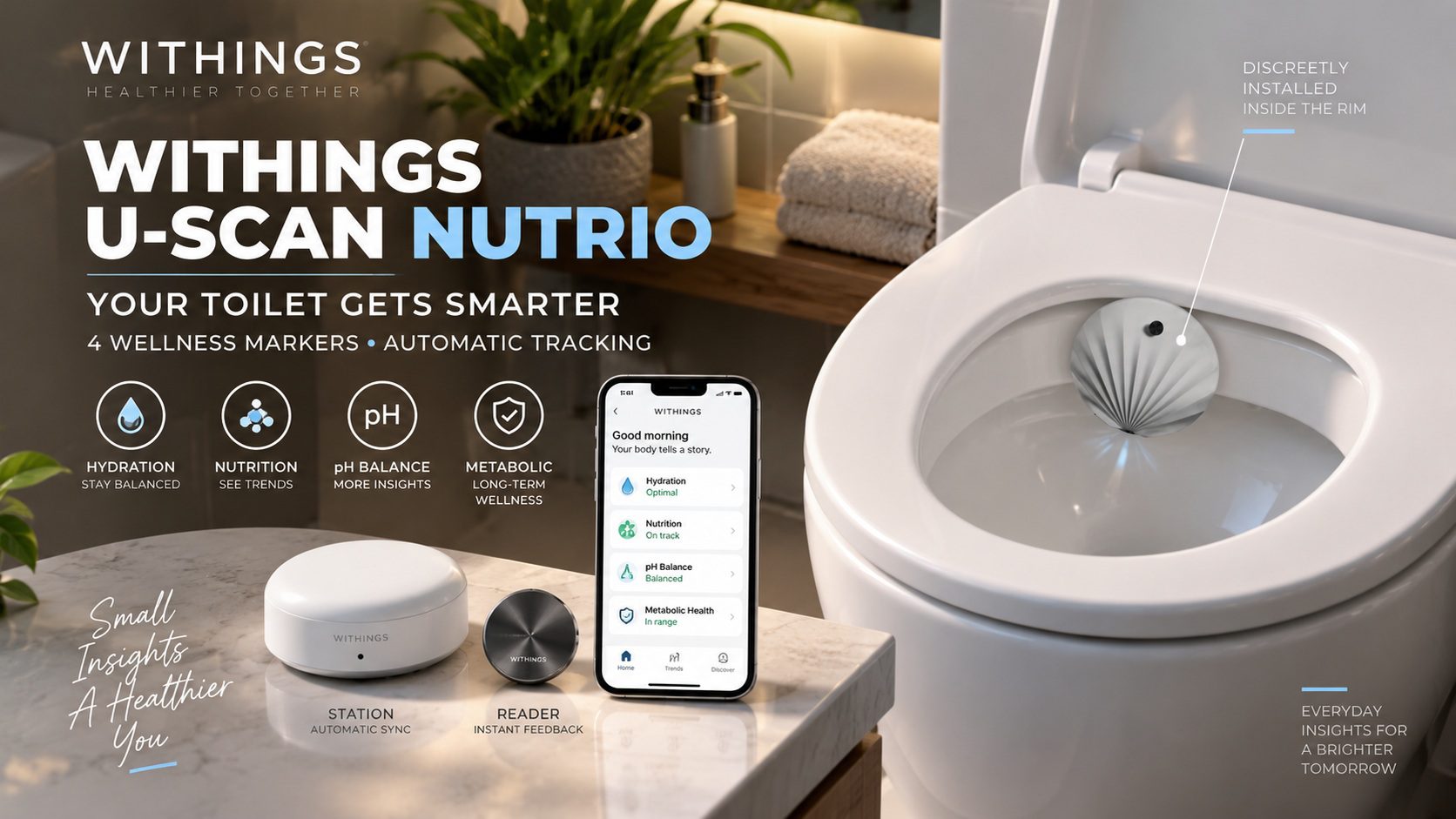
Withings U-Scan Nutrio turns your toilet into an automated wellness tracker
The Withings U-Scan Nutrio may be one of the more unusual connected wellness devices to reach the consumer market.
Instead of sitting on your wrist, finger or bedside table, U-Scan lives inside your toilet.
The small sensor automatically analyses urine and sends the resulting information to the Withings app.
Nutrio focuses on four parameters: hydration-related specific gravity, vitamin C, ketones and pH balance.
The idea is not to diagnose illness.
In fact, Withings explicitly states that U-Scan Nutrio is not a medical device and its measurements should not be used for diagnosis.
Instead, the system turns urine into another source of longitudinal wellness information.
That distinction matters.
Smartwatches have made continuous heart rate, sleep and activity tracking ordinary. U-Scan asks whether another type of useful health information has been sitting unnoticed in the bathroom all along.
Withings U-Scan Nutrio automatically analyses urine
The Withings U-Scan Nutrio is designed to sit inside a compatible toilet bowl.
Withings supplies small, medium and large toilet clips to help position the reader.
Once installed, the system can take measurements without requiring the user to collect a sample in a separate container.
That automation is central to the concept.
Traditional urine testing requires deliberate action.
U-Scan attempts to turn the process into something that happens naturally during an existing daily routine.
Results then move into the Withings ecosystem rather than remaining on a disposable test strip.
Four parameters form the core of Nutrio
The Nutrio cartridge measures four parameters.
These are specific gravity, pH, ketones and vitamin C.
Withings translates some of these into more consumer-friendly terminology.
Specific gravity contributes to its HydroStatus information, while pH becomes Bio-Acidity.
Ketones provide information related to energy metabolism.
Vitamin C measurement adds another nutrition-related data point.
The four measurements are therefore not four diagnoses.
Instead, they provide information that users can observe alongside diet, exercise and other lifestyle factors.
HydroStatus looks at water balance
U-Scan Nutrio measures urine specific gravity as part of its HydroStatus feature.
Specific gravity reflects how concentrated or diluted urine is.
Withings uses that measurement to provide information about water balance.
For someone tracking exercise, diet or general wellness, changes over time may provide useful context.
However, this needs an important qualification.
U-Scan Nutrio cannot diagnose clinical dehydration.
Withings specifically excludes that use.
HydroStatus should therefore be understood as a wellness-tracking feature rather than a substitute for medical assessment.
Ketone tracking looks at energy metabolism
The Withings U-Scan Nutrio also measures ketones.
Ketones are produced when the body uses fat as an energy source under conditions where carbohydrate availability is lower.
That makes the measurement potentially interesting for people following ketogenic diets, practising intermittent fasting or participating in endurance training.
The value comes from tracking.
Instead of manually performing a separate urine strip test whenever someone wants a reading, U-Scan can integrate measurements into a regular schedule.
However, ketone information from Nutrio remains wellness data.
It should not be used to diagnose diabetes or another medical condition.
Vitamin C becomes another trackable parameter
Vitamin C is the third nutrition-related parameter measured by Nutrio.
Dietary intake can influence urinary vitamin C.
U-Scan therefore gives users another data point to consider alongside their nutritional habits.
The Withings app can place that information into a longer-term trend rather than presenting a single isolated result.
That is an important difference between connected health technology and conventional one-off testing.
A single reading tells you what happened at one moment.
Repeated measurements can show whether a pattern develops.
Nevertheless, users should not interpret U-Scan’s vitamin C measurement as a diagnosis of a nutritional deficiency.
Bio-Acidity tracks urinary pH
The fourth measurement is pH, which Withings presents through its Bio-Acidity feature.
Urinary pH can vary for several reasons, including dietary factors.
Again, the value of the connected system lies in observing patterns.
Users can see how readings change over time rather than relying on memory or manually recording individual test strips.
However, pH data can also be easy to overinterpret.
A change does not automatically indicate that something is medically wrong.
Withings positions Bio-Acidity within general fitness and wellness tracking rather than clinical diagnosis.
The cartridge performs repeated measurements
U-Scan uses replaceable cartridges.
The Nutrio cartridge contains the chemistry required to perform its four measurements.
Withings says a cartridge provides around 100 individual biomarker results.
Because each measurement generates several biomarker results, that translates into repeated testing rather than 100 complete four-marker sessions.
The exact testing schedule is managed through the Withings app.
Withings supports measurement schedules of up to five times per week depending on the selected plan.
That allows users to collect enough information to observe trends without necessarily measuring every bathroom visit.
Cartridges have a limited lifespan once opened
The consumable nature of the cartridge is an important part of owning U-Scan.
Withings says test strips inside an opened cartridge expire after three months once exposed to air.
A sealed cartridge has a stated shelf life of 15 months.
Users should therefore install an opened cartridge promptly rather than storing it for later use.
This also means U-Scan is not a one-time hardware purchase in the conventional sense.
Ongoing measurements require replacement cartridges.
Potential buyers should consider that recurring requirement alongside the initial hardware.
Withings offers Proactive and Intensive plans
Withings currently structures U-Scan Nutrio around two packages: Proactive and Intensive.
The Proactive package includes one cartridge with the reader and station.
The Intensive option includes two cartridges and supports a more frequent measurement approach.
Automatic cartridge renewal forms part of Withings’ intended ownership model.
That turns U-Scan into something closer to a monitoring service than a conventional standalone gadget.
The physical reader provides the platform.
Cartridges provide the ongoing tests.
Meanwhile, the app and Withings+ turn the resulting measurements into trends and guidance.
Wi-Fi moves results into the Withings app
The Withings U-Scan Nutrio uses Wi-Fi synchronisation.
This removes another manual step.
Users do not need to type results into an app after every measurement.
The data moves into Withings’ software ecosystem, where it can become part of a broader wellness record.
The Withings app supports iOS and Android.
Withings also lists compatibility with Apple Health, Google Health Connect and Google Fit.
That matters because U-Scan data becomes more useful when considered alongside other wellness information rather than existing in isolation.
Withings+ adds interpretation around the measurements
Collecting data is relatively easy.
Understanding what to do with it is harder.
Withings therefore places U-Scan within its Withings+ ecosystem.
The service adds trends, health scores, guidance and personalised recommendations.
That reflects a wider change in connected wellness technology.
Manufacturers increasingly compete not only on what their sensors can measure but also on how effectively software can turn those measurements into understandable information.
For U-Scan, that layer is especially important.
Most consumers already understand what step count means.
Far fewer routinely interpret urinary specific gravity or pH.
Up to five measurements can be scheduled each week
Withings says U-Scan can support up to five weekly measurements.
The app manages measurement scheduling.
That is useful because more data is not automatically better.
A controlled schedule makes it easier to compare readings under reasonably consistent circumstances.
It also extends the usefulness of the consumable cartridge.
The goal is longitudinal tracking rather than testing every single time someone uses the bathroom.
Users can therefore build a dataset gradually.
The reader is surprisingly small
The U-Scan reader measures approximately 90 × 32mm.
It weighs around 134g.
Those dimensions matter because the device needs to remain inside the toilet without becoming excessively intrusive.
Withings has designed the reader around that environment rather than adapting a conventional countertop testing device.
The unit is also water and splash resistant.
Withings specifies an IP45 protection rating for the reader.
That does not mean it should be treated as indestructible or submerged outside its intended use.
Battery life reaches approximately three months
Withings rates the U-Scan battery for approximately three months.
The system includes a separate U-Scan Station for cleaning and wireless charging.
Charging uses a Qi-based wireless system.
The station itself connects through USB-C.
This means users do not need to connect a charging cable directly to the toilet-mounted reader.
Instead, the reader can be removed and placed on its dedicated station.
That arrangement makes sense for a device designed to spend most of its operating life in a wet bathroom environment.
The cleaning station is part of the system
The U-Scan Station does more than provide somewhere to store the reader.
It forms part of the cleaning and charging process.
Withings includes cleansing powder with the cartridge package.
Protective gloves are also supplied.
This is an important reminder that U-Scan is not a maintenance-free sensor.
It operates in a challenging environment.
Regular cleaning and correct handling therefore form part of normal ownership.
Automation removes much of the measurement process, but it does not eliminate hygiene requirements.
U-Scan Nutrio is for adults
Withings specifies the Nutrio cartridge for users aged 18 and older.
The company explains that urine parameter reference ranges differ substantially for babies, children and teenagers.
Consequently, Nutrio should not be treated as a household diagnostic system suitable for everyone.
It is an adult wellness-tracking product.
That restriction also reinforces the importance of using the device according to its intended purpose rather than interpreting it as a general medical laboratory.
Withings has published analytical performance data
One interesting aspect of U-Scan is that Withings publishes analytical testing information for the Nutrio cartridge.
The company evaluated the system using a semi-quantitative approach.
Its support documentation reports precision figures of 97% for pH, 87% for specific gravity, 100% for ketones and 99% for vitamin C.
These numbers require context.
They describe Withings’ analytical performance testing methodology.
They should not be interpreted as percentages describing the device’s ability to diagnose disease.
Nutrio does not have that intended use.
Certain substances can interfere with measurements
Urine chemistry is complicated.
Withings therefore identifies several substances that may interfere with U-Scan measurements.
Its product documentation lists captopril, nitrofurantoin, phenazopyridine and riboflavin among the potential interfering substances.
The company also provides additional guidance around circumstances that can affect specific measurements.
That makes following the product instructions important.
Automating a chemical test does not remove the biological and chemical factors that can influence its result.
Users taking medication or concerned about their health should rely on appropriate professional medical advice rather than trying to interpret U-Scan results independently.
Withings U-Scan Nutrio specifications
| Specification | Withings U-Scan Nutrio |
|---|---|
| Product type | Toilet-mounted wellness analyser |
| Nutrio measurements | 4 |
| Specific gravity | Yes |
| pH | Yes |
| Ketones | Yes |
| Vitamin C | Yes |
| HydroStatus | Based on specific gravity |
| Bio-Acidity | Based on pH |
| Measurements | Up to 5 weekly |
| Connectivity | Wi-Fi |
| Reader dimensions | 90 × 32mm |
| Reader weight | 134g |
| Reader protection | IP45 |
| Battery life | Approx. 3 months |
| Charging | Wireless via U-Scan Station |
| Station connection | USB-C |
| App | Withings |
| Apple Health | Compatible |
| Google Health Connect | Compatible |
| Google Fit | Compatible |
| Minimum age | 18 |
| Medical device | No |
| Diagnostic use | No |
South African availability remains unconfirmed
The Withings U-Scan Nutrio page supplied to TechnologyBlog is Withings’ European store.
TechnologyBlog has not confirmed an official South African listing for U-Scan Nutrio.
Therefore, we are not publishing converted European pricing as South African pricing.
There is another practical consideration.
U-Scan relies on replacement cartridges.
Importing the initial hardware would make considerably less sense if replacement Nutrio cartridges were difficult or expensive to obtain locally.
South African buyers should therefore investigate both hardware availability and the long-term cartridge supply before considering an imported system.
Withings U-Scan Nutrio makes the bathroom part of connected wellness
The Withings U-Scan Nutrio represents a fascinating direction for consumer wellness technology.
Wearables already collect information while we sleep, exercise and move through the day.
Smart scales analyse the body when we step onto them.
U-Scan extends that idea into the bathroom.
Its biggest innovation may not be any individual measurement.
Specific gravity, pH, ketone and vitamin C testing already exist.
Instead, Withings automates the collection process and connects repeated measurements to software that can track them over time.
That could make previously inconvenient information considerably easier to observe.
However, the boundary between wellness and medicine needs to remain clear.
U-Scan Nutrio is not designed to diagnose dehydration, diabetes, kidney disease, vitamin deficiency or other conditions.
Used within those limits, it demonstrates something more interesting: connected health technology is moving beyond watches and scales and into parts of everyday life that previously generated useful biological information without anyone routinely measuring it.


