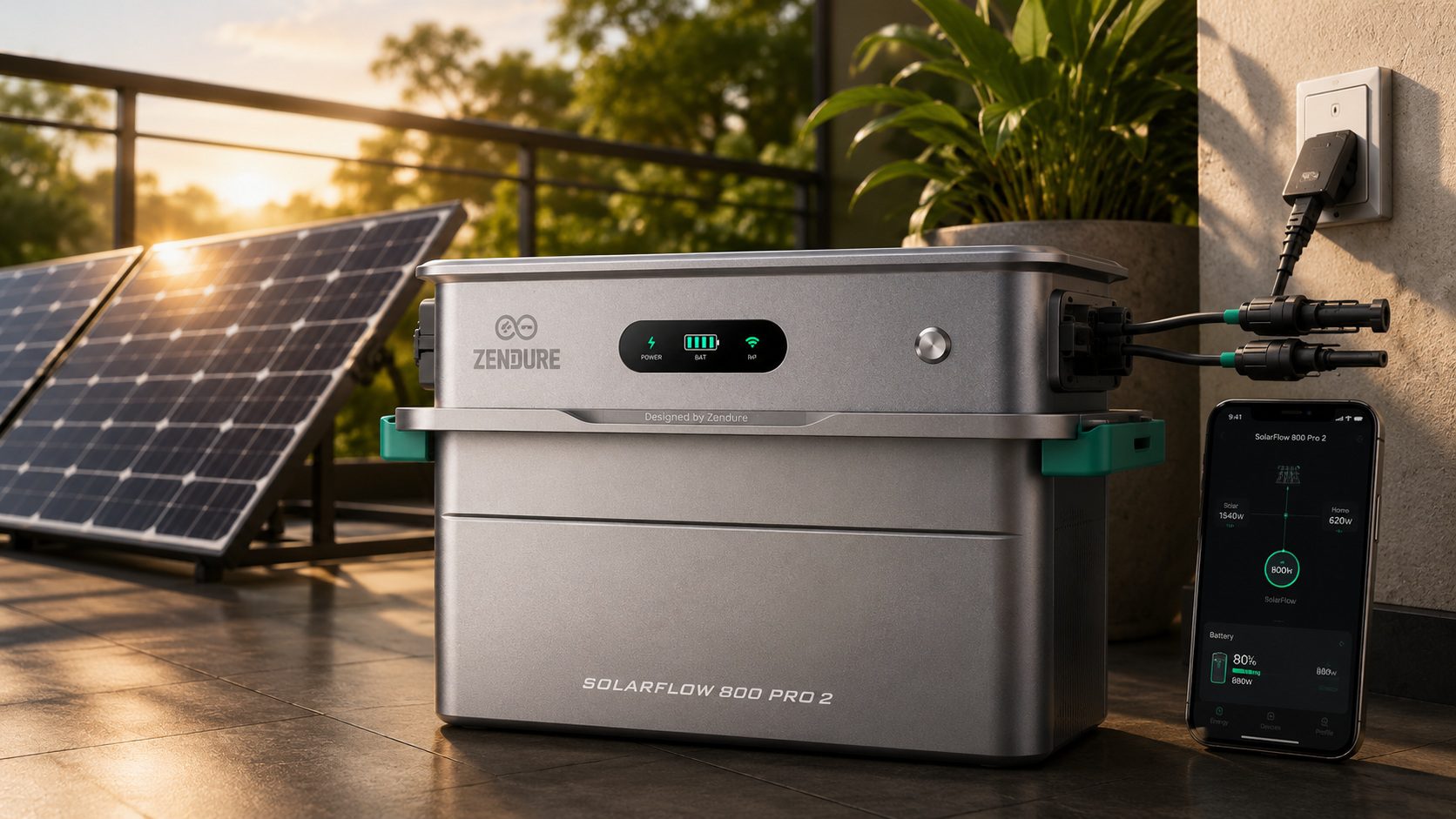
Zendure SolarFlow 800 Pro 2 combines solar, battery storage and backup power
The Zendure SolarFlow 800 Pro 2 combines solar input, a 1.92kWh LiFePO₄ battery, an 800W grid-tied output and a separate 1,000W backup outlet in one compact home-energy system.
Four independent MPPT inputs can handle up to 2,640W of solar panels, while Wi-Fi, Bluetooth and Zendure’s home energy management software control how the system stores and distributes electricity.
The concept could appeal to South Africans looking for smaller solar-storage systems. However, there is an important catch: Zendure designed the SolarFlow platform around European plug-in balcony solar regulations, and TechnologyBlog could not verify the required South African grid-connection approval for this model.
Zendure SolarFlow 800 Pro 2 starts with a 1.92kWh battery
The Zendure SolarFlow 800 Pro 2 contains a 1,920Wh, 48V LiFePO₄ battery.
That works out to 1.92kWh of nominal energy storage before conversion losses and battery-management limits.
The capacity places the system below the larger 5kWh and 10kWh batteries commonly used in whole-home solar installations.
That is intentional.
Zendure targets the SolarFlow 800 Pro 2 at smaller energy loads, apartments, balconies, workshops and households that want to store solar power without installing a large conventional battery bank.
The new Pro 2 also uses a more compact enclosure than the previous SolarFlow 800 Pro. Zendure says the underlying capabilities remain essentially the same, while the new design reduces the physical footprint.
Four MPPT inputs support up to 2,640W of solar
Solar input is one of the system’s stronger specifications.
Zendure provides four independent MPPT channels, with each accepting up to 660W. Together, they support a maximum rated PV input of 2,640W.
Each input operates between 14V and 55V, and Zendure warns users not to exceed a 55V open-circuit voltage.
The independent MPPT design can help when panels face different directions or receive different levels of sunlight.
Instead of forcing every panel to operate under one shared tracking point, the system can manage the four inputs independently.
For a South African household with limited roof, balcony or garden space, that flexibility could prove more useful than the headline 2,640W figure alone.
SolarFlow 800 Pro 2 can send 800W into the home
The built-in bidirectional inverter supports a maximum continuous 800W grid-connected AC output at 230V and 50Hz.
Zendure also allows up to 1,000W of AC input from the grid.
In the European use case, the unit connects to a household circuit and supplies stored or solar-generated electricity into the home’s electrical system.
That 800W limit may sound modest compared with a conventional 5kW inverter, but the purpose is different.
The SolarFlow does not try to run an entire house from its grid-connected output. Instead, it can offset continuous household consumption from appliances such as routers, televisions, refrigerators, computers and other smaller loads.
Smart meters can help match output to household demand
Zendure can pair the system with devices such as its Smart Meter 3CT and supported Shelly meters.
Using real-time household consumption data, SolarFlow can adjust how much power it supplies rather than sending a fixed amount regardless of demand.
This could help reduce unwanted export where the system and local regulations support that configuration.
Users can also schedule charging and discharging according to time.
Zendure supports grid charging, which means the battery can recharge from AC electricity rather than relying exclusively on solar.
That capability has more value in markets with strong time-of-use electricity tariffs.
Whether the tariff-optimisation features provide the same benefit in South Africa depends on the household’s electricity tariff and local utility.
Zendure adds AI to its energy-management system
Zendure calls its software platform an AI-driven Home Energy Management System, or HEMS.
The system can consider solar production, electricity consumption, battery state, weather forecasts and dynamic tariffs when planning charging and discharging.
Zendure claims its system can reduce energy costs by up to 42% under the company’s laboratory model using dynamic electricity pricing.
South African consumers should not treat that figure as an expected saving.
Zendure bases the claim on its own testing and a pricing model that may differ substantially from local electricity tariffs. Actual savings depend on solar production, consumption, electricity prices and system configuration.
The more useful feature is the automation itself.
A home-energy system that knows when solar generation exceeds household demand can decide whether to store the excess or make it available later.
A separate outlet provides 1,000W during an outage
The Zendure SolarFlow 800 Pro 2 also provides a dedicated off-grid AC outlet.
Zendure rates it at 1,000W continuous output, with a 1,200W peak lasting up to 10 seconds. The company says the outlet can switch to battery operation in around 15 milliseconds after grid power fails once users enable the off-grid function.
That distinction is important.
The grid-connected output does not keep energising the household electrical network during an outage. Like other compliant grid-connected inverters, the system stops feeding the grid when mains electricity disappears.
Only equipment connected to the dedicated off-grid outlet receives backup power.
That makes the SolarFlow 800 Pro 2 different from a conventional South African backup inverter wired into an essential-loads distribution board.
1,000W backup power has clear limits
A 1,000W output can keep several low-power devices running, but it cannot handle every household appliance.
A router, laptop, television or several LED lights could fit comfortably within that limit.
High-power appliances require much more caution.
Kettles, heaters, ovens, tumble dryers, microwaves and many air conditioners can exceed 1,000W individually.
The backup outlet should therefore be viewed as a way to keep selected essential devices running rather than a whole-home load-shedding solution.
A 1.92kWh battery also does not mean 1,920W of equipment can run for exactly one hour. Conversion losses, battery-management limits and other factors reduce usable runtime.
Storage can expand beyond the built-in battery
Zendure allows users to add compatible SolarFlow batteries.
Its current support documentation lists AB1000, AB2000 and several later S and X variants, with support for stacked expansion batteries. Zendure currently quotes a maximum system capacity of up to 11.52kWh for the supported configuration.
That changes the system significantly.
A 1.92kWh SolarFlow setup targets relatively small energy requirements. Expanding towards 11.52kWh moves it much closer to the storage capacity associated with a conventional residential battery system.
Buyers should check battery compatibility carefully, as not every newer Zendure battery family works with the SolarFlow 800 Pro 2.
The compact unit weighs 22.6kg
Zendure measures the SolarFlow 800 Pro 2 at 392.7 × 236.3 × 276mm and approximately 22.6kg.
Despite its “balcony” branding, this is not a lightweight portable power station.
The system contains a substantial battery and power electronics inside its relatively small enclosure.
Zendure gives the main unit an IP65 rating when used in the appropriate configuration. However, the company warns that it does not retain the same water-resistance protection when the off-grid socket is in use or when its waterproof cover is not correctly closed.
That qualification matters for outdoor installations.
Zendure SolarFlow 800 Pro 2 specifications
| Specification | Zendure SolarFlow 800 Pro 2 |
|---|---|
| Model | ZDSF800P |
| Product type | Solar-storage / balcony energy system |
| Built-in battery | 1,920Wh |
| Battery chemistry | LiFePO₄ |
| Battery voltage | 48V |
| PV inputs | 4 independent MPPT |
| Maximum PV input | 2,640W |
| Maximum per MPPT | 660W |
| PV operating range | 14–55V DC |
| Grid-connected AC output | Up to 800W |
| Off-grid AC output | Up to 1,000W |
| Off-grid peak | 1,200W for 10 seconds |
| AC charging input | Up to 1,000W |
| AC voltage/frequency | 230V / 50Hz |
| Wi-Fi | 2.4GHz |
| Bluetooth | Yes |
| Smart-meter support | Yes |
| Grid charging | Yes |
| Expandable storage | Yes |
| Maximum stated capacity | Up to 11.52kWh |
| Protection | IP65* |
| Dimensions | 392.7 × 236.3 × 276mm |
| Weight | Approx. 22.6kg |
*IP65 protection depends on configuration and correctly closed protective covers.
The South African problem is the plug-in design
This is where the Zendure SolarFlow 800 Pro 2 becomes particularly interesting from a South African perspective.
Zendure says European users can install the system themselves and plug the grid-connected system into a suitable household socket. It cites European grid standards including VDE-AR-N 4105 and EN 50549.
South Africans should not assume the same installation approach applies here.
Eskom states that households and small businesses with embedded-generation systems below 100kVA must register them when they operate in parallel with its network, even when the system does not export electricity. Eskom also requires an NRS 097-2-1 type-test certificate for the inverter as part of its registration requirements.
Municipal requirements can differ.
For example, the City of Cape Town requires authorisation for new solar PV and battery systems connected within its supply area and requires approved inverters and professional sign-off.
TechnologyBlog could not verify the SolarFlow 800 Pro 2 on a South African approved-inverter list or find an NRS 097-2-1 certificate for this exact model.
European certification does not automatically mean South African approval
This distinction is important.
Zendure’s European certifications demonstrate that the company designed the inverter around grid-safety requirements in those markets.
They do not automatically establish compliance with South Africa’s NRS 097-2 requirements.
NRS 097-2 covers issues including anti-islanding, voltage and frequency behaviour, power quality and safe disconnection for small-scale embedded generation connected to low-voltage networks.
The local utility ultimately decides whether it will approve a grid-connected installation.
Consumers considering importing a SolarFlow 800 Pro 2 should therefore verify approval before buying it for grid-connected use.
It is not a conventional South African home inverter
The product category itself also needs some context.
South Africans have become familiar with hybrid inverters connected to rooftop solar, large battery banks and an essential-loads distribution board.
The SolarFlow 800 Pro 2 approaches home energy from another direction.
It packages a small battery, solar charge controllers and microinverter into one compact system designed around relatively low grid-connected output.
That could make sense for apartments or homes with relatively modest daytime loads.
Its dedicated 1,000W off-grid outlet can also provide basic backup.
However, anyone expecting it to behave like a 5kW hybrid inverter powering an entire essential-loads circuit will find the SolarFlow’s capabilities much more limited.
Could the SolarFlow concept work in South Africa?
Technically, the idea is appealing.
South Africa has abundant solar resources, and not every household needs a large rooftop system with a 5kW or 10kW inverter.
A compact battery that can accept more than 2.6kW of solar input and intelligently shift that energy into evening use could suit smaller homes.
The 1.92kWh starting capacity also makes sense for people who want to cover a baseline electrical load rather than power an entire property.
The problem is not the concept.
It is whether the exact equipment carries the local certification and utility approval needed for a legal grid-connected installation.
Until that is confirmed, South Africans should treat the SolarFlow 800 Pro 2 as an interesting international energy-storage product rather than a ready-to-install local alternative to a conventional solar inverter.
Is the Zendure SolarFlow 800 Pro 2 worth watching?
The Zendure SolarFlow 800 Pro 2 packs an unusual amount of home-energy technology into a small enclosure.
A 1.92kWh LiFePO₄ battery provides the storage, while four MPPT inputs can accept up to 2,640W of solar. The 800W grid-connected output can offset smaller household loads, and the separate 1,000W off-grid outlet provides limited backup during an outage.
Zendure’s smart-meter integration and energy-management software add another useful layer.
For European apartments and homes operating under plug-in balcony-solar regulations, the appeal is obvious.
South Africa changes the equation.
Our embedded-generation rules do not allow consumers to assume that a European plug-and-play inverter can simply connect to a household socket and feed power into the electrical installation.
Until Zendure confirms South African certification, distribution and grid approval for the SolarFlow 800 Pro 2, the most interesting thing about the product may be the direction it represents: smaller, modular solar-storage systems that sit somewhere between a portable power station and a full residential inverter installation.


