Rainbow Six Siege is nearly 11 years old – and Ubisoft is still expanding it
Most multiplayer shooters do not survive for a decade.
Tom Clancy’s Rainbow Six Siege is approaching its eleventh anniversary, yet Ubisoft Montreal is still releasing operators, changing maps, rebuilding competitive systems and planning for another year of development.
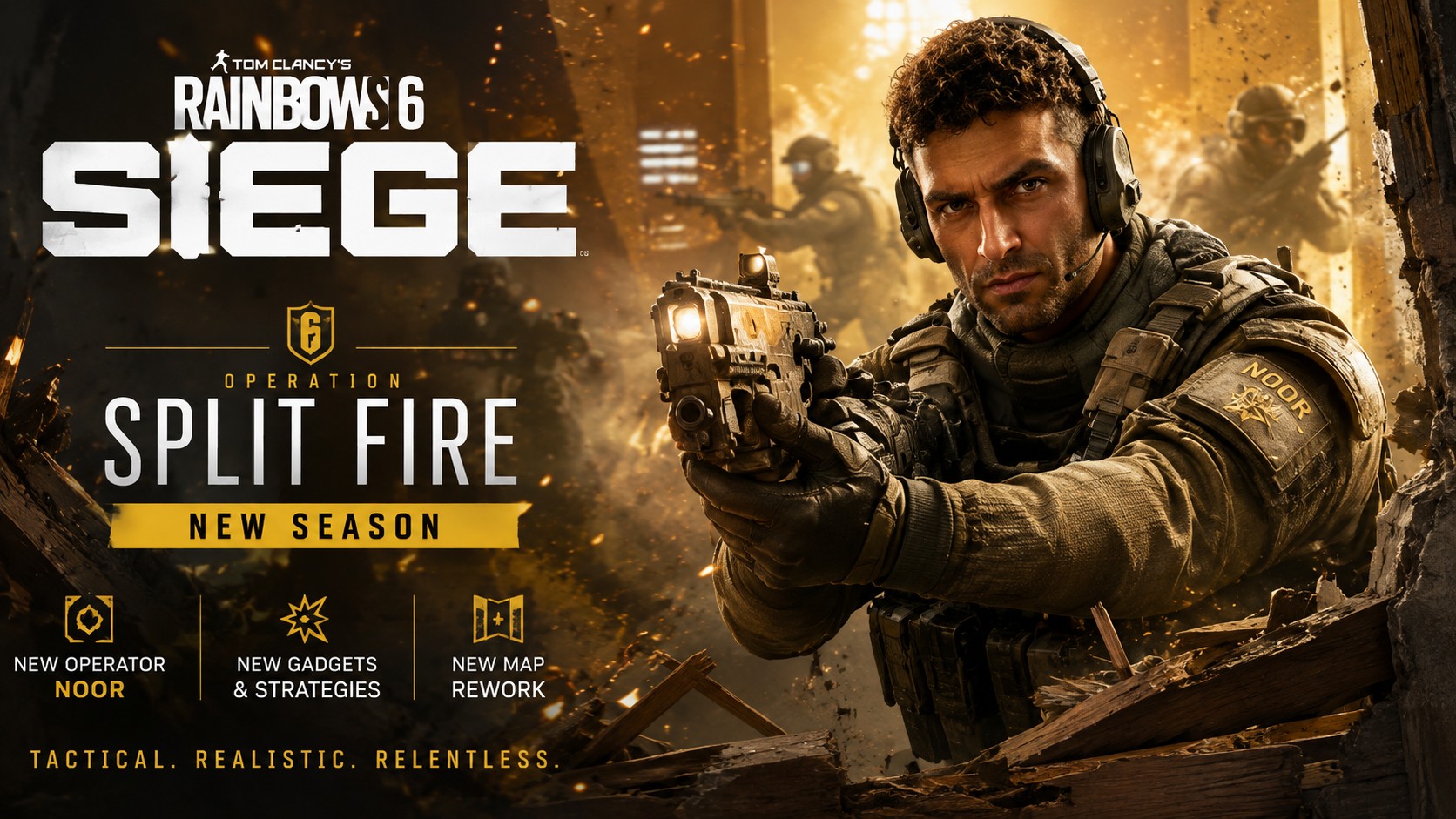
The latest chapter arrived on 1 September 2026 with Operation Split Fire, the third season of Year 11. It introduces Noor, a new defensive Operator specifically designed to counter ballistic shields, alongside changes to Villa, balancing updates and a new 3v3 Arcade mode.
More importantly, players are still turning up.
When TechnologyBlog checked SteamDB on 3 September, roughly 80,000 players were playing Rainbow Six Siege simultaneously on Steam, while its 24-hour peak had exceeded 95,000. The game reached its Steam record of 201,933 concurrent players in March 2024.
Those numbers only represent Steam.
Almost 11 years after launch, Siege is clearly not surviving on nostalgia.
Rainbow Six Siege started very differently
Ubisoft Montreal released the game on 1 December 2015.
At its core, the concept was straightforward.
Two teams enter a highly destructible environment.
Attackers need to gather information, breach defensive positions and complete their objective.
Defenders reinforce the environment, deploy gadgets and attempt to control where the attackers can move.
However, Siege separates itself from conventional multiplayer shooters through the importance it places on information.
Knowing where someone is can be more valuable than simply having faster reactions.
A drone beneath a doorway can reveal a defender.
A camera can expose an attacker.
Breaking part of a wall can create a new firing angle.
Destroying a floor can allow someone to attack vertically.
Consequently, the map itself becomes part of the weapon set.
Destruction remains one of Siege’s defining ideas
Many games contain destructible objects.
Siege builds strategies around destruction.
Defenders can reinforce certain walls and hatches. Attackers can then bring equipment specifically designed to breach those reinforced surfaces.
Other walls can be opened with explosives or gunfire.
Floors and ceilings can also create opportunities.
That means a room does not always have the same entrances.
A team can create its own.
Ubisoft describes destruction as a tactical tool rather than simple environmental chaos. Players can use it to create lines of sight, alter routes and gain positional advantages.
Even after more than a decade of multiplayer shooters, that remains an important part of Siege’s identity.
Operators changed the traditional tactical-shooter formula
The Operator system adds another layer.
Instead of every player entering a match with broadly identical capabilities, individual characters bring specialised gadgets and weapons.
Some Operators gather intelligence.
Others deny areas.
Certain attackers specialise in breaching.
Defenders can create traps, disrupt electronics or protect important positions.
The result is a constantly changing tactical puzzle.
A strategy that works against one defensive combination may fail against another.
Therefore, players need to understand more than their own Operator.
They gradually learn what everyone else can do.
That creates enormous depth.
Unfortunately, it also creates one of Siege’s biggest barriers for newcomers.
Starting Rainbow Six Siege in 2026 can be intimidating
Joining an established competitive game is rarely easy.
Joining one with almost 11 years of accumulated knowledge is considerably harder.
Experienced players understand maps.
They know common angles.
They recognise Operator abilities.
They know which walls usually get reinforced.
They understand where defenders commonly place equipment.
They may even know where someone is likely to stand before seeing them.
A new player knows almost none of this.
Siege can therefore punish beginners brutally.
However, Ubisoft has spent considerable effort improving onboarding.
The current Steam description highlights a structured clearance-level progression intended to teach new players the fundamentals before they enter more demanding tactical matches.
Year 11 also introduced rotating trial Operators, allowing players to experiment with different characters without immediately unlocking everything.
That does not make Siege easy.
It makes learning it more manageable.
The free-access model changes the entry point
One of the biggest changes to modern Siege is how players can start.
Steam now lists Rainbow Six Siege as free to play.
However, there is an important qualification.
Free Access provides Quick Match and Unranked modes with a selection of Operators. Features including Ranked, Siege Cup, additional Operators and certain cosmetics require payment to unlock.
Therefore, the free version functions as a substantial entry point rather than automatically unlocking the complete competitive experience.
For newcomers, that is still valuable.
You can learn the shooting.
You can test the destruction.
You can experience the Operator system.
Most importantly, you can decide whether Siege’s slower and more punishing style suits you before spending money.
This is not a shooter built around constant respawning
Siege demands a different mentality from many multiplayer FPS games.
Death matters.
During its core tactical rounds, getting eliminated removes you from direct combat for the remainder of that round.
That changes behaviour.
Running blindly into a room carries consequences.
Checking corners matters.
Listening matters.
Information matters.
Waiting can sometimes be the correct move.
So can retreating.
A player with excellent mechanical aim can certainly dominate encounters, but raw shooting skill cannot solve every situation.
The best teams combine aim with communication, map knowledge and planning.
That is why Siege can feel extremely satisfying when everything works.
A successful round may have been won before the final shot because someone gathered the right information thirty seconds earlier.
Operation Split Fire has just arrived
The timing of this article is particularly relevant because Siege has just entered another major season.
Operation Split Fire launched on 1 September 2026 as Year 11 Season 3.
Its headline addition is Noor, an Egyptian defensive Operator.
Noor is designed specifically as a shield counter.
His Horus Lance fires a projectile that can attach to ballistic shields or environmental surfaces before emitting flames.
That creates an interesting defensive option against attackers relying heavily on shield-based pressure.
However, the season contains considerably more than one character.
Villa has received targeted changes
Operation Split Fire also changes Villa.
Rather than completely replacing the map, Ubisoft has made targeted updates to walls, hatches and bomb-site locations.
That approach makes sense for an established competitive game.
Players may have spent years learning a map.
Completely rebuilding it can erase large amounts of accumulated knowledge.
Smaller structural changes can disrupt established strategies without removing the map’s entire identity.
Consequently, experienced players still recognise Villa while having to rethink certain approaches.
That balance between familiarity and disruption is important in a game this old.
A new 3v3 mode changes the scale
Split Fire also introduces a new 3v3 Arcade mode.
Siege’s identity remains firmly connected to 5v5 Attack versus Defence.
However, smaller modes give players somewhere to experience the game’s mechanics outside the full competitive structure.
Arcade modes can also provide useful breaks from Ranked.
Not every session needs to involve maximum pressure.
For a game famous for tension, offering different ways to engage with the mechanics helps broaden its appeal.
Ranked is getting another high-level challenge
Operation Split Fire is also preparing the Legend Division.
Ubisoft describes it as a new playlist intended for the best players, with availability planned for the mid-season period.
This follows the Ranked 3.0 overhaul introduced during Year 11 Season 2.
That season, Operation System Override, launched on 2 June 2026 and also introduced the Calypso Casino map, a new assault rifle and a Dokkaebi remaster.
The continued attention to Ranked demonstrates something important.
Ubisoft is not simply adding cosmetic content to keep an old game generating revenue.
Core competitive systems are still being changed.
Year 11 has already been unusually busy
Split Fire is only one part of Siege’s 2026 story.
Year 11 began in March with Operation Silent Hunt.
That season introduced an Operator almost nobody would have expected when Siege originally launched.
Solid Snake.
The Metal Gear Solid character joined Rainbow Six Siege as an attacking Operator, complete with his own weapon and abilities. Ubisoft also introduced a Metal Gear-inspired event alongside balancing updates and modernised versions of Oregon, Villa and Coastline.
Then June brought System Override.
September has now brought Split Fire.
For a game entering its eleventh year, this is not a maintenance schedule.
It is an active development roadmap.
Ubisoft is already talking about Year 12
Perhaps the strongest indication of Siege’s future comes from what Ubisoft has said about next year.
The official Rainbow Six Siege site currently points towards four Operators per year beginning with Year 12.
That matters.
The game is approaching eleven years old, yet Ubisoft is discussing increasing the flow of playable characters rather than preparing to wind development down.
Siege has effectively become a platform.
Its original 2015 release is simply the foundation underneath years of additional systems, maps, Operators and balancing changes.
Steam activity remains remarkably strong
The player numbers make that continued investment easier to understand.
When TechnologyBlog checked on 3 September 2026, SteamDB recorded roughly 80,000 concurrent Steam players.
Its 24-hour peak stood above 95,000.
The game’s all-time Steam record is 201,933 concurrent players, reached on 17 March 2024.
SteamDB also tracks more than 1.5 million reviews across its available review data, with an overall rating above 81%.
Again, Steam does not represent the entire Rainbow Six Siege community.
However, it gives us a useful public measurement.
An almost 11-year-old competitive shooter pulling tens of thousands of simultaneous players on one PC platform remains significant.
Steam reviews tell a more complicated story
Current Steam sentiment is not uniformly positive.
The store lists overall English reviews as Very Positive, with around 82% of more than 800,000 English reviews positive.
Recent reviews are lower.
At the time TechnologyBlog checked, approximately 72% of more than 13,000 reviews from the previous 30 days were positive, giving the game a Mostly Positive recent rating.
That difference is worth noting.
A game can maintain a large audience while parts of its community remain frustrated with individual changes.
In fact, that tension is common in long-running competitive games.
Players invest enormous amounts of time learning systems.
When those systems change, opinions can become intense.
Balance becomes harder with every new Operator
Adding content to Siege creates an unusual development problem.
Every new Operator potentially interacts with every existing Operator.
A gadget that looks balanced in isolation may create an unexpected combination elsewhere.
New weapons affect engagements.
Map changes alter strategies.
Operator remasters can revive characters who have fallen out of the competitive meta.
Therefore, Ubisoft is not balancing a static shooter.
It is managing an expanding network of interactions.
Year 11’s roadmap includes repeated balancing updates throughout individual seasons.
That work is essential.
Without it, years of accumulated content could eventually make the competitive game impossible to control.
Siege rewards knowledge in a way few shooters do
This complexity also explains why experienced players stay.
Time invested in Siege has value.
Learning a map makes you better.
Understanding sound makes you better.
Knowing Operator interactions makes you better.
Recognising common defensive setups makes you better.
Eventually, players start seeing possibilities that newcomers do not.
A wall is no longer simply a wall.
It might be a firing angle.
A ceiling might be an entrance.
A drone might provide enough information to win a round.
That learning process creates long-term attachment.
Leaving Siege for another shooter means leaving behind years of specialised knowledge.
Returning means that much of that knowledge still has value.
Sound can be as important as vision
Siege also encourages players to listen carefully.
Footsteps can reveal movement.
Gunfire provides information.
Breaking surfaces can expose where an opponent is operating.
Gadgets create recognisable audio cues.
Therefore, headphones are not simply about immersion.
They can become part of situational awareness.
Combined with cameras and drones, sound turns the game into an information battle.
You are constantly trying to determine where the opposing team is while preventing them from doing the same to you.
That creates tension before anyone fires a shot.
Communication transforms the experience
Siege can be played without a coordinated group.
However, communication dramatically changes what teams can accomplish.
One player can use a drone to identify a defender.
Another can prepare a breach.
Someone else can cover the angle created by that breach.
Defenders can similarly share camera information, coordinate traps and reposition around an attack.
A team that communicates can therefore outperform a collection of individually skilled players who refuse to work together.
That makes Siege particularly rewarding with friends or a regular squad.
It also explains why competitive play remains such an important part of the game’s identity.
The game still has an esports identity
Steam’s community tags continue to identify Siege strongly with competitive play and esports.
That fits naturally with the design.
Rounds are relatively short.
Teams have clearly defined objectives.
Information matters.
Operators create strategic variation.
Destruction makes maps dynamic.
Meanwhile, the absence of unlimited respawning during the core tactical round gives individual decisions weight.
Those characteristics make high-level matches understandable as tactical contests rather than simple shooting exhibitions.
Even spectators who cannot replicate professional mechanical skill can understand why information, positioning or a particular breach changed a round.
Free access could introduce another generation of players
The biggest challenge facing an old competitive game is replacing people who eventually leave.
No community stays unchanged forever.
Players move to other games.
Work and family reduce gaming time.
Some simply lose interest.
Therefore, reducing the barrier for newcomers becomes increasingly important.
The current free-access structure gives Siege a way to keep feeding new players into the ecosystem.
Someone who ignored the game for ten years can now simply try it.
The difficult part comes afterwards.
Ubisoft needs to convert that curiosity into players willing to learn an unusually complicated tactical shooter.
South African players can test it without buying the full experience
For South African gamers, free access provides a useful advantage.
There is no need to make a purchase simply to determine whether Siege appeals to you.
Download it.
Learn the basic mechanics.
Try Quick Match and Unranked.
See how the game performs on your connection.
Because Siege is an online competitive shooter, latency and network stability can affect the experience.
However, TechnologyBlog has not conducted controlled tests across South African ISPs, so we will not invent a local latency figure.
Actual performance will depend on factors including the player’s connection, routing and the servers used for a particular session.
The free entry point means you can judge that yourself before deciding whether to unlock more of the game.
It remains a difficult game to recommend casually
Rainbow Six Siege is not necessarily a game someone should install expecting immediate mastery.
There is a learning curve.
There are many Operators.
Maps contain enormous amounts of tactical information.
Veteran players can be unforgiving.
Mistakes can end your round quickly.
Sometimes you will die without immediately understanding how the other player saw you.
That can be frustrating.
However, those same characteristics create the satisfaction.
Eventually, you recognise the angle.
You remember the sound.
You predict the breach.
You understand what the opposing Operator is trying to do.
The game starts making sense.
That moment is what Siege has built its longevity around.
Nearly 11 years later, Siege still has somewhere to go
Rainbow Six Siege could have become a very different story.
It could have launched in 2015, received several years of updates and gradually disappeared as Ubisoft moved towards a sequel.
Instead, the original game kept changing.
Operators accumulated.
Maps evolved.
Competitive systems were rebuilt.
Onboarding improved.
The entry model changed.
Now, in September 2026, Operation Split Fire has just launched, tens of thousands of Steam players are online simultaneously, and Ubisoft is already discussing Year 12.
That makes Siege unusual even among successful live-service games.
Its longevity is no longer simply about keeping an old game alive.
Ubisoft Montreal has turned it into a tactical platform that continues to evolve around a community that has spent years learning how it works.
For newcomers, that history makes Siege intimidating.
For veterans, it is exactly why leaving can be difficult.
And with four Operators per year planned from Year 12, Ubisoft clearly believes there are still plenty of walls left to breach.


