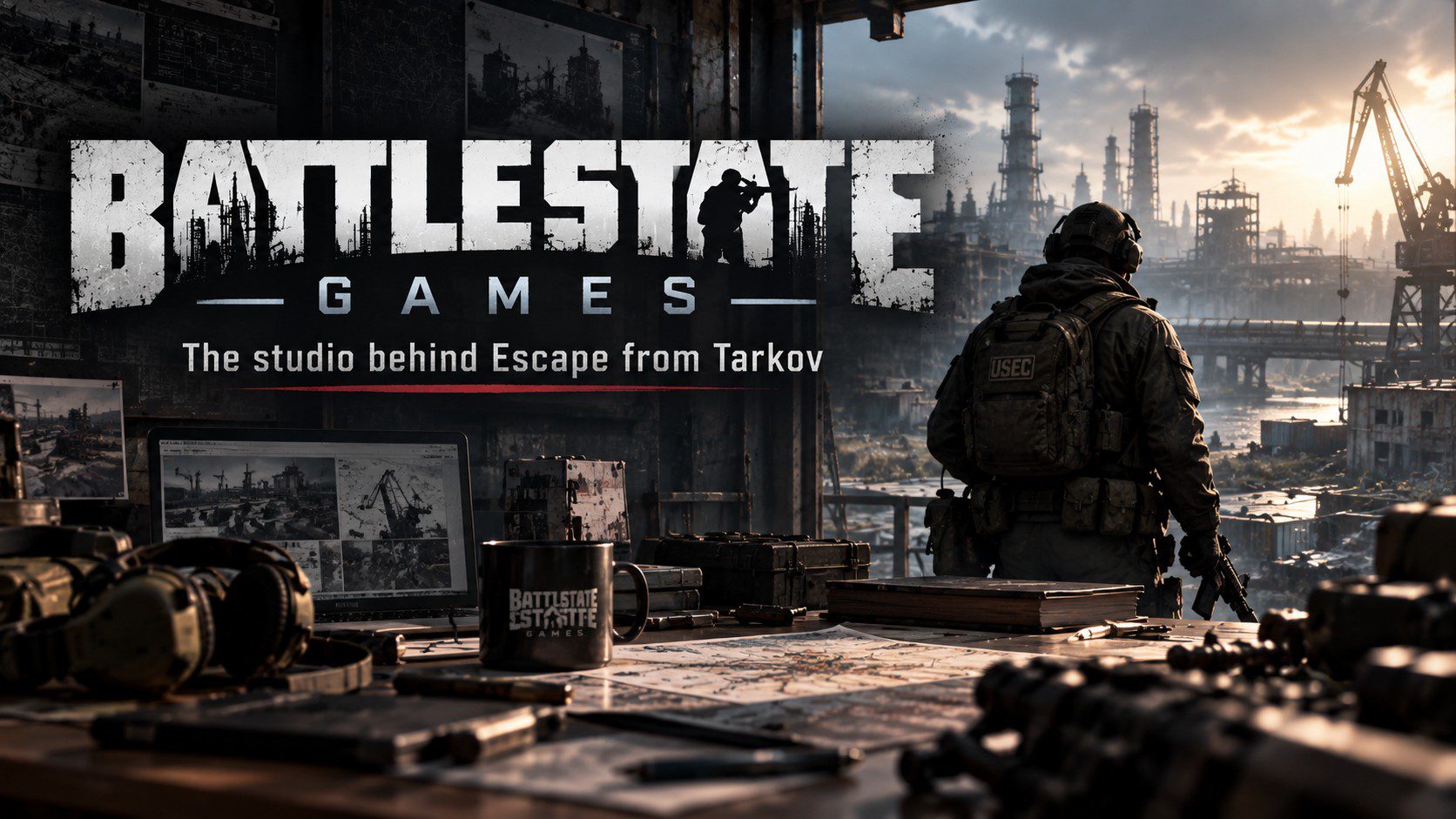
Battlestate Games built a studio around the risk of losing everything
Battlestate Games built its reputation around a simple but uncomfortable idea: a firefight should have consequences long after the shooting stops.
In Escape from Tarkov, a player can spend hours gathering equipment, preparing weapons and completing tasks. Then one badly judged encounter can cost them much of what they carried into a raid.
That pressure is not an accidental side effect. It is central to the experience the developer wanted to create.
Rather than building a conventional multiplayer shooter around repeated matches and predictable equipment, Battlestate Games connected combat to an economy, persistent progression and the possibility of permanent equipment loss.
The result became one of the most recognisable names in extraction shooters.
However, the studio’s story also involves a long development process, ambitious technical decisions and a community that has repeatedly challenged its approach to monetisation and communication.
Battlestate Games emerged from an earlier shooter project
The roots of Battlestate Games reach back to AbsolutSoft, where members of its foundational team worked on Contract Wars.
That browser-based shooter provided practical experience developing online multiplayer combat.
It also helped the developers build technical knowledge around Unity, the engine they would later use for Tarkov.
In a developer feature published by Unity, Nikita Buyanov explained that the earlier project gave the team both experience and a technological foundation for its next ambitions.
The same feature identifies Battlestate Games as a St Petersburg-based development team focused on its interconnected Russia 2028 fictional universe.
Made with Unity
That background matters because Tarkov did not emerge from a studio experimenting with its first shooter.
Its developers already understood multiplayer weapons, online systems and the challenges of building competitive environments.
They wanted to take those ideas considerably further.
The Russia 2028 universe came before Tarkov’s success
Battlestate Games did not initially conceive Tarkov as an isolated fictional setting.
The studio developed its work around the wider Russia 2028 universe, a fictional world involving political instability, military conflict and competing interests.
Contract Wars formed part of that background.
Escape from Tarkov expanded the setting into a more demanding survival experience.
Instead of focusing primarily on repeated competitive matches, Tarkov would place players inside a hostile region where they needed to manage equipment, resources and the consequences of their decisions.
The setting provided the foundation.
The gameplay systems made the project distinctive.
Battlestate Games made preparation part of combat
Most first-person shooters concentrate their complexity inside the match.
Tarkov asks players to make important decisions before entering one.
Weapons need ammunition and magazines. Protective equipment takes up space, while medical supplies and other items must be selected before deployment.
A more expensive loadout can provide advantages.
However, it also creates greater potential losses.
That relationship changes the player’s priorities.
The objective is no longer simply to enter a match and eliminate opponents. Players must consider whether the equipment they bring is appropriate for the task and whether the possible reward justifies the risk.
Battlestate Games turned preparation into part of the strategy.
Escape from Tarkov connected realism with uncertainty
Tarkov’s military simulation influences are visible throughout its design.
Weapons support extensive modification. Ammunition selection matters, while protective equipment and injuries affect combat outcomes.
However, the game’s distinctive tension comes from combining those mechanics with incomplete information.
Players do not always know where opponents are positioned.
They cannot predict every encounter.
Even a successful firefight may leave somebody too badly injured to continue safely.
Consequently, survival involves much more than shooting accurately.
A player who understands the environment, manages resources and avoids unnecessary engagements may achieve more than somebody who wins several fights but fails to extract.
Battlestate Games made equipment loss meaningful
The possibility of losing equipment changes how players behave.
A customised rifle represents more than its immediate usefulness.
It may contain valuable components, ammunition and attachments acquired through earlier raids or purchases.
A backpack can contain items required for progression.
Medical supplies and protective equipment also represent resources that need replacing.
When players die, losing eligible equipment can undo part of that preparation.
This creates an emotional attachment to ordinary inventory items.
A player may hesitate before taking an expensive weapon into a dangerous location.
That hesitation is part of Tarkov’s design.
Battlestate Games created a game where deciding what to risk can be as important as knowing how to fight.
The studio built an economy around survival
Tarkov’s traders, tasks, equipment and Hideout systems connect individual raids to longer-term progression.
Recovered items can serve several purposes.
Some can be sold.
Others support upgrades, crafting or objectives.
Equipment may be kept for a future raid rather than used immediately.
This makes looting more complicated than collecting whatever appears valuable.
Players gradually learn which resources matter to their current goals.
They also learn that the value of an item depends on circumstances.
A modest object needed for a task can become more important than a weapon that looks impressive.
The game’s economy reinforces its wider philosophy.
Knowledge creates advantages.
Extraction became the defining objective
The central difference between Tarkov and a conventional multiplayer shooter is the importance of leaving alive.
Players enter dangerous locations, search for resources, fight enemies and attempt to complete objectives.
However, success often depends on reaching an available extraction point.
A raid can contain several successful encounters and still end in failure.
That makes the final journey particularly tense.
A player carrying valuable loot has more to lose than somebody who has found nothing.
Another fight might offer rewards, but it could also destroy everything already achieved.
Battlestate Games made retreat a legitimate strategic decision.
Sometimes the smartest player is the one who knows when to leave.
Escape from Tarkov grew through years of testing
Tarkov became widely known long before its eventual full release.
Its extended testing period allowed Battlestate Games to introduce new maps, weapons, equipment, progression systems and technical changes over time.
Players became accustomed to a game that could change significantly between major updates.
The development process also created expectations.
Some players invested years in the project, purchasing editions, learning systems and adapting to repeated changes.
Others became frustrated by technical problems, balancing decisions or the length of the development cycle.
That relationship between the developer and its audience became one of Tarkov’s defining features.
Battlestate Games developed its own approach to community feedback
Tarkov’s community has played an important role in shaping its development.
Players analyse ammunition, weapons, maps and progression systems in extraordinary detail.
They also scrutinise technical performance, cheating, matchmaking and changes to the game’s economy.
This creates a demanding environment for the developer.
A change that appears minor on paper can have substantial consequences across the game.
Adjusting equipment availability affects progression.
Changing enemy behaviour affects survival.
Altering matchmaking can influence how players experience raids.
Battlestate Games therefore operates a game where almost every major system interacts with several others.
That complexity is both a strength and a development challenge.
The studio expanded beyond one style of Tarkov gameplay
Battlestate Games also developed Escape from Tarkov: Arena.
Arena takes the franchise’s weapon handling and combat systems into a more structured competitive environment.
It retains the wider Tarkov identity but places greater emphasis on direct encounters rather than the complete extraction loop.
The studio’s wider catalogue therefore includes different approaches to the same underlying fictional world and combat technology.
However, the main extraction shooter remains the project most closely associated with Battlestate Games.
Battlestate Games faced criticism over The Unheard Edition
One of the studio’s most significant public controversies emerged in April 2024.
Battlestate Games introduced The Unheard Edition, a premium version of Tarkov that initially included access to a persistent cooperative PvE mode.
The announcement attracted criticism from existing players, particularly owners of the earlier Edge of Darkness edition.
That edition had been marketed with access to future DLC, creating disagreement over whether the new PvE mode should be included.
Players also questioned whether certain paid benefits created unfair gameplay advantages.
Battlestate Games subsequently adjusted its plans amid the backlash.
GameSpot
+1
The controversy mattered because Tarkov’s long development had depended heavily on players purchasing access before full release.
Those supporters expected the developer to honour the value of earlier editions.
Paid advantages remain an important question
The debate surrounding Tarkov’s editions did not end with the original 2024 announcement.
In May 2026, Battlestate Games released The Unheard Steam Edition Expansion Pack.
The Steam listing includes an expanded stash, larger PMC pockets, trader benefits and a 20% experience bonus that also applies to group members.
These are documented features, not merely community allegations.
Steam Store
Whether such benefits constitute unacceptable pay-to-win mechanics remains a matter of debate.
However, they raise a legitimate design question.
When a game makes progression and resources central to its difficulty, paid progression advantages can affect how players perceive fairness.
That issue belongs in any balanced account of Battlestate Games.
Escape from Tarkov finally reached full release
On 15 November 2025, Escape from Tarkov reached its full 1.0 release.
The milestone followed years of development, testing and expansion.
It also brought the game to Steam, placing it on a major storefront beyond Battlestate’s original distribution approach.
Full release represented an important moment for the studio.
Tarkov had already established a substantial reputation.
However, releasing version 1.0 meant presenting the project as a completed commercial game rather than one still awaiting that milestone.
The transition did not end ongoing development.
Battlestate continued updating the game in 2026.
The Official Escape from Tarkov Wiki
Battlestate Games entered 2026 with new responsibilities
By 2026, the studio faced a different challenge from the one it had during Tarkov’s early development.
The question was no longer whether its unusual shooter concept could attract an audience.
The question was how to maintain and improve an established game.
Post-release work included technical fixes, AI adjustments and changes to locations.
The June 2026 patch history, for example, documents fixes involving raid entry, enemy behaviour and geometry on the Icebreaker location.
The Official Escape from Tarkov Wiki
These are not necessarily the most exciting changes to advertise.
However, they matter to players whose experience depends on stable systems and predictable rules.
A game that punishes mistakes severely must also work reliably enough for players to understand why they failed.
Unity helped Battlestate Games realise its ambitions
Battlestate Games’ relationship with Unity is another important part of its history.
The studio did not develop its own engine from scratch.
Instead, it built on experience acquired during the Contract Wars era.
Unity’s developer case study explains how that technical background helped the team establish Tarkov’s foundation.
The project then required the studio to develop complex interconnected systems involving equipment, combat and multiplayer interaction.
Made with Unity
Tarkov demonstrates that a game’s identity does not depend entirely on proprietary technology.
Its distinctive character comes from how Battlestate Games uses those tools.
Battlestate Games helped shape expectations for extraction shooters
Tarkov’s influence extends beyond its own player base.
The game helped establish a recognisable modern extraction-shooter structure built around entering dangerous environments, collecting resources and escaping with valuable equipment.
Other games have explored different interpretations of that formula.
However, Tarkov remains closely associated with the demanding end of the genre.
Its particular combination of detailed equipment management, tactical combat and persistent progression created a distinctive experience.
That influence does not mean Battlestate Games invented every element of extraction gameplay.
It means the studio brought those elements together in a form that became highly recognisable.
The studio’s greatest strength is also its greatest challenge
Battlestate Games built Tarkov around complexity.
Weapons, ammunition, injuries, traders, equipment, progression and extraction all interact.
That complexity gives players reasons to keep learning.
It also makes the game difficult to balance, explain and maintain.
A new player may struggle to understand why an encounter went badly.
An experienced player may be frustrated when an update changes a familiar system.
The developer must satisfy an audience that values difficulty while also addressing technical and accessibility concerns.
Removing too much complexity could undermine Tarkov’s identity.
Leaving problems unresolved could undermine confidence in the experience.
That tension is central to the studio’s future.
Why Battlestate Games matters in 2026
Battlestate Games built its reputation by refusing to make survival feel routine.
The studio took experience gained from earlier online shooters and developed a game where preparation, knowledge and risk carry unusual weight.
Its long development process helped establish Tarkov as a major name in extraction shooters.
However, that success also created responsibilities.
Players expect technical stability.
They expect fair treatment.
They expect clear communication about paid editions and progression advantages.
And they expect the demanding combat systems to remain worth mastering.
Tarkov reached full release in 2025, but the studio’s work did not end there.
In 2026, Battlestate Games is responsible for maintaining the experience it spent years building.
Its legacy is already visible in the genre.
The more important question now is how successfully it can sustain that legacy.
