Mortal Shell II expands the Soulslike formula with eight warriors and stamina-free combat
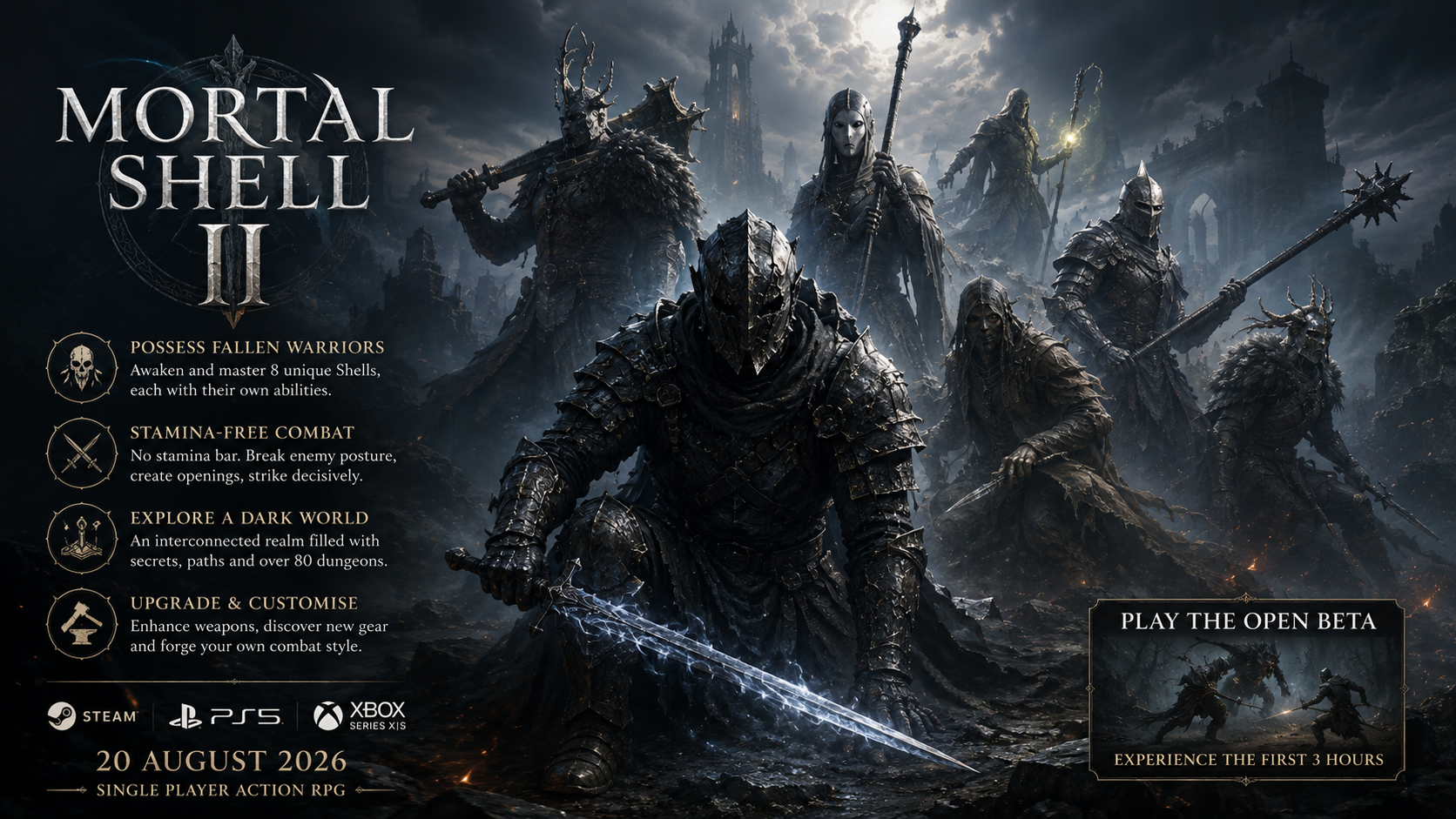
Mortal Shell II is set to launch worldwide on 20 August 2026, bringing Cold Symmetry’s follow-up to the 2021 Soulslike Mortal Shell to PC, PlayStation 5 and Xbox Series X|S.
The sequel keeps the original game’s central idea of inhabiting the bodies of fallen warriors, but expands it into an interconnected open world with more exploration, deeper weapon upgrades, more dungeons and eight playable Shells.
For South African PC gamers, the standard edition is currently listed at R599 on Steam. The game also has an open beta that lets prospective players experience the opening section before deciding whether to purchase the full release.
A bigger Mortal Shell rather than a completely different game
The original Mortal Shell released in 2021 as a compact Soulslike built around difficult combat, exploration and its distinctive Shell system.
Mortal Shell II retains that identity but expands the scope considerably.
Players take the role of the Harbinger, a prophesied figure tasked with reclaiming the blessed Ova of the Undermether from creatures and zealots guarding it. The journey takes players through an interconnected world containing forests, temples, icy areas and other dark-fantasy environments.
The developers describe the world as deliberately compact rather than a huge open-world map filled with empty space.
That is an important distinction.
The intention is to give players freedom to explore while keeping the world dense enough that exploration regularly produces something useful, whether that means a new Shell, weapon, upgrade, story element or dungeon.
Eight Shells replace the traditional character-class approach
One of the game’s defining mechanics is the Shell system.
Instead of creating a conventional character class and sticking with it, players discover the remains of fallen warriors throughout the world. Those bodies can then be awakened and possessed, giving the Harbinger access to different abilities and combat characteristics.
The full game features eight playable Shells.
Each Shell provides its own abilities and combat identity, giving players another way to approach the game’s enemies and bosses.
The system also encourages exploration because finding another Shell is not simply about discovering a new piece of equipment. It can fundamentally change how the player approaches combat.
Combat removes stamina restrictions
One of the most significant changes from the traditional Soulslike formula is the combat system.
Mortal Shell II does not restrict combat through a stamina bar. Instead, players can attack, evade and manoeuvre without the conventional stamina management found in many Soulslike games.
That does not mean the game is intended to be easy.
The developers have instead built the combat around enemy posture, positioning and finding opportunities to deliver critical attacks.
Players can use different tactics to break an opponent’s posture before exploiting the opening.
The game also expands weapon customisation, with extensive upgrade options and additional weapons that can complement each Shell’s abilities.
This could make the sequel feel different from the original even for players who already understand the first game’s basic mechanics.
The world is built around exploration
The developers describe the world as an interconnected network of paths rather than a collection of completely separate levels.
Players can wander away from the obvious route and discover new areas, equipment, Shells and story elements.
The official Steam listing says the world contains more than 80 dungeons, each designed to challenge the abilities and equipment players have accumulated.
That gives exploration a practical purpose.
Rather than simply moving through the world to reach the next boss, players have reasons to investigate side paths and hidden areas.
The combination of compact open-world design and numerous dungeons also appears to be one of the sequel’s biggest departures from the original game’s more limited structure.
The beta gives players three hours before launch
Cold Symmetry has already given players an opportunity to try the game through an open beta.
The beta provides access to approximately the first three hours of the game, beginning with the prologue and extending into the first explorable region. Players can encounter optional dungeons, mini-bosses and other challenges during the trial.
The beta was released on Steam on 5 June 2026 and later became available on PlayStation 5 and Xbox Series X|S.
Importantly, beta progress does not transfer completely to the final game.
Currency, weapons, Shells, collectibles and other items found during the beta reset at launch. Players who progressed far enough through the beta could, however, unlock the option to skip the prologue in the full game.
That makes the beta more useful as a try-before-you-buy opportunity than as an early-access version of the complete game.
The beta has received a strong response
The open beta has received a notably positive response on Steam.
At the time of checking, the beta had thousands of reviews and a Very Positive rating, with the English-language reviews also rated Very Positive.
That is encouraging for Cold Symmetry, but it needs to be put into context.
These are reviews of an in-development beta, not the finished Mortal Shell II.
The developers themselves warned beta players that they could encounter bugs, performance issues and other rough edges while development continued.
TechnologyBlog.co.za therefore would not use the beta’s rating as a substitute for a review of the finished game.
South African price is R599 on Steam
For South African PC gamers, Steam’s regional pricing lists the standard edition at R599.
The international Steam price is US$49.99, but the South African price is the more useful figure for local readers.
The Devout Edition is priced at US$59.99 internationally. Its main additional benefit is Advanced Access, allowing purchasers to begin playing up to 72 hours before the standard release, along with eight Obsidian Shell skins.
The standard game therefore launches on 20 August, while Devout Edition owners can access it from 17 August.
That distinction is particularly relevant for South African players who see the game already being played online before the official launch date.
PC requirements are fairly demanding
The published PC requirements are considerably higher than those of many older Soulslike games.
The minimum specification requires Windows 10 or 11, an Intel Core i7-10700K or AMD Ryzen 5 3600, 16GB of RAM and either an Nvidia RTX 2060 Super 8GB or AMD Radeon RX 6600 8GB.
The game also requires DirectX 12, 30GB of storage and an SSD.
Mortal Shell II PC requirements
| Specification | Minimum |
|---|---|
| Operating system | Windows 10 / 11 |
| CPU | Intel Core i7-10700K / AMD Ryzen 5 3600 |
| Memory | 16GB RAM |
| GPU | Nvidia RTX 2060 Super 8GB / AMD Radeon RX 6600 8GB |
| DirectX | Version 12 |
| Storage | 30GB |
| Storage type | SSD required |
The developer has not published a recommended PC specification on the Steam listing available at the time of reporting.
For South African gamers, that means the hardware requirement deserves attention before buying. Meeting the minimum specification does not guarantee a particular frame rate or graphical setting.
TechnologyBlog.co.za has not independently benchmarked the game, so no performance claims are being made here.
It remains a single-player experience
Mortal Shell II is listed as a single-player action RPG.
That is useful information for South African players because there are no multiplayer server regions or latency considerations to worry about.
The game is designed around exploration, combat and character progression rather than online competition.
For players with unreliable internet connections, that also makes it a more straightforward proposition than an online-only action game, although an internet connection may still be required for downloading and updating the game.
What makes Mortal Shell II different?
The Soulslike market is crowded, so Mortal Shell II needs more than difficult combat to stand out.
Its strongest differentiators are the combination of Shell possession, stamina-free combat and a deliberately compact interconnected world.
The eight Shells give players different approaches to combat, while the absence of stamina restrictions changes the rhythm of encounters.
The world design then encourages players to experiment and explore rather than simply following a linear path from one boss to another.
Those are meaningful changes from simply producing another Soulslike sequel with a new setting.
South African players can try before they buy
For South African gamers considering Mortal Shell II, the most useful option may be the open beta.
Rather than relying solely on trailers or reviews, players can experience the opening section themselves and determine whether the combat, visual style and difficulty suit them.
The R599 Steam price also puts the standard edition below many new AAA releases, although whether it represents good value will ultimately depend on the finished game’s length, performance and quality.
Those are areas that cannot be fairly judged from the pre-release material alone.
For now, Mortal Shell II looks like a substantial expansion of the original rather than a simple sequel built around more of the same. The real test begins when the full game releases on 20 August 2026 and players can explore its complete world, all eight Shells and its full combat and progression systems.