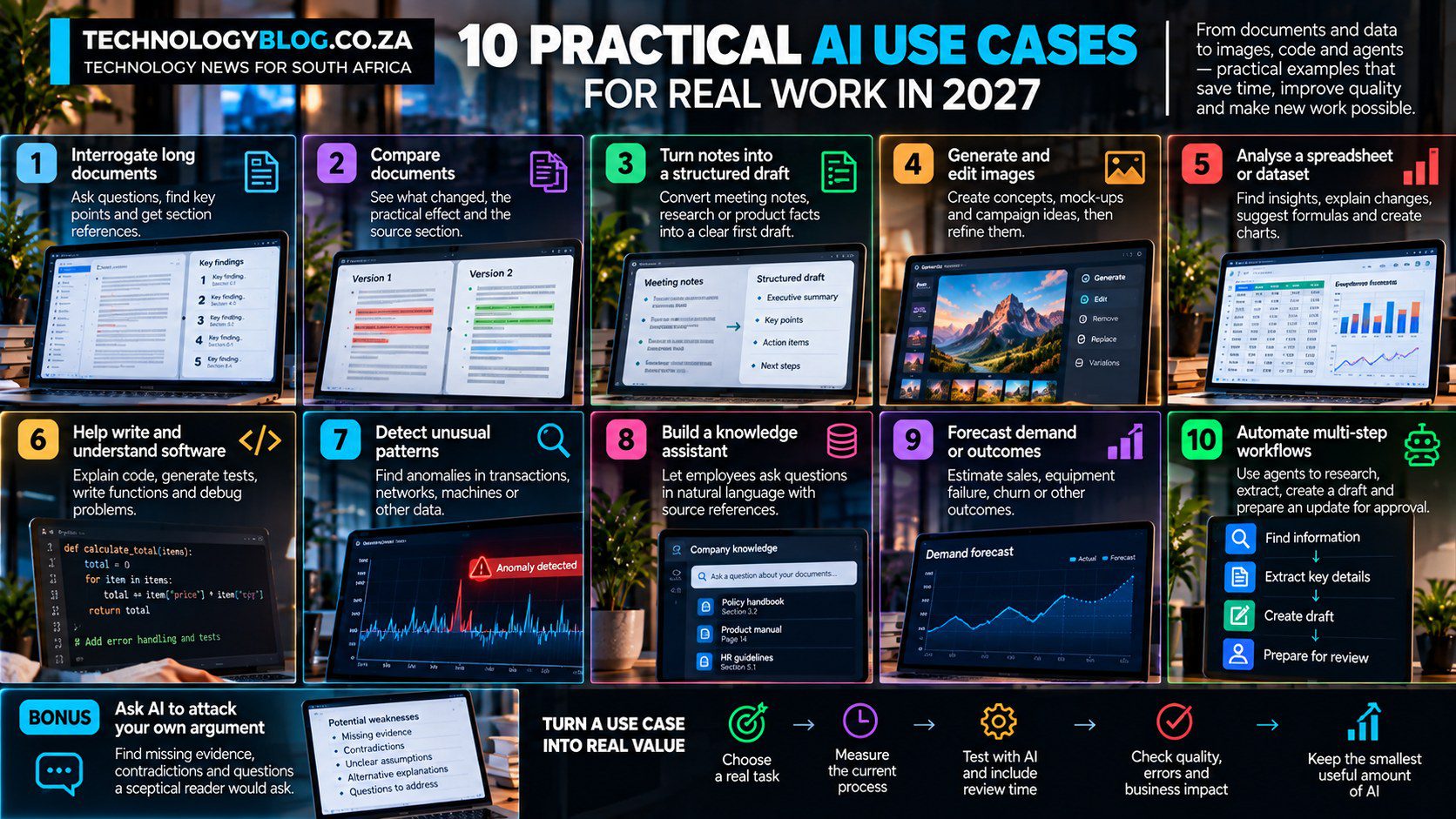
10 Useful Things You Can Do With Artificial Intelligence in 2027
“Use AI” is not a workflow. “Compare these two policy documents and show me the clauses that changed” is.
That difference is what separates a technology demo from useful work. The ten examples below span generative AI, predictive systems and agents rather than treating every AI use case as another chatbot prompt. Each one can be tested against a practical question: does it save time, improve quality or make previously impractical work possible?
1. Interrogate a long document instead of reading it linearly
Upload a report, manual or policy to a supported AI system and ask targeted questions.
A better request than “summarise this” is: identify the five findings relevant to my decision, give the section supporting each one and mark anything the document does not establish.
Traceability turns document Q&A from a convenience into a reviewable workflow.
2. Compare two versions of the same document
Give the system the old and new versions of a policy, contract, proposal or technical specification.
Ask for a table containing the changed text, the practical effect and the source section. The human reviewer can then focus on substantive changes instead of rereading everything.
For legal material, this supports rather than replaces qualified review.
3. Turn rough information into a structured first draft
AI is strong at transformation when the facts already exist.
Meeting notes can become an action list. Research notes can become a briefing structure. Product facts can become an article outline. The instruction should tell the model not to invent owners, dates or claims that are missing from the source.
This keeps the human’s knowledge at the centre while AI handles organisation.
4. Generate and edit images
Generative image systems can create editorial illustrations, concepts, mock-ups and campaign ideas. Editing systems can remove or replace specific elements and produce variations.
For professional work, control matters more than novelty. Can the tool preserve the product, character or composition while changing one element? Can the publisher distinguish synthetic illustration from documentary photography?
5. Analyse a spreadsheet or dataset
AI can group data, explain large changes, identify anomalies, suggest formulas and generate chart ideas.
Predictive machine learning can go further by forecasting future values or estimating risk.
Important calculations should be reproducible. Ask the system to show the method, then verify the result before it reaches a decision-maker.
6. Help write and understand software
Coding assistants can explain unfamiliar functions, propose tests, write routine code, generate documentation and suggest debugging paths.
The developer remains responsible for the result. Generated code can compile and still be insecure, inefficient or wrong for the architecture.
The best workflow treats AI as a fast collaborator whose work still enters normal engineering review.
7. Detect unusual patterns humans would struggle to scan
Machine-learning systems can monitor transactions, networks, machines or sensors and flag behaviour that differs from the norm.
This is useful for fraud detection, predictive maintenance and operational monitoring.
The hard part is not only finding more anomalies. It is keeping false alarms low enough that the humans responsible for investigation do not ignore the system.
8. Build a natural-language knowledge layer
Organisations can connect AI to approved internal documents so employees ask questions in natural language instead of searching folders manually.
The system should preserve source references and respect the permissions on the underlying documents.
A useful knowledge assistant helps a person find what they are already allowed to know; it does not become a shortcut around access control.
9. Forecast demand, failure or other outcomes
Predictive AI can estimate sales, equipment failure, churn, delivery times or other outcomes from historical patterns.
A forecast is not a promise. Teams need to understand the expected error and monitor whether the world has changed from the data on which the model was evaluated.
This is a very different AI problem from generating text, even though both sit under the same umbrella.
10. Automate part of a multi-step workflow
Agents can combine models with search, files, software and connected tools. For high-impact deployments, NIST’s AI Risk Management Framework provides a useful lifecycle approach to risk management.
A bounded workflow might gather information, extract details, create a draft and prepare an update for approval. The word bounded matters. Permissions should match the task, and consequential actions should require confirmation where appropriate.
Bonus: ask AI to attack your own argument
Instead of generating another draft, ask the model to list missing evidence, unsupported claims, contradictions and questions a sceptical reader would ask.
This is especially useful in journalism, strategy and technical documentation because the human remains the author while the AI acts as a critic.
How to choose the first one
Pick a task you already perform regularly and understand well enough to judge.
Measure the old process. Run the AI-assisted version. Include preparation, review and correction time. If the total effort falls or the quality improves, the workflow has earned a place.
If you need a deeper adoption process, read How to Use Artificial Intelligence in 2027. For workplace examples, continue with AI at Work.
Use the smallest useful amount of AI
Not every one of these jobs requires an autonomous agent or the largest available model. A transcription model, classifier, ordinary search system or deterministic workflow may solve the problem with less cost and less risk.
Start with the minimum capability required. Add complexity only when it solves a real limitation in the simpler approach. This keeps the technology attached to the work rather than the hype cycle.
Keep evidence attached to the result
When AI helps with research, document analysis or factual writing, preserve the references that support the output. A useful-looking paragraph becomes much harder to trust once it has been copied away from the source that justified it.
This is especially important when the result will be published, sent to a client or used in a formal decision. The AI can organise evidence, but the evidence should remain independently reachable.
A good experiment should teach you where the system fails
Do not test only the clean example that made the product look impressive. Try incomplete information, ambiguous instructions and cases where the correct response is to stop or ask for help.
The point of an early experiment is not merely to prove that AI can perform the task. It is to discover the boundary beyond which a person, rule or different tool should take over.


