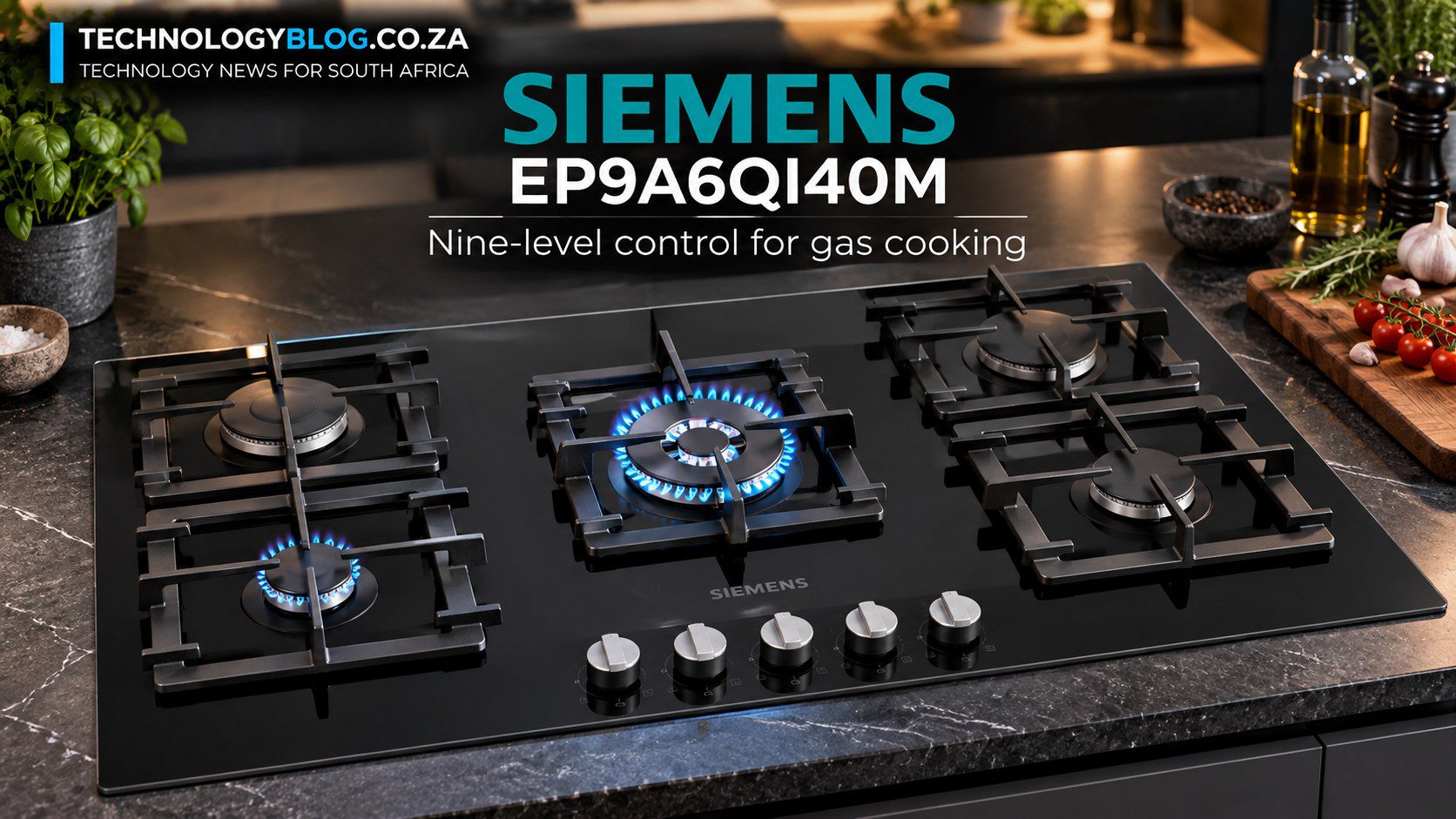
Siemens EP9A6QI40M gives gas cooking nine levels of flame control
The Siemens EP9A6QI40M tackles one of the less precise aspects of cooking with gas.
A conventional gas hob gives immediate visual feedback and responds quickly when someone turns the control knob. However, returning to exactly the same flame setting can involve some judgement.
Siemens approaches that problem with stepFlame Technology.
Instead of relying entirely on visually judging flame height, the EP9A6QI40M divides its flame control into nine defined settings.
That brings an element of repeatability to a 90cm gas hob that otherwise remains deliberately conventional.
There are five cooking positions, physical controls, cast-iron pan supports and a powerful central wok burner.
For households that prefer cooking over a visible flame, the technology is being used to refine gas rather than replace it.
The Siemens EP9A6QI40M provides five cooking positions
The Siemens EP9A6QI40M is a 90cm built-in gas hob with five cooking positions.
That wider format provides more room for cookware than a typical four-burner 60cm hob.
The advantage is not simply the extra burner.
Spacing matters when several pots and pans are being used simultaneously. A fifth cooking position is far less useful if larger cookware prevents the surrounding burners from being used comfortably.
Siemens positions the larger wok burner centrally, with two additional burners on either side.
This creates a symmetrical layout and gives larger cookware a prominent position in the centre of the hob.
stepFlame Technology provides nine defined settings
The most distinctive feature is stepFlame Technology.
Siemens provides nine flame settings rather than relying only on continuous adjustment between minimum and maximum.
That does not change the fundamental way gas cooks.
The flame still heats the cookware directly, and users retain physical control over each burner.
Instead, stepFlame adds reference points.
If a particular pan and recipe works well at a certain setting, returning to that numbered level should be easier than trying to reproduce a flame height by eye.
That can be particularly useful for cooking tasks that need lower and more controlled heat.
Repeatability is the real benefit
Gas is already responsive.
Turn the flame down and the heat source changes immediately. There is no electric element that needs time to cool.
Therefore, stepFlame should not be presented as solving slow response.
Its more useful contribution is repeatability.
Cooking often involves learning where a particular pan behaves best.
One setting may work for bringing liquid towards a boil, while another may maintain a gentle simmer.
Defined levels provide a reference that can be used again.
That is a relatively simple idea, but it addresses a genuine weakness of traditional gas controls.
A 4kW wok burner handles the highest heat
At the centre of the hob is a 4kW wok burner.
This is the highest-output cooking position on the EP9A6QI40M.
A powerful burner is useful when a large pan or wok needs substantial heat.
It can also shorten the initial heating stage for large cookware.
However, 4kW should not be interpreted as the appropriate setting for every cooking task.
High burner output is useful when the cookware and recipe require it. Lower heat remains important for simmering, sauces and more delicate cooking.
The combination of a high-output burner and nine-level flame control therefore makes more sense than maximum power alone.
Cast-iron pan supports provide a solid cooking platform
Siemens uses separable cast-iron pan supports.
Cast iron is well suited to gas hobs because it creates a rigid platform above the burners.
The supports also need to deal with the weight of large cookware, particularly around the central wok burner.
Siemens describes the arrangement as semi-continuous.
That helps cookware move across the cooking area while still allowing the supports to be removed individually for cleaning.
This is an important practical consideration.
A large single-piece support can become awkward to lift and wash.
Breaking the support structure into manageable sections makes routine cleaning easier.
The pan supports and knobs can be removed
Gas hobs inevitably create more cleaning obstacles than a flat induction surface.
There are burner caps, pan supports and physical controls surrounding the cooking area.
Siemens therefore makes the metallic sword-style control knobs detachable.
The pan supports can also be removed.
That exposes more of the tempered-glass surface for cleaning.
It does not make the EP9A6QI40M as simple to wipe down as a completely flat induction hob.
However, removable components reduce the number of fixed obstacles around which spills need to be cleaned.
Black tempered glass changes the traditional gas-hob look
The EP9A6QI40M uses black tempered glass as its primary surface material.
That gives it a noticeably different appearance from a conventional stainless-steel gas hob.
The dark glass creates a flatter visual surface beneath the burners and cast-iron supports.
Siemens describes the glass as highly heat resistant.
As with any glass cooking surface, that does not mean it is immune to damage.
Heavy cookware, impacts and inappropriate cleaning materials still need to be avoided.
The combination of black glass and cast iron also means dust, grease and fingerprints may remain visible depending on lighting.
Appearance and ease of cleaning are related, but they are not the same thing.
Flame-failure protection cuts the gas supply
Safety is particularly important with a gas appliance.
Siemens equips the EP9A6QI40M with what it calls Gas Safety Lock.
The system stops gas flow if a flame goes out.
This addresses a potentially dangerous situation where a burner is supplying gas without an active flame.
A flame can be extinguished unexpectedly by a strong draught, overflowing liquid or another disturbance.
Automatically interrupting the gas supply provides an important layer of protection.
It does not remove the need for correct installation, ventilation and normal gas safety practices.
Physical controls keep operation straightforward
Despite the stepFlame system, Siemens has not turned the EP9A6QI40M into a touchscreen appliance.
Each burner uses a physical rotary control.
For gas cooking, that makes practical sense.
The user can see the flame while making an adjustment and physically turn the corresponding control.
There is no need to navigate an interface simply to increase or decrease heat.
The technology therefore remains subordinate to the cooking process.
stepFlame adds defined control positions without changing the familiar interaction between the cook and the hob.
Five burners make the 90cm width useful
A wider hob needs to justify the additional worktop space it occupies.
The EP9A6QI40M does this with five usable cooking positions rather than simply spreading four burners across a larger surface.
For households that frequently cook several dishes at once, the additional space can be valuable.
A large central pan can occupy the wok burner while smaller cookware uses the surrounding positions.
The exact amount of simultaneous cookware that fits comfortably will still depend on pan diameter and shape.
Five burners do not guarantee that five oversized pots will fit without interfering with one another.
The hob arrives configured for liquid gas
The South African specification contains an important installation detail.
Siemens lists the EP9A6QI40M as preset for liquid gas G30/G31 at 28–30/37 mbar.
The manufacturer also supplies a nozzle set for an alternative natural-gas configuration.
This matters because gas appliances must be configured correctly for the fuel and supply pressure being used.
Changing gas type is not simply a matter of connecting a different pipe.
The appropriate nozzles, pressure requirements, installation instructions and local regulations need to be followed.
A qualified gas installer should therefore form part of the installation process.
Gas compatibility should be checked before installation
South African households use different gas arrangements.
Many residential installations rely on LPG cylinders, while circumstances differ for properties with access to other gas infrastructure.
The fact that Siemens supplies alternative nozzles does not mean every gas source is automatically compatible.
The exact installation needs to match the appliance specification.
That includes the correct gas type, regulator, pressure, ventilation and connection.
TechnologyBlog would not recommend modifying or converting the hob without following Siemens’ installation documentation and applicable South African requirements.
Gas cooking still has an electrical consideration
A gas hob is often attractive because the primary heat source is not an electric element.
That can be relevant in South Africa.
However, buyers should not automatically interpret every gas appliance as completely independent of electricity.
Ignition and other supporting functions can have electrical requirements depending on the installation.
The exact electrical connection should therefore be handled according to Siemens’ installation documentation rather than assumptions based solely on the word “gas”.
The important distinction is that the cooking heat itself comes from gas.
Gas offers immediate visual feedback
One reason gas remains popular is that the heat source is visible.
The cook can see the flame.
Adjusting the control produces an immediate change beneath the cookware.
That direct relationship can be useful for anyone accustomed to judging heat visually.
The EP9A6QI40M retains that characteristic while adding defined stepFlame settings.
It therefore sits somewhere between completely traditional gas control and the more numerical approach associated with electric and induction hobs.
stepFlame does not turn gas into induction
The nine settings should not be misunderstood.
They do not give a gas burner the same heating characteristics as induction.
Gas still burns beneath the cookware. Heat still spreads around the base, and the surrounding hob components become hot.
Induction works differently by generating heat directly in compatible cookware through an electromagnetic field.
TechnologyBlog has previously looked at this distinction in our coverage of the Bosch PUE611BB5E induction hob.
The EP9A6QI40M instead focuses on improving the controllability of traditional gas.
Installation space matters with a 90cm hob
The 90cm class makes this a substantial built-in appliance.
Anyone replacing an existing hob should not assume that a nominally similar width guarantees the same worktop cut-out.
External dimensions and installation dimensions are different specifications.
The worktop also needs to meet the requirements for supporting and safely installing a gas appliance.
This becomes especially important when replacing a smaller hob.
Moving from a 60cm cooking surface to a 90cm model can require substantial changes to the worktop and surrounding cabinetry.
Installation should therefore be planned around Siemens’ model-specific documentation rather than the headline width alone.
The EP9A6QI40M avoids unnecessary connectivity
There is another notable characteristic: the EP9A6QI40M is not being sold on app control.
Its key technology is directly connected to cooking.
stepFlame changes how the burner is controlled.
The 4kW wok burner changes the available heat output.
Gas Safety Lock addresses what happens if a flame disappears.
Those features operate at the hob rather than moving basic cooking controls onto a smartphone.
For this kind of appliance, that restraint makes sense.
A connected feature is only useful when it improves the task.
Siemens EP9A6QI40M specifications
| Specification | Siemens EP9A6QI40M |
|---|---|
| Series | iQ500 |
| Product type | Built-in gas hob |
| Nominal width | 90cm |
| Cooking positions | 5 |
| Flame control | stepFlame Technology |
| stepFlame settings | 9 |
| Main high-output burner | Wok burner |
| Wok burner output | 4.0kW |
| Surface | Black tempered glass |
| Pan supports | Separable cast iron |
| Pan-support design | Semi-continuous |
| Controls | Detachable metallic sword knobs |
| Flame-failure protection | Gas Safety Lock |
| Preset gas type | Liquid gas G30/G31, 28–30/37 mbar |
| Alternative nozzle set | Natural gas H/E/(L), 20 (25) mbar |
| Official South African listing | Yes |
| Local retailer links | Yes |
| Connected/app control | Not a highlighted feature |
The Siemens EP9A6QI40M makes gas more repeatable
The Siemens EP9A6QI40M does not try to reinvent gas cooking.
That is arguably its strongest idea.
A visible flame remains the heat source. Physical knobs remain the controls. Cast-iron supports still hold cookware above the burners.
Instead, Siemens concentrates its technology on areas where traditional gas can be improved.
stepFlame provides nine reference points for flame control. The central 4kW wok burner provides substantial heat when it is required. Removable supports and knobs make the complicated surface easier to clean.
Most importantly, flame-failure protection shuts off the gas supply if the flame disappears.
The result is a gas hob that retains the responsiveness and familiarity people expect while adding more structured control.
For South African kitchens where gas remains attractive, that approach has obvious relevance.
The EP9A6QI40M is not trying to make gas behave like a smart appliance.
It is trying to make gas cooking easier to repeat, easier to control and safer to manage.


