TP-Link History: From a 10Mbps LAN Card to Global Networking—and a New Corporate Structure
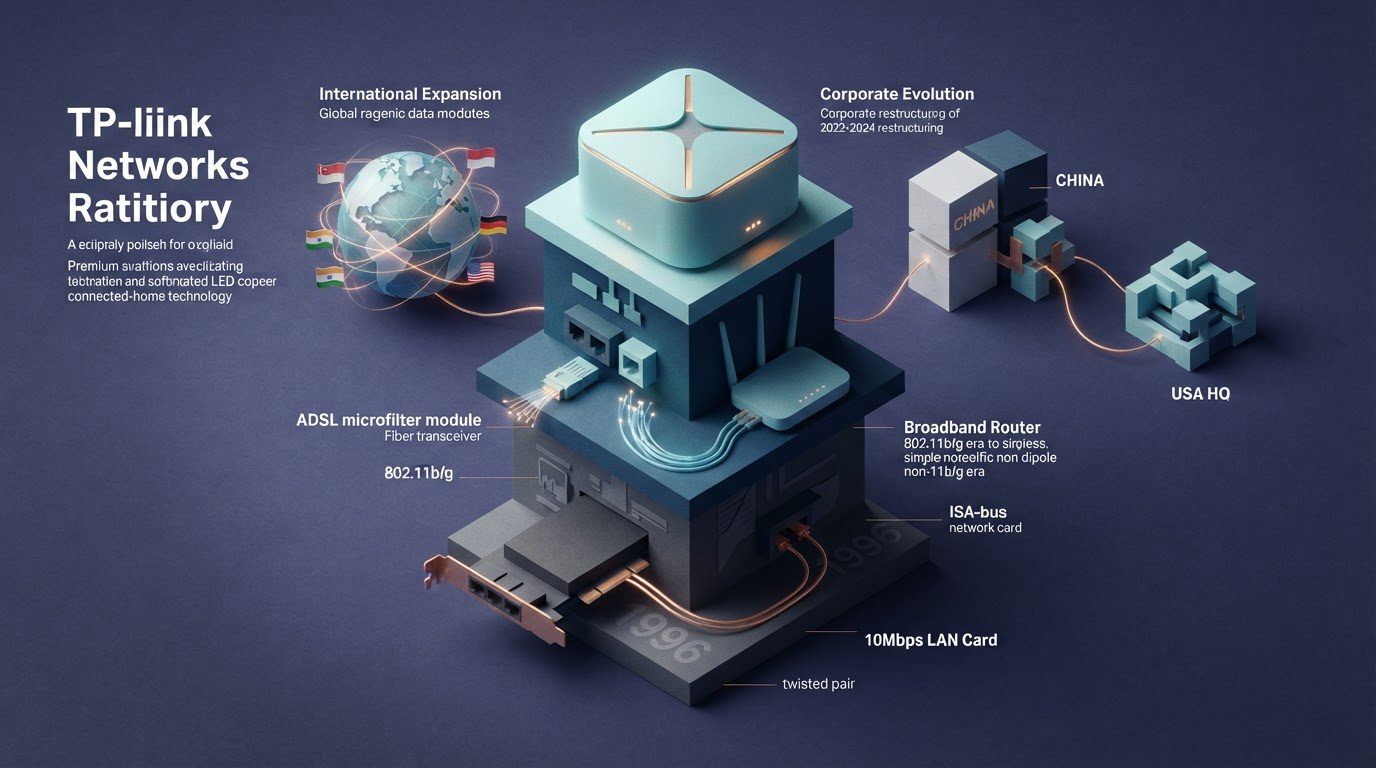
TP-Link began in 1996 with a networking problem far smaller than the connected-home portfolio associated with the name today. Corporate material from the company’s earlier era says brothers Cliff and Jeffrey Chao co-founded the business and that an ISA-bus 10 Mbps LAN card was among its first products. The name itself referred to “Twisted Pair Link”, placing wired local networking—not Wi-Fi—at the centre of the original identity.
The company followed the network as home and small-business connectivity changed. Fibre transceivers and ADSL products appeared around 2001, while 2002 brought a web-smart switch and broadband router. Wireless products based on 802.11b followed in 2003 and 802.11b/g products in 2004. TP-Link’s later association with Wi-Fi therefore grew out of successive networking standards rather than defining its first years.
From a 10Mbps LAN Card to Global Networking—and a New Corporate Structure
International expansion became a second turning point. TP-Link’s older corporate chronology records an overseas push beginning in the mid-2000s, with offices in Singapore, India, Germany and the United States. Distribution scale mattered because consumer networking depends on more than radio engineering. Routers and switches have to be locally certified, supported, stocked and replaced across very different markets.
The corporate structure has changed again in the 2020s. TP-Link’s current US fact sheet says the global TP-Link Systems business began separating from TP-LINK Technologies in mainland China in 2022 and established TP-Link Systems Inc. in Irvine, California, as global headquarters and parent company in 2024. The 1996 origin explains the brand lineage, while the present global company structure is materially different from the original organisation.
TP-Link today
The global TP-Link business is now headed by TP-Link Systems Inc. in Irvine, California. The company says it completed its separation from TP-LINK Technologies, which serves mainland China, and the current portfolio spans consumer networking, Omada business products, Tapo smart-home devices and related software.
Today the portfolio extends from Wi-Fi routers and mesh systems into switches, business networking, smart-home devices and management software. The useful historical link is the network itself. TP-Link moved from the physical connection of an ISA Ethernet card to broadband, wireless and managed connectivity as each became a mainstream requirement. The company’s scale came from repeatedly following that infrastructure shift rather than from a single breakthrough device.