Toshiba History: From 1875 Industrial Roots to Laptops, Semiconductors and Infrastructure
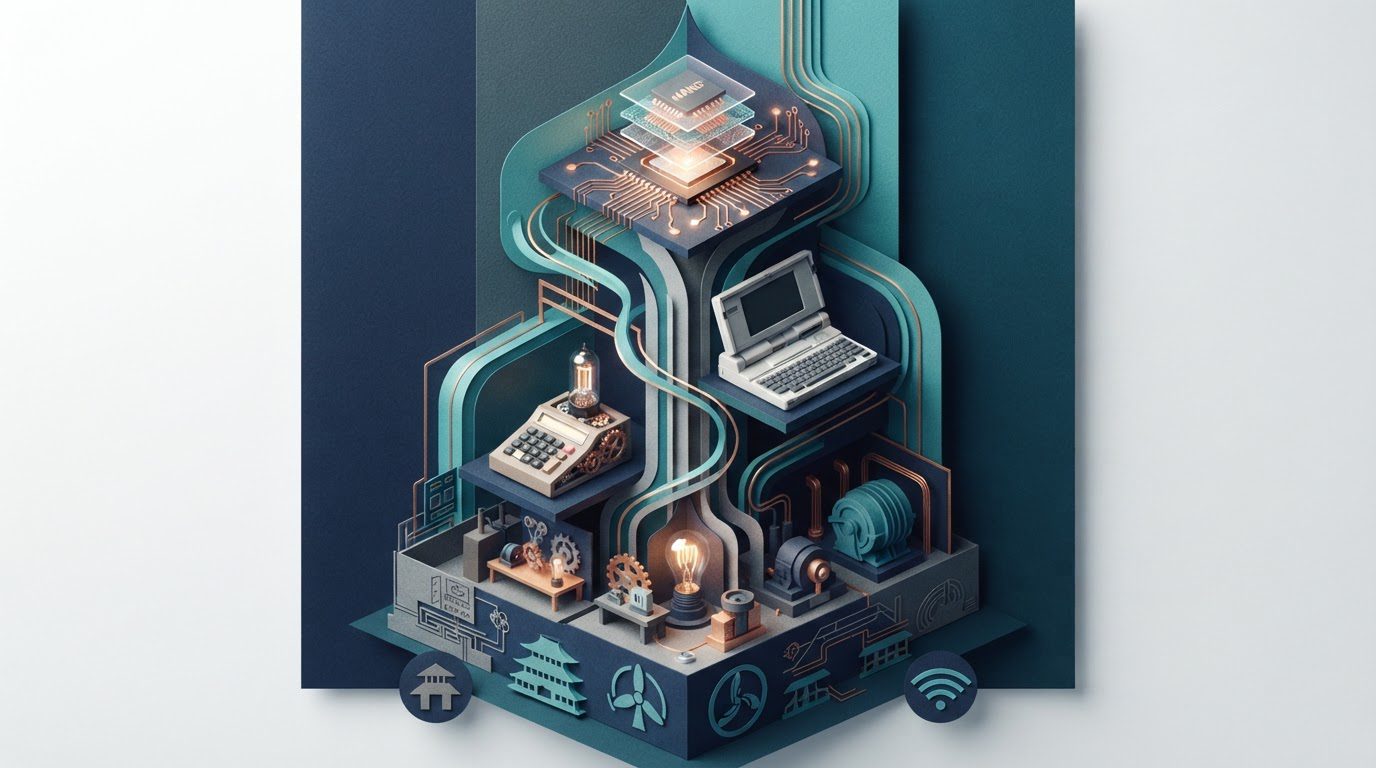
A 1939 founding date captures an important merger in Toshiba’s history, but it does not capture the beginning of the businesses that became Toshiba. The company itself traces one line back to a workshop established by inventor Hisashige Tanaka in 1875 and the other to Hakunetsu-sha, founded in 1890 to manufacture incandescent lamps. Those two industrial traditions—heavy electrical machinery and consumer electrical products—combined in 1939 as Tokyo Shibaura Electric.
That ancestry explains why Toshiba cannot be accurately reduced to the laptop business for which many PC users remember it. Long before personal computing, its predecessors worked on motors, lamps, radio equipment, power machinery and appliances. Toshiba’s chronology records a series of Japanese firsts in areas such as electric washing machines and refrigerators, while the post-war company expanded across energy, electronics and communications.
From 1875 Industrial Roots to Laptops, Semiconductors and Infrastructure
Computing nevertheless produced one of Toshiba’s most visible international breakthroughs. In 1985 the company launched the T1100 in Europe, a portable PC that Toshiba later described as the product that created the modern laptop market. By 1997, Toshiba said cumulative worldwide portable-PC shipments had reached 10 million units. The consequence was larger than one successful model: portable computing became a major part of Toshiba’s global consumer identity even though PCs represented only one branch of a much older industrial group.
Semiconductors created another important legacy. Toshiba engineers developed NAND flash memory in the 1980s, technology that later became central to solid-state storage. That business eventually followed its own corporate path and became Kioxia, illustrating why company history and present ownership must be separated carefully. A technology can originate inside a corporation without remaining part of that corporation forever.
Toshiba today
Toshiba is now a private company: it was delisted in December 2023 and became a wholly owned subsidiary of TBJH later that month. The group remains active across infrastructure and industrial technology, while individual businesses continue to be restructured and evaluated separately.
Modern Toshiba is consequently best understood as the product of repeated industrial transitions rather than a single continuous PC story. The 1939 merger, the later adoption of the Toshiba name, the expansion into portable computing and the development of semiconductor technologies each changed what the company was known for. The common thread is engineering across infrastructure and electronics, not gaming or generic personal-computer branding. That broader frame explains why Toshiba cannot be reduced to the products that made it most visible to PC buyers.