Kioxia History: From Toshiba’s NAND Breakthroughs to the 2019 Name
Calling Kioxia a company founded in 2019 is legally understandable but historically incomplete. The Kioxia name arrived in October 2019, when Toshiba Memory was renamed, while the memory technology behind the business reaches back more than three decades. Kioxia's own group history begins in 1987 with Toshiba's invention of NAND flash memory.
Kioxia’s name is younger than its NAND history
That distinction between corporate lineage and brand launch is central to the story. Toshiba Memory Corporation was established as a separate company in 2017 during the restructuring of Toshiba's memory business. Toshiba Memory Holdings followed in 2019, and both the operating company and holding structure adopted the Kioxia name that October. The rebrand therefore did not create a new technical capability from scratch; it put a new identity on an established flash-memory operation.
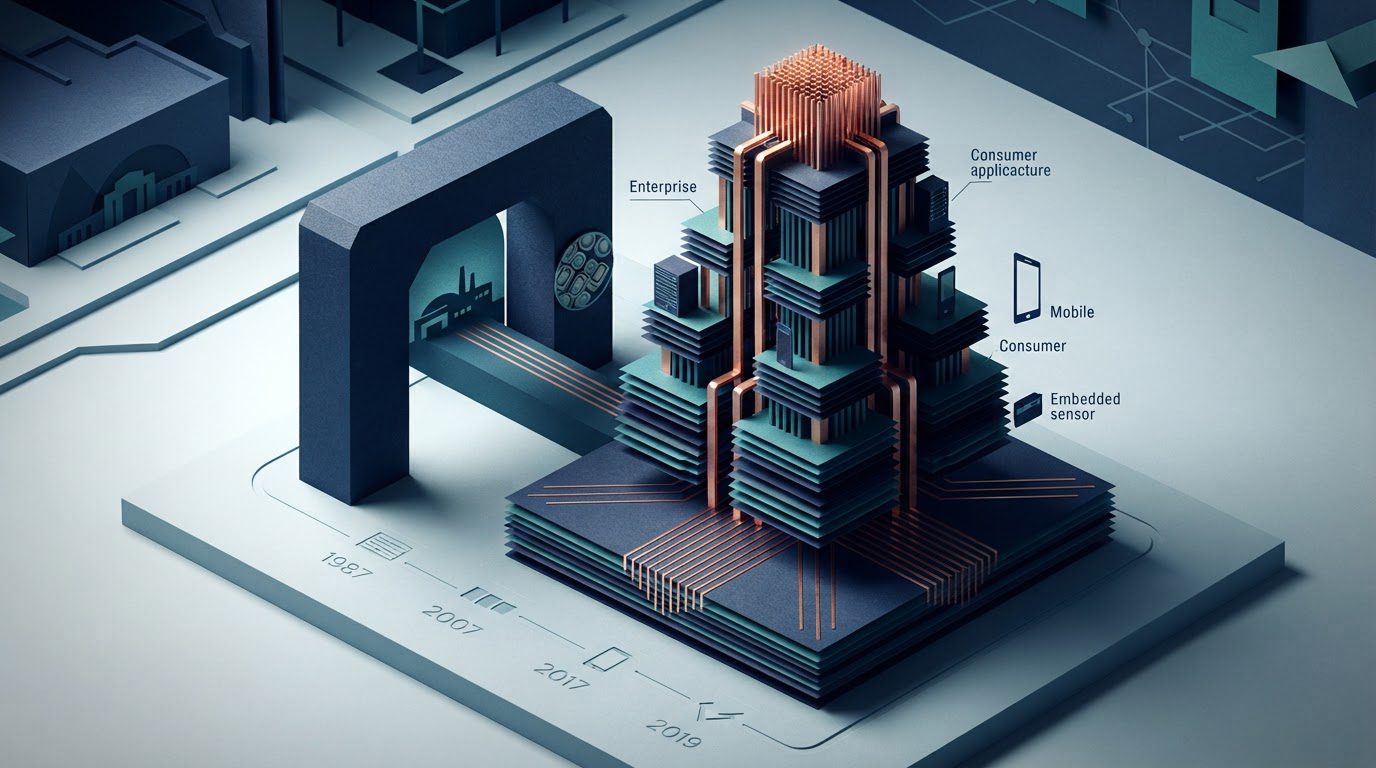
Kioxia's timeline credits its predecessor business with mass-producing NAND flash in the early 1990s, announcing 3D flash-memory technology in 2007 and later commercialising multilayer BiCS FLASH. Those milestones track the industry's need to keep increasing storage density as planar NAND approached physical limits. Stacking memory cells vertically became one of the central methods for raising capacity without relying only on ever-smaller two-dimensional geometries.
From Toshiba Memory to Kioxia
The company now sells NAND flash and SSD products into consumer, enterprise and embedded markets. It also acquired Lite-On Technology's SSD business in 2020, adding product and controller expertise to a business still rooted in flash manufacturing. The current Kioxia brand is therefore younger than many of the technologies and facilities it inherited.
The ownership and naming changes also matter because they separate intellectual history from corporate identity. NAND was developed inside Toshiba, not inside a business called Kioxia, and the 2019 name change came after the memory operation had already been separated from its former parent. That distinction is useful when assessing claims about 'Kioxia inventions': some are achievements of the Toshiba semiconductor lineage inherited by Kioxia, while others belong to the company after the reorganisation. The continuity is technical—flash-memory research, fabrication and SSD development—rather than a single uninterrupted brand name. Treating those layers separately produces a more accurate account of why a young brand can legitimately have decades of engineering history.
Kioxia shows why brand history and company history cannot be reduced to one date. '2019' explains the name readers see today; '1987' explains the technical lineage. Both are factual, but they answer different questions, and the company's story only makes sense when they are kept separate.