Kingston History: How Memory Testing and Warranty Built a Storage Giant
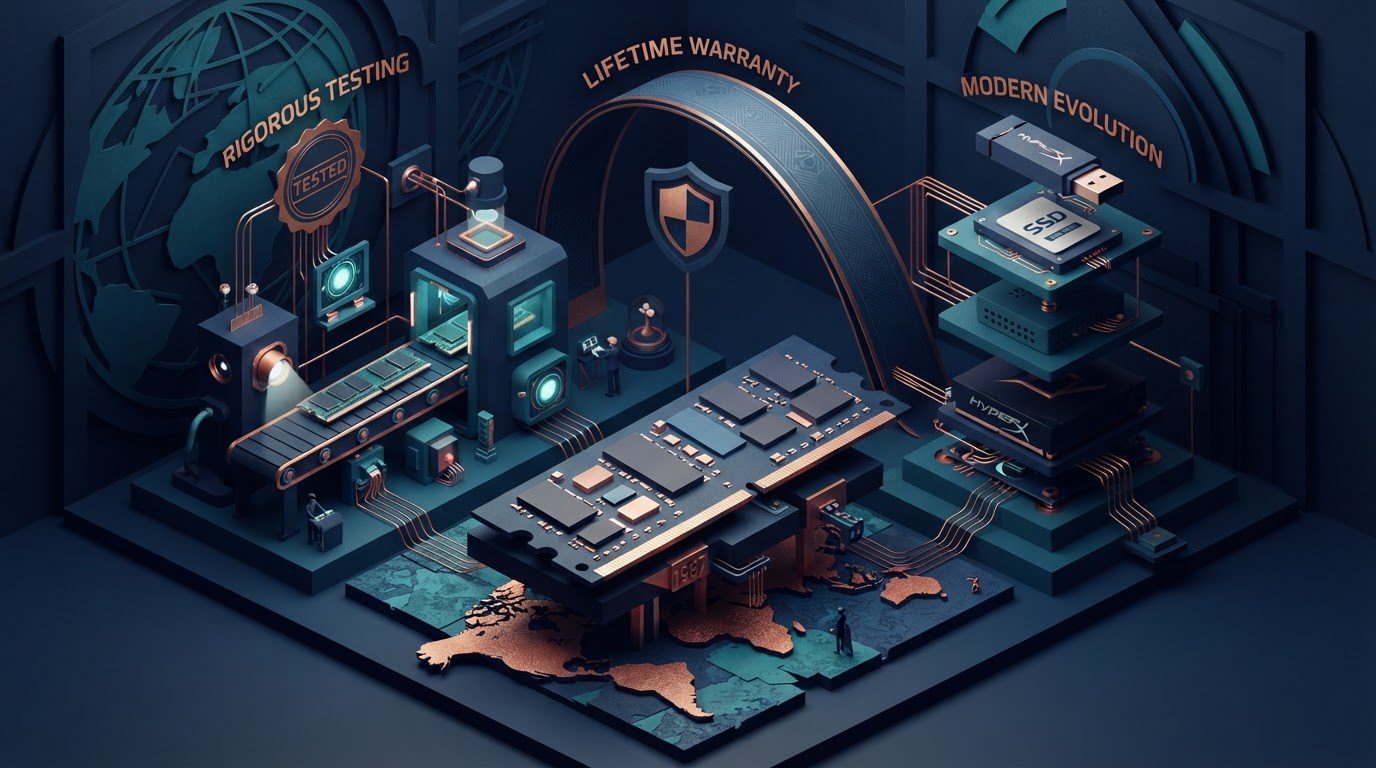
Kingston Technology began with a shortage. In 1987, engineers John Tu and David Sun saw that surface-mount memory chips were difficult to obtain and designed a new memory module to solve an immediate supply problem. Kingston's own history identifies that module as its first product, giving the company a concrete origin in aftermarket PC memory rather than a vague start in 'technology'.
A memory shortage created Kingston’s first product
The young company then made quality control part of the product proposition. Kingston introduced a lifetime warranty on DRAM modules in 1988 and says it moved to 100% individual product testing in 1989. Those policies mattered because memory upgrades were compatibility-sensitive components bought by users and resellers who needed confidence that modules would work across a large and changing installed base of PCs.
From memory, Kingston expanded into processor upgrades, networking, flash storage, USB drives, SSDs and other products. It also created HyperX in 2002 as a performance-memory label for enthusiasts. That brand later grew into gaming peripherals, but HP's 2021 acquisition covered the HyperX peripherals business rather than Kingston's gaming memory, flash and SSD products—an important ownership distinction when tracing the two brands.
Testing and warranty became the differentiator
Kingston today operates across consumer, enterprise and embedded memory and storage. The company is not a semiconductor fabrication business in the way Samsung or Micron is; its value lies in module design, qualification, testing, channel reach and the ability to build products around memory supplied by major chip manufacturers. That position in the supply chain helps explain why compatibility and warranty became such durable parts of its identity.
The quality policies that followed the first module were not incidental marketing. A lifetime warranty and 100% individual product testing were ways of attacking a specific problem in the memory market: buyers had to trust that third-party modules would work in expensive computers whose manufacturers did not make every upgrade themselves. Kingston built its name by making compatibility and reliability part of the product proposition. Later diversification into flash drives, SSDs and removable storage changed the media, but not that underlying business. Even the later HyperX story grew out of the same premise—memory could be differentiated through validation, performance targets and support rather than sold as an anonymous commodity.
The 1987 shortage story still fits the modern company. Kingston was created to turn semiconductor components into a usable, dependable upgrade product, and much of its later expansion has repeated that pattern in new forms of memory and storage. The technology has moved from SIMMs to DDR5 and NVMe, but the commercial problem—making complex memory technology reliable for a broad customer base—has remained strikingly consistent.