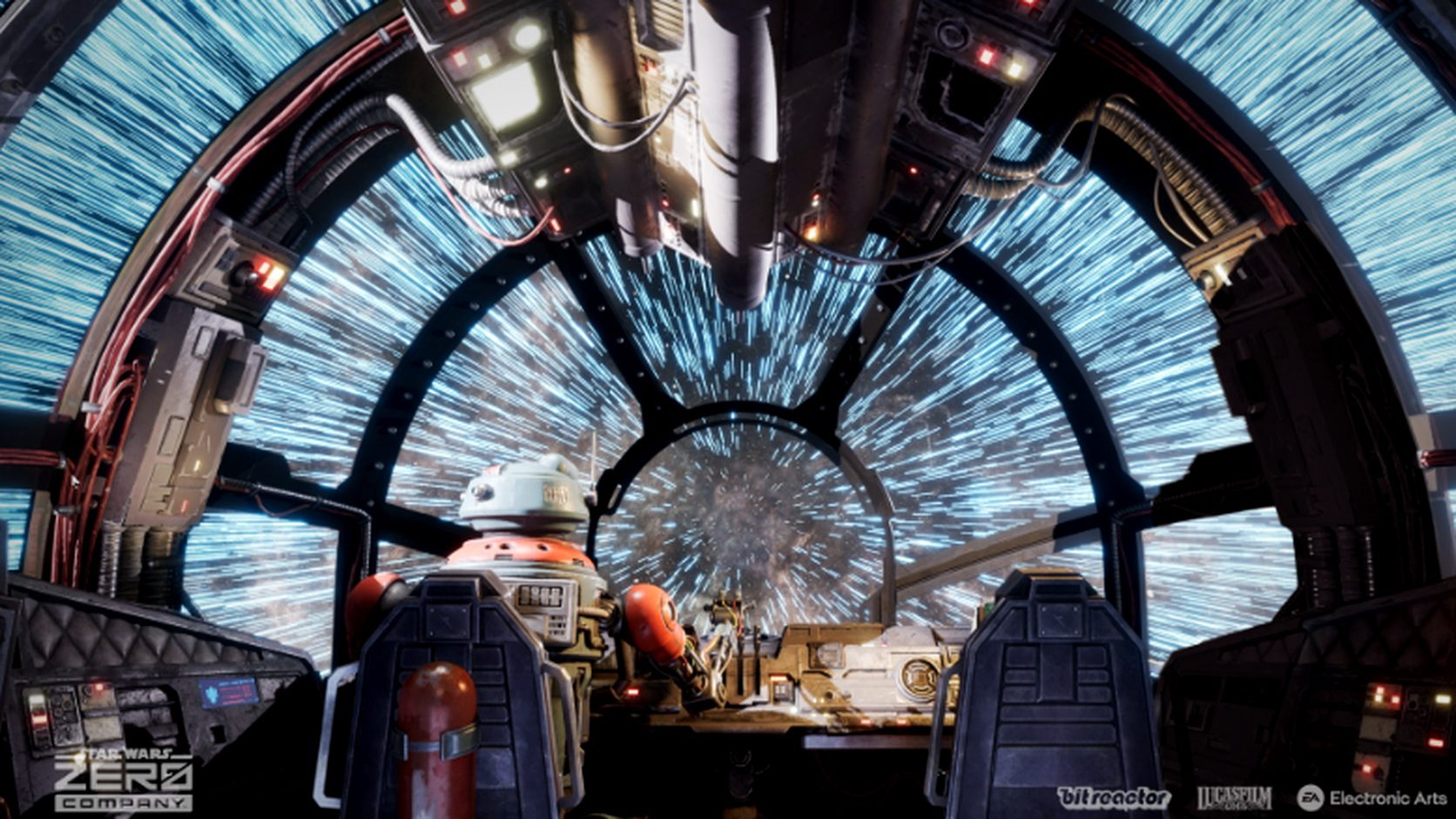
Star Wars Zero Company brings XCOM-style tactics to the Clone Wars
Star Wars Zero Company launched on 27 August 2026, giving Star Wars fans a very different type of game from the lightsaber-heavy action adventures that have dominated the franchise in recent years.
Developed by Bit Reactor and published by Electronic Arts, Zero Company is a single-player turn-based tactics game set during the final stages of the Clone Wars. Players command an unconventional squad led by Hawks, a former Galactic Republic officer recruited to investigate an emerging threat capable of affecting the wider galaxy.
The result is essentially the Star Wars tactical strategy game many XCOM players have been waiting for, although calling it simply “Star Wars XCOM” undersells what Bit Reactor is trying to build.
The studio includes developers who previously worked on games such as XCOM, Civilization and Marvel’s Midnight Suns, giving it considerable experience with turn-based strategy.
Zero Company puts the squad ahead of the Jedi
Star Wars games understandably tend to concentrate on Jedi, Sith and other major characters.
Zero Company approaches the universe differently.
Players take control of Hawks, a former Republic officer who leads a group of operatives during the twilight of the Clone Wars.
The squad can include several different Star Wars archetypes, ranging from scoundrels and astromech droids to experienced soldiers and even a Jedi.
That mixture allows Bit Reactor to use familiar parts of the Star Wars universe without building the entire game around one powerful character.
Instead, survival depends on how effectively the squad works together.
Each operative brings different tactical abilities to a mission, while successful deployments improve their skills and unlock additional combat synergies between squad members.
That makes the relationship between characters more than a narrative feature.
It directly affects what the squad can do in combat.
Every move matters in turn-based combat
Combat takes place through turn-based tactical encounters where positioning, abilities and squad composition determine how effectively players can approach each mission.
Players need to consider cover, enemy placement and the strengths of individual operatives rather than relying purely on reflexes.
That immediately separates Zero Company from games such as Star Wars Jedi: Survivor or Star Wars Battlefront.
There is time to consider each move.
However, that does not necessarily make the game forgiving.
Bit Reactor has built the game around the idea that tactical choices can have consequences. Decisions made during missions and at the player’s base can change how situations develop, giving different playthroughs the potential to unfold differently.
Permadeath can also add considerably more weight to those decisions depending on how players configure their experience.
Several reviews have compared that tension directly with XCOM, where losing a developed squad member can hurt far more than simply failing an objective.
The XCOM comparison isn’t accidental
Comparisons with XCOM were inevitable from the moment Zero Company was announced.
They also make sense when looking at the team behind it.
Bit Reactor says members of the studio have previously worked on XCOM, Civilization, Gears of War and The Elder Scrolls Online. The developer has also acknowledged that numerous members of its team contributed to the XCOM franchise.
Creative director and Bit Reactor CEO Greg Foertsch previously worked at Firaxis, including on the modern XCOM games.
That experience is visible in the emphasis on squad composition, tactical positioning and developing characters across multiple missions.
However, Zero Company is not simply reproducing an existing strategy game with stormtroopers added.
Bit Reactor has placed considerably more emphasis on cinematic presentation, character interaction and third-person sequences between its tactical battles.
That makes it potentially more approachable for Star Wars players who have never previously considered a turn-based tactics game.
Your squad is not completely predetermined
Customisation is another major part of the game.
Players can customise Hawks’ appearance and combat specialisation, while the wider squad can include both original characters and custom-created Star Wars operatives.
Appearance, abilities and equipment can all be adjusted to suit a particular approach.
That gives players more ownership over Zero Company.
Rather than controlling exactly the same group in every playthrough, squad construction becomes another strategic decision.
A team built around aggressive close-range combat may approach an encounter very differently from one designed around ranged attacks or support abilities.
The Clone Wars is an ideal setting for a tactics game
Setting the game during the twilight of the Clone Wars gives Bit Reactor access to one of the most militarised periods in Star Wars history.
The Galactic Republic and Separatists are already locked in a galaxy-wide conflict, while numerous independent factions, mercenaries and criminal organisations operate around them.
That makes the period particularly well suited to a game about a small specialist unit conducting operations away from the main battlefield.
It also allows familiar Star Wars elements to appear without making the game’s original characters feel irrelevant.
The story takes place as the Clone Wars approach their conclusion, meaning players already know that something much larger is developing in the background.
However, Zero Company’s immediate problem is its own mission.
EA describes the squad as confronting an emerging threat that could consume the galaxy if left unchecked.
There is more to do than fight battles
The tactical missions are only one part of the game.
Players also operate from a base where they can develop their squad and prepare for future operations.
EA describes gameplay as moving between tactical operations, investigations and decisions made at the base of operations.
This creates two connected layers.
One involves surviving the immediate battle.
The other involves preparing Zero Company to survive the battles that come afterwards.
Character progression therefore becomes important because an operative who survives several missions can become considerably more valuable than a new recruit.
That also gives permanent character loss greater meaning.
Zero Company is a single-player Star Wars game
One useful distinction is that Star Wars Zero Company is completely focused on single-player tactical gameplay.
Steam lists no competitive multiplayer or online co-op modes.
For South African players, that removes the usual questions surrounding international matchmaking and high multiplayer latency.
There are no competitive overseas servers to worry about during a tactical mission.
However, the PC version does still require an internet connection as well as both an EA Account and Steam Account, which must be linked to play.
That distinction is worth knowing before buying.
The game itself is single-player, but the Steam release is not completely independent of EA’s online account system.
PC requirements are surprisingly demanding
The tactical nature of Zero Company does not mean it has lightweight hardware requirements.
The minimum PC specification calls for an Intel Core i5-8400 or AMD Ryzen 5 2600X, 16GB of RAM and either an Nvidia GeForce GTX 1080, AMD Radeon RX 5600 XT or Intel Arc B580.
Bit Reactor targets 1080p at 30fps on Low settings with that configuration.
Recommended hardware increases substantially.
Star Wars Zero Company PC requirements
| Specification | Minimum | Recommended |
|---|---|---|
| Operating system | Windows 10/11 64-bit | Windows 10/11 64-bit |
| Processor | Core i5-8400 / Ryzen 5 2600X | Core i7-10700K / Ryzen 7 3700X |
| Memory | 16GB RAM | 32GB RAM |
| Graphics | GTX 1080 / RX 5600 XT / Arc B580 | RTX 3080 / RX 7800 XT |
| DirectX | Version 12 | Version 12 |
| Storage | 50GB | 50GB |
| Performance target | 1080p / 30fps / Low | 1440p / 60fps / High |
The recommended specification targets 2560×1440 at 60fps on High settings and requires 32GB of RAM alongside an RTX 3080 or Radeon RX 7800 XT.
Those are developer-published targets rather than TechnologyBlog.co.za benchmark results.
The 32GB recommended memory requirement is particularly notable for a turn-based strategy game and is worth checking before PC players purchase it.
Early Steam reviews are positive, but still developing
Because Star Wars Zero Company only launched on 27 August, its Steam reception is still changing rapidly.
When checked on 28 August 2026, Steam showed its English-language reviews as Mostly Positive, with 74% of 2,228 reviews recommending the game.
That is a useful early indication, but it is far too soon to treat it as the game’s settled long-term reception.
The number of reviews has been increasing rapidly since launch, and the percentage can move substantially during the first days of release.
Professional reviews have generally been enthusiastic about the tactical combat and squad systems, although TechnologyBlog.co.za has not independently tested the game and is therefore not making its own review judgement here.
Zero Company could bring tactics games to a much wider audience
The most interesting thing about Star Wars Zero Company may not be what it offers experienced strategy players.
It may be what it does for people who normally avoid the genre.
Turn-based tactical games can appear intimidating.
There are action points to manage, abilities to understand, characters to develop and mistakes that may have lasting consequences.
Star Wars provides an immediately recognisable way into those systems.
A player may not understand tactical positioning terminology, but they probably understand what a Jedi, clone soldier, astromech or scoundrel should broadly be capable of doing.
Bit Reactor can use that familiarity to teach a more complicated strategy game.
For experienced XCOM players, meanwhile, the attraction works in the opposite direction.
They already understand the tactical foundation.
What Star Wars provides is a new universe in which to use those skills.
A very different direction for modern Star Wars games
Recent major Star Wars games have largely concentrated on direct action.
The Star Wars Jedi series gave players lightsaber combat and exploration. Star Wars Battlefront focused on large multiplayer battles, while Star Wars Outlaws explored an open-world criminal adventure.
Zero Company deliberately goes in another direction.
It asks players to command rather than simply react.
The Jedi is not automatically the most important person in the room. Individual squad members matter, positioning matters and sometimes keeping everyone alive may be more important than eliminating every enemy on the battlefield.
That makes Star Wars Zero Company one of the more unusual Star Wars releases of recent years.
Bit Reactor does not need to convince people that Star Wars works as an action game.
Decades of releases have already done that.
Its challenge is proving that commanding a small group of operatives one carefully considered move at a time can be just as compelling.
Star Wars Zero Company is available now on PC, PlayStation 5 and Xbox Series X|S.
