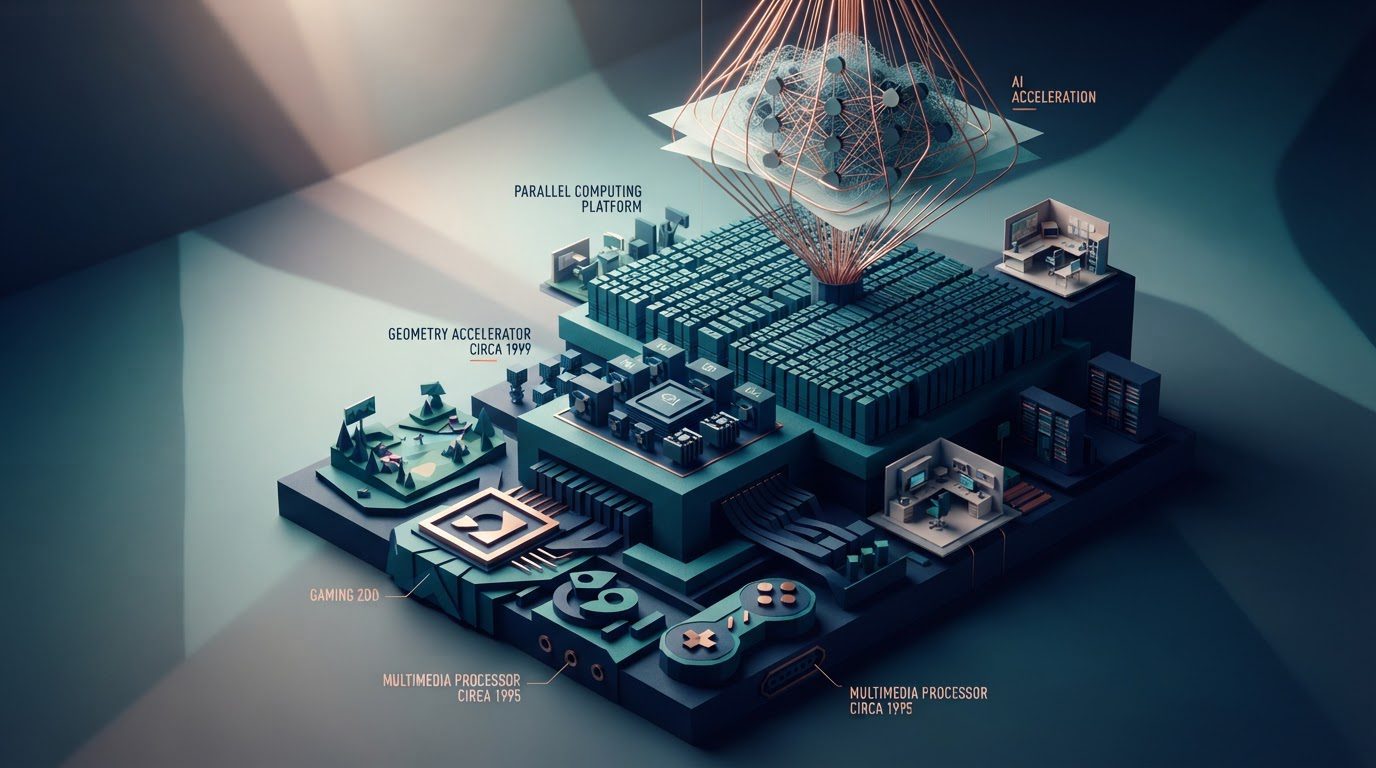
NVIDIA History: From the NV1 to GeForce, CUDA and AI Acceleration
Nvidia was founded in 1993 around a belief that the PC would become a major platform for graphics-intensive computing. Its first commercial processor, the NV1 in 1995, was an ambitious multimedia chip that combined 2D, 3D, audio and game-controller functions. It was not the architecture that would ultimately define the company, but it put Nvidia into the market it intended to reshape.
NV1 came before GeForce
The defining early milestone arrived in 1999 with GeForce 256. Nvidia marketed the product as the world's first GPU, a term it used for a chip that moved transform, lighting and rendering work onto dedicated graphics hardware. The 'first GPU' label is historically contested when applied broadly to all earlier graphics processors, so it is best preserved as Nvidia's framing; the technical consequence is clearer. More of the graphics pipeline was becoming programmable and independent of the CPU.
That shift created a platform rather than a one-off accelerator business. GeForce became a major PC-gaming family, while professional graphics and workstation products addressed design and visualisation. In the mid-2000s, CUDA opened Nvidia GPUs to general-purpose parallel computing, giving researchers and software developers a way to use the same massively parallel architecture for workloads beyond rendering.
GeForce and CUDA turned graphics into a computing platform
The rise of deep learning transformed the importance of that earlier bet. Training neural networks maps well onto the parallel maths that GPUs were already designed to execute, and Nvidia built data-centre accelerators, networking, software libraries and complete systems around that advantage. The company now competes across gaming, AI infrastructure, professional visualisation, automotive computing and other accelerated workloads.
GeForce 256 is another case where wording matters. Nvidia markets the 1999 chip as the world's first GPU, a term it helped popularise around hardware transform and lighting, but 'first' depends on how GPU is defined and should therefore remain attributed to Nvidia. What is less contentious is the strategic consequence: graphics processors were becoming increasingly programmable and capable of taking more work away from the CPU. CUDA later formalised that general-purpose compute opportunity. The same parallel-processing strengths that served graphics eventually became central to scientific computing and AI, making Nvidia's present data-centre role intelligible from its graphics history rather than separate from it.
The useful link between NV1, GeForce 256 and modern AI accelerators is not that every product was an immediate success. It is that Nvidia kept building around parallel computation and increasingly surrounded the silicon with software. The company's modern position is the result of turning a graphics processor into a programmable computing platform and then making that platform useful far beyond graphics.