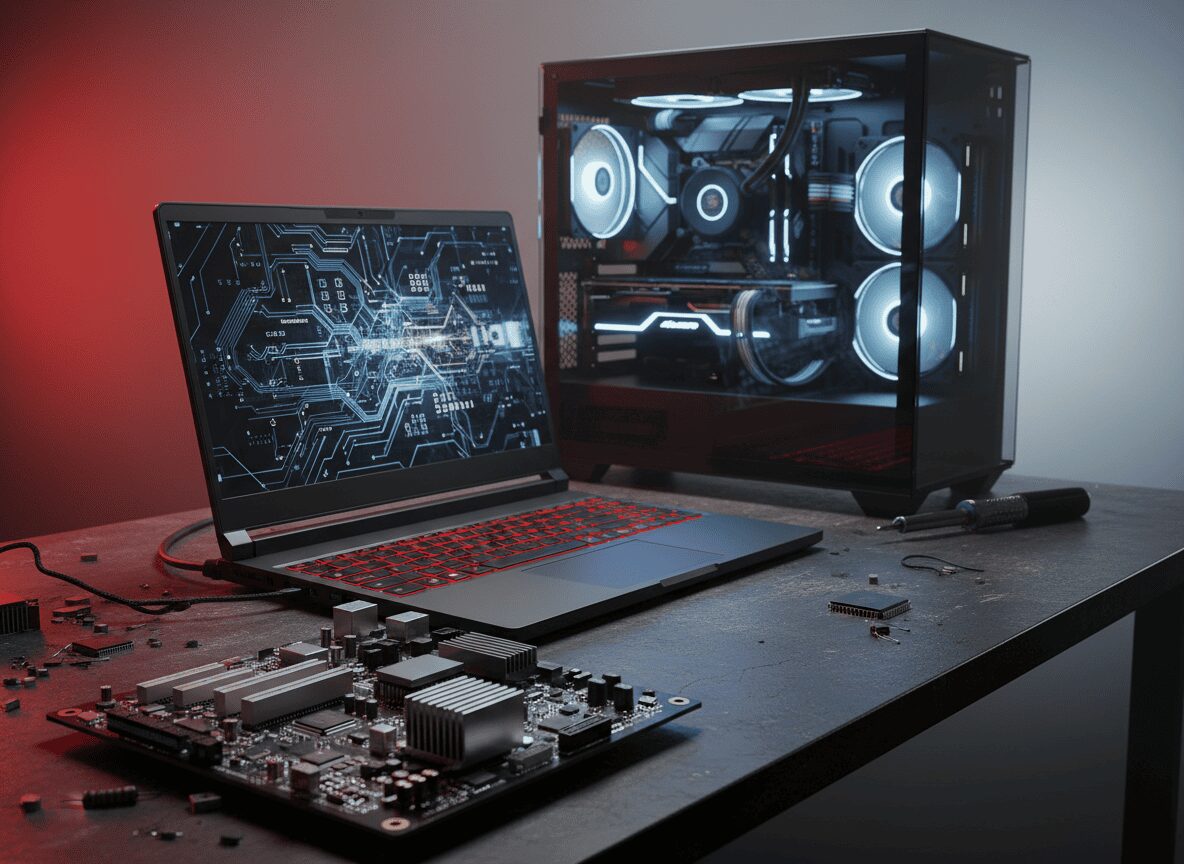
MSI History: From Motherboards to Gaming Laptops and Full PC Systems
MSI’s route into gaming began with motherboards, not laptops. Founded in Taiwan in 1986, Micro-Star International built its early reputation around PC motherboards and add-in hardware. An early overclockable 286 motherboard places MSI inside the enthusiast practice of extracting more performance from standard PC platforms long before ‘gaming laptop’ became a major category.
Motherboards came before MSI gaming laptops
Motherboards gave MSI a strategic view of the whole PC. A board has to coordinate processors, memory, expansion, storage, firmware and power delivery, so expertise there translated naturally into graphics cards and complete systems. As the enthusiast market grew, MSI could move downstream from being one component inside a build to selling more of the finished gaming experience under its own name.
MSI identifies the GX600, launched in 2007, as a key gaming milestone and has described it as the world’s first overclockable gaming notebook. That ‘world first’ wording comes from MSI and remains a company-attributed claim. The important consequence is less contentious: the GX600 era helped make notebooks a serious part of MSI’s gaming identity rather than an extension of its motherboard catalogue.
The GX600 made notebooks central to MSI gaming
From there the company expanded across gaming laptops, desktops, monitors, graphics cards and peripherals while continuing to sell motherboards and professional systems. That breadth gives MSI multiple roles in the PC supply chain, from individual components to complete branded computers.
MSI’s move from motherboards into complete gaming systems changed the responsibilities it carried as a vendor. A motherboard maker can optimise board layout, firmware and power delivery while relying on customers or system builders to choose the rest. A notebook brand has to integrate display, cooling, keyboard, acoustics, battery, firmware and industrial design into one shipping product. The GX600 era therefore matters not only because of MSI’s claim about overclocking; it marked a shift toward owning more of the end-user experience. That transition later supported gaming desktops, monitors and creator-focused PCs alongside the company’s component business.
The motherboard origin still explains much of the modern company. MSI’s strongest products tend to sit where thermal design, power delivery and component integration determine how much performance a system can sustain. Gaming became the visible brand, but the engineering roots lie in the less glamorous task of making the PC’s core components work together reliably—and sometimes beyond their default limits.