Nearity History: From a 2018 Start to Enterprise Meeting-Room Hardware
Nearity has a documented starting point: the company says it was founded in 2018 to make professional meeting technology easier to deploy and use. That places its origin before the pandemic-era explosion in video meetings, but close enough to the cloud-collaboration shift that conference hardware was already moving away from specialised room systems toward USB, IP and software-managed devices.
A first-generation speakerphone won enterprise validation
An early commercial proof point came in 2020, when Nearity says ByteDance adopted its first-generation speakerphone and its daisy-chain audio technology. That matters more than simply naming a first product because it shows the consequence: a large enterprise used the system in real meeting spaces, validating the company's approach to scalable audio rather than only consumer-scale conferencing.
Nearity then raised Series A financing in 2021 and expanded internationally. By 2022, according to its own timeline, the brand had reached more than 100 countries and regions. In 2023 it received Zoom certification and design awards for multiple products, while the range broadened across speakerphones, cameras, ceiling microphones and all-in-one meeting systems.
Zoom certification followed international expansion
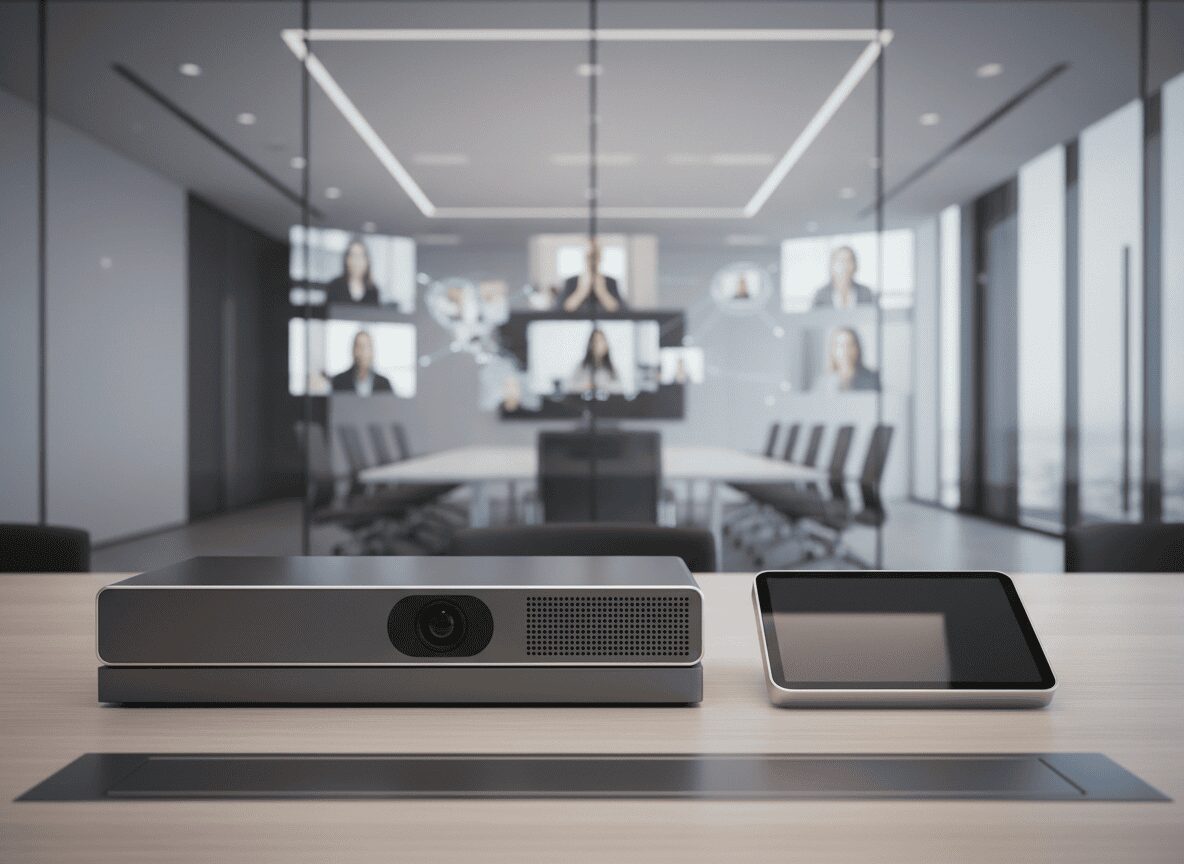
The technical layer Nearity occupies is integration. It does not own the videoconferencing platforms used by customers; instead it builds microphones, cameras, signal processing and device-management tools that must work reliably with those platforms and with difficult room acoustics. Features such as speaker tracking, noise reduction and daisy-chaining therefore matter because they reduce the engineering required to make hybrid meetings usable.
The ByteDance deployment is a particularly useful early-customer marker because it shows what Nearity's technology had to prove. Enterprise meeting rooms need predictable microphone pickup, echo cancellation, device management and compatibility across many installations; a product that works on one desk is not automatically suitable for a fleet of rooms. Nearity's subsequent expansion into ceiling microphones and camera systems can be read as a response to that scale problem. Instead of selling isolated gadgets, the company increasingly competes on how well multiple audio and video components work together inside a conferencing environment.
Nearity's short history already has a coherent sequence: foundation in 2018, enterprise validation in 2020, international expansion after 2021 and a widening room-system portfolio. That chronology is stronger than a generic story about 'hybrid work' because it shows exactly how the company moved from an audio product into a broader collaboration-hardware business.