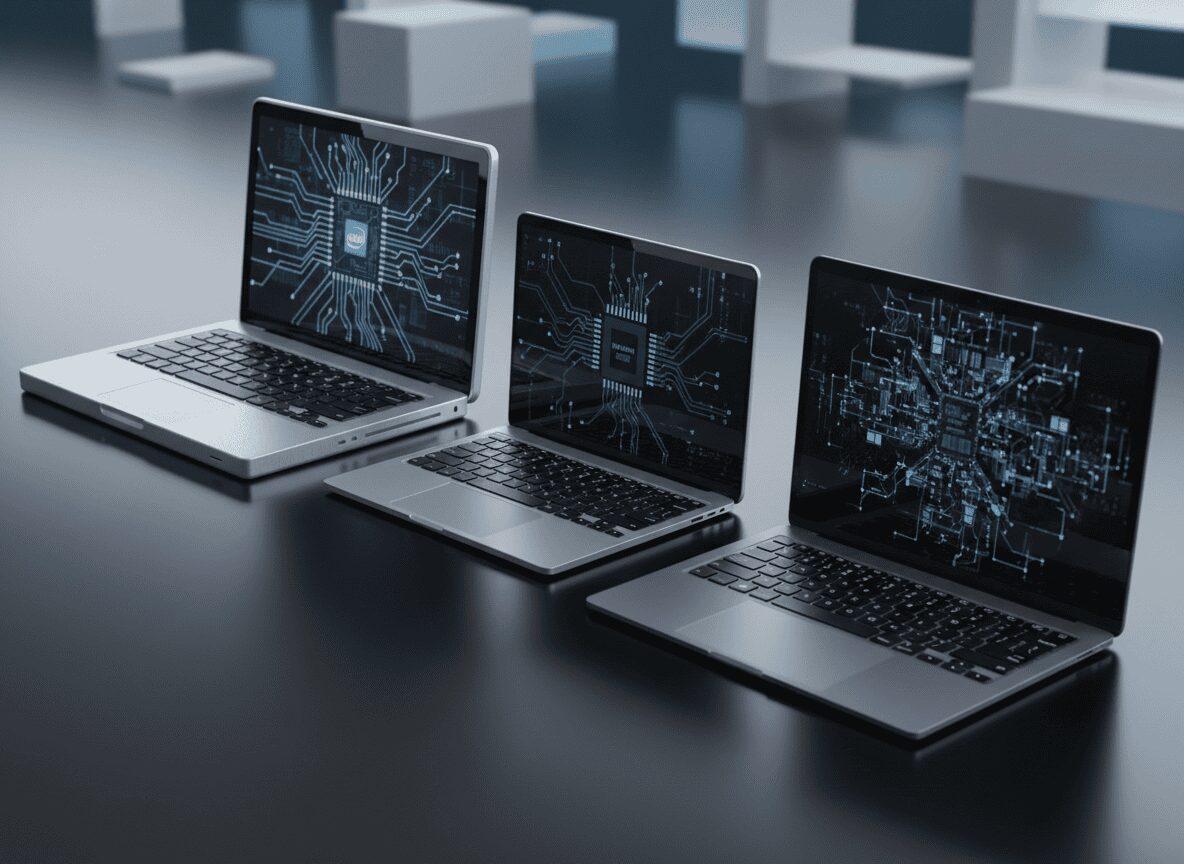
MacBook History: From Apple’s 2006 Intel Transition to Apple Silicon
The MacBook name arrived during one of the most consequential hardware transitions in Apple’s computer history. On 16 May 2006, Apple introduced the first MacBook with Intel Core Duo processors, replacing both the iBook and the 12-inch PowerBook. That product completed Apple’s move to Intel processors across its portable Mac lineup.
The 2006 MacBook completed Apple’s Intel notebook shift
The original MacBook was therefore not simply a new laptop shell. It consolidated Apple’s consumer notebook branding while the company changed processor architectures. Features such as MagSafe, the built-in iSight camera and a widescreen display were part of the package, but the strategic point was compatibility: Apple was moving the Mac onto the same x86 processor family used by mainstream PCs while retaining control of macOS and its hardware design.
The MacBook name later became complicated. Apple created distinct MacBook Air and MacBook Pro families, discontinued the original polycarbonate MacBook, revived a thin 12-inch MacBook in 2015 and discontinued that model in 2019. In everyday speech, ‘MacBook’ now often means Apple’s notebook range as a whole, but historically the standalone MacBook was a specific product line.
Apple silicon rewrote the MacBook architecture
A second architecture shift began in 2020 when Apple moved Macs from Intel processors to its own Apple silicon. MacBook Air and MacBook Pro became showcases for that strategy, combining Apple-designed CPUs, GPUs and media engines with macOS. Unlike the 2006 transition, which aligned the Mac with the wider x86 ecosystem, the Apple-silicon transition brought more of the core computing architecture back under Apple’s direct control.
Apple’s first 2006 MacBook is not the founding point of Apple, and the modern MacBook family includes Air and Pro lines with histories of their own. The MacBook name dates to 2006, while Apple’s 1976 founding belongs to the parent-company history. That distinction becomes especially useful when discussing Apple silicon, because the current machines are connected to the 2006 MacBook primarily by product family and Apple’s integrated design philosophy—not by a single processor architecture or unchanged model line.
The MacBook story is therefore best told as a sequence of platform decisions rather than a list of screen sizes. The 2006 model closed the iBook era and completed the Intel notebook transition; later Air and Pro models turned the name into shorthand for Apple’s portable Macs; Apple silicon then changed the architecture again. The common element is Apple’s insistence on treating the notebook as an integrated hardware-and-software product.