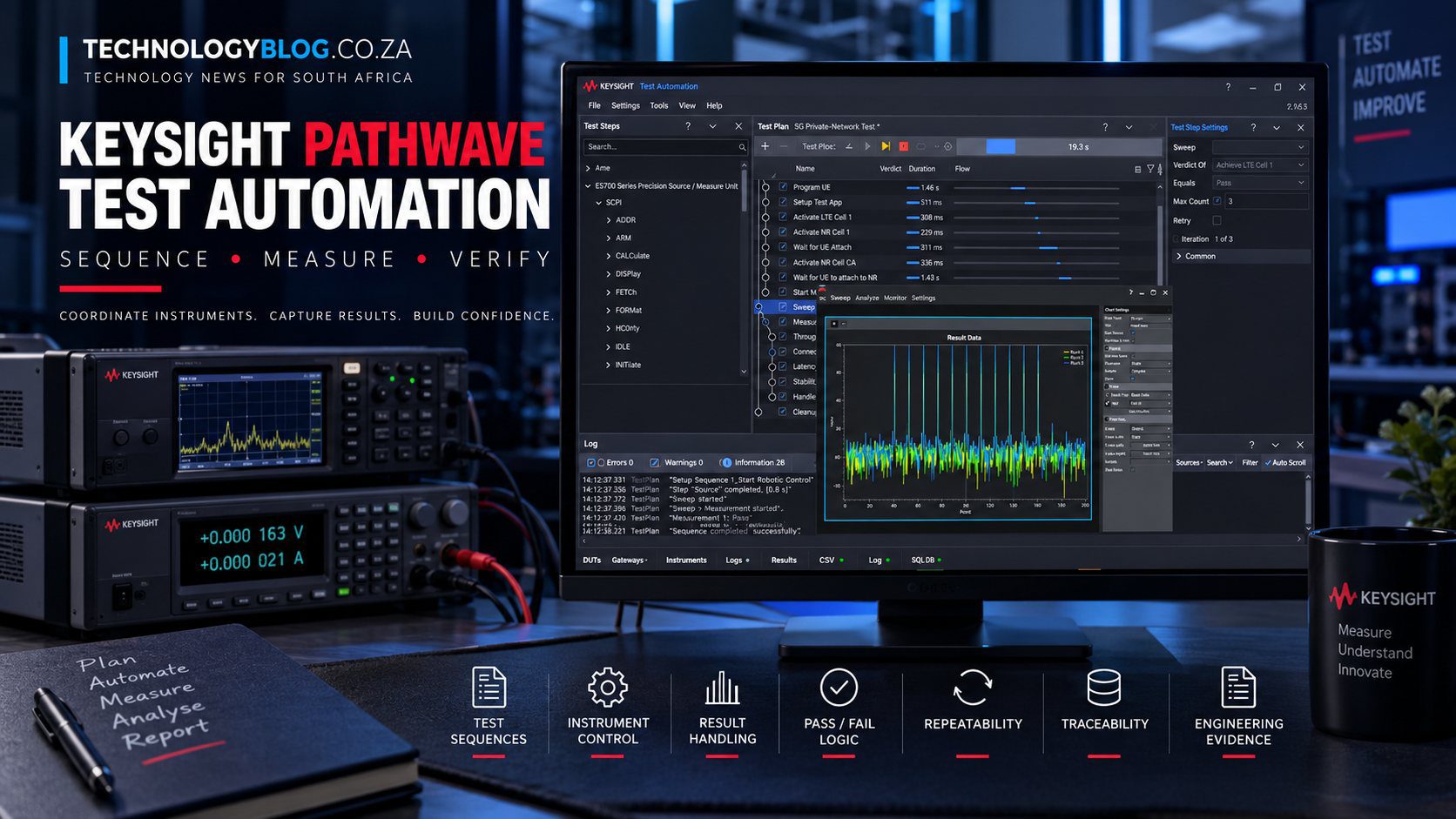
PathWave Test Automation: coordinating instruments and results
Keysight PathWave Test Automation is about turning a collection of instruments and test scripts into a repeatable engineering process with controlled sequencing, data and pass/fail logic.
Keysight released PathWave Test Automation 9.34 in July 2026.
Test automation coordinates instruments, procedures and result handling
Test automation coordinates instruments, procedures and result handling. Repeatability matters because manual setup differences can look like product variation. After deployment, somebody has to maintain the settings, updates, data, compatibility and support path that keep the capability useful.
PathWave Test Automation sits in a toolchain, so file formats, design databases and hand-offs matter alongside the analysis engine. A result that cannot be traced back to the underlying design or reproduced by another engineer is much less valuable in a regulated or high-cost development process.
Limit logic and sequencing encode engineering intent
Limit logic and sequencing encode engineering intent. A fast automated run is dangerous if the wrong limits or preconditions are embedded in the procedure.
The strongest consequence of this PathWave Test Automation capability is earlier feedback. Finding a problem before fabrication, test or field deployment can save far more than the tool licence, but only when teams trust the setup enough to act on the result.
Automation produces large result sets
Automation produces large result sets. Traceability from device under test to software version, calibration state and measured data is essential when investigating failures.
The important output is engineering evidence rather than a colourful interface. Assumptions, models and constraints decide what the tool can prove or predict, and those inputs have to survive design review if the result is going to change a real implementation. For PathWave Test Automation, that consequence belongs to this specific 2026 product context.
From analysis output to engineering decision
Limit logic and sequencing encode engineering intent. In practice in the evidence an engineer is prepared to trust. Models, constraints and source data have to describe the real design closely enough that a faster result is still a defensible result.
Automation produces large result sets. The third point determines what happens after the analysis. A tool earns its place when the output can be traced into a design decision, reviewed by another engineer and carried into the next iteration without losing assumptions along the way.
Why earlier feedback has economic value for PathWave Test Automation
Limit logic and sequencing encode engineering intent. Iteration speed is the economic argument for tools such as the test-automation tool. Finding a conflict or weak design choice before hardware, field work or certification can save far more than the software licence. Speed alone is not sufficient, however. That matters because a workflow that produces many answers without clear confidence can move uncertainty downstream instead of removing it. The useful gain is earlier feedback that engineers trust enough to act on while the design is still cheap to change.
Toolchains create their own dependencies. The test-automation tool rarely works in isolation: files, databases, libraries, revision systems and hand-offs connect it to upstream design and downstream verification. That matters because small mismatches in units, coordinate systems, versions or model libraries can invalidate an otherwise correct calculation. Reproducible project setup and controlled data exchange therefore matter just as much as the analysis engine when several teams or suppliers touch the same programme.
What long projects demand from the software for PathWave Test Automation
Long projects also make versioning a technical issue. A design may outlive several releases of the test-automation tool, while customers still need to reproduce an old result or continue a certified baseline. Current features can improve productivity, but migration has to preserve project data, assumptions and review evidence. That is why lifecycle and compatibility belong in the engineering story rather than being treated as procurement details outside the technical work.
That matters because engineering software earns trust through the assumptions behind its output. Geometry, models, constraints and source data have to represent the real design closely enough that a faster answer remains a defensible answer. The colourful result is not the endpoint; another engineer must be able to trace it back to inputs and understand what the tool did not model. That traceability is especially important when the result changes an expensive prototype, fabrication run or regulated design.
The practical benchmark for the test-automation tool is whether it changes the number and quality of engineering iterations before commitment becomes expensive. That matters because a useful tool makes assumptions visible, produces evidence that survives review and lets teams explore more design space without losing traceability. It should also make disagreement productive: when two engineers reach different conclusions, the project needs enough model and version information to explain why. That is a more demanding standard than raw solver or processing speed, but it is closer to the reason organisations invest in specialist engineering software. For the test-automation tool, the value appears when earlier insight prevents rework later in fabrication, commissioning or certification.
PathWave Test Automation in the wider manufacturer portfolio
For related coverage from the same manufacturer, see Keysight PathWave Design: where RF simulation meets measurement. It covers a different product or service in the portfolio and is included for context rather than as a direct alternative.
Why the current generation matters for PathWave Test Automation
Engineering teams often keep projects alive across several software releases, so database compatibility, licensing and reproducibility matter when a tool evolves.
PathWave Test Automation: why the 2026 context matters
Keysight released PathWave Test Automation 9.34 in July 2026. That current position matters because the central issue is specific to PathWave Test Automation: Keysight PathWave Test Automation is about turning a collection of instruments and test scripts into a repeatable engineering process with controlled sequencing, data and pass/fail logic. The lifecycle and the technical story therefore meet in the same place—what the product can do now, what surrounding system has to support it and which part of the value proposition changes as the portfolio moves forward.
For PathWave Test Automation, the consequence is not an abstract specification comparison. The product has to be understood through the workload or service it changes, the operational cost it removes or creates, and the continuity expected from the current generation. That is the context that turns the documented features into a useful 2026 explanation rather than a catalogue entry.
Source note: Official information for PathWave Test Automation was checked on 19 September 2026. Primary source. Manufacturer performance claims remain manufacturer claims unless independently stated.
