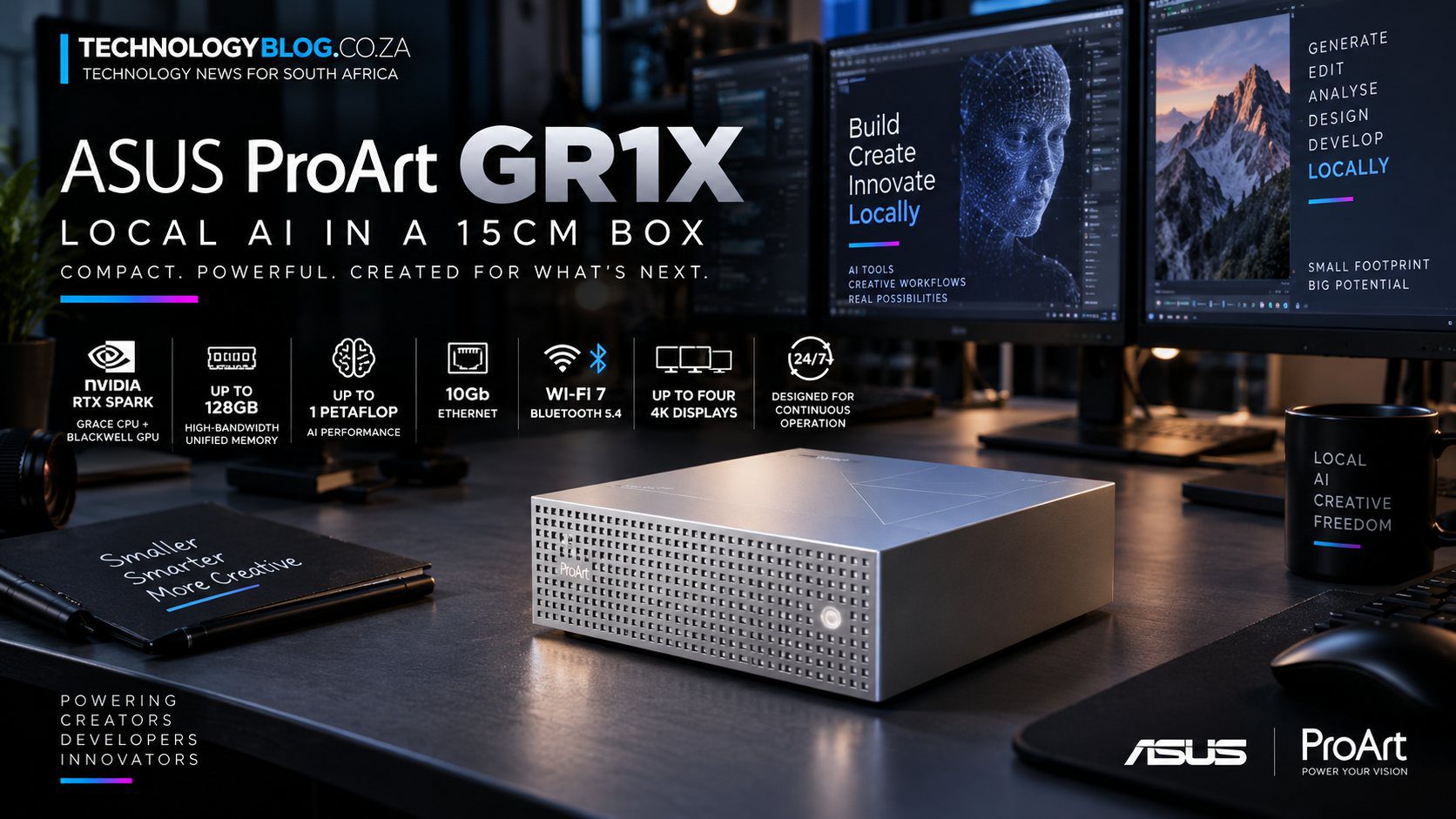
ASUS ProArt GR1X shrinks RTX Spark’s local-AI workstation idea into a 15cm box
The most interesting part of ASUS’s ProArt GR1X is not that it is a small PC. Mini PCs are no longer unusual. The more consequential idea is that ASUS wants a box measuring roughly 150 x 150 x 51mm to behave like a local AI workstation: enough unified memory for unusually large models, enough networking to move serious datasets, and a cooling system designed for continuous operation rather than occasional bursts.
That puts the GR1X in a different category from the tiny office PCs that have traditionally traded expansion and sustained performance for compactness. ASUS announced it alongside ProArt laptops built around NVIDIA’s RTX Spark platform, but the desktop format changes the engineering priorities. A machine that does not have to carry a battery or display can devote more of its thermal and connectivity budget to keeping compute running for hours at a time.
RTX Spark changes what “mini workstation” can mean
At the centre of the GR1X is NVIDIA’s RTX Spark platform, which combines a Grace CPU and Blackwell-generation GPU in one tightly integrated system. ASUS says the platform can provide up to one petaflop of AI performance and as much as 128GB of high-bandwidth unified memory. It also highlights fifth-generation Tensor Cores, FP4 support and NVLink-C2C connectivity between the CPU and GPU portions of the system.
The memory architecture is arguably more important than the headline compute number. Conventional workstations often split system RAM from dedicated graphics memory. That can become a hard ceiling when a local language model, large 3D scene or generative-media workflow needs more GPU-accessible memory than a discrete graphics card carries. A large unified pool reduces that boundary. ASUS says the RTX Spark platform can run language models with up to 120 billion parameters and work with 3D scenes exceeding 90GB.
Those maximum figures do not mean every 120-billion-parameter model will run quickly or that memory capacity alone guarantees useful performance. Quantisation, model architecture, context length, software support and storage throughput all matter. But the capacity changes which experiments are possible on a single compact machine. A developer can keep more of a model local instead of immediately reaching for a cloud GPU instance simply because the model does not fit.
A 24/7 design matters more than it sounds
ASUS explicitly describes the GR1X as suitable for 24/7 operation. That is a meaningful distinction for local AI because many useful workloads are persistent rather than interactive. An inference service may sit behind an internal application. An agent might monitor a queue or index documents through the night. A creative studio could use the machine as a shared render, transcoding or generation node rather than as a personal desktop.
Sustained operation makes cooling less glamorous but more important. ASUS says the chassis uses two fans with a combined 218 blades and claims up to 1.6 times greater thermal coverage than a conventional design. A seven-level fan-control system is intended to balance acoustics and cooling. The real test will be how much performance the machine maintains under long workloads, something a launch specification cannot establish on its own.
The compact enclosure also makes serviceability and upgrade options worth watching. Unified memory is central to the platform, but that architecture generally means buyers need to choose capacity carefully at purchase rather than assuming desktop-style memory expansion later. The benefit is high-bandwidth access shared by CPU and GPU; the trade-off is that traditional modularity can be reduced.
Networking makes the box more useful as infrastructure
The GR1X includes 10Gb Ethernet, Wi-Fi 7 and Bluetooth 5.4, according to ASUS. Ten-gigabit wired networking is particularly relevant in a workstation that may be fed large model weights, video assets or datasets from network storage. A 100GB model checkpoint is not a theoretical file size in modern AI work. Moving files of that scale repeatedly over ordinary gigabit Ethernet can become an everyday bottleneck.
ASUS also says the machine can drive up to four 4K displays. That sounds like a desktop convenience, but it reinforces the fact that the GR1X is not only an appliance-style inference node. It is meant to serve as a primary creator workstation too. A video editor, 3D artist or developer can attach a multi-monitor workspace while still using the same hardware for local AI acceleration.
The more interesting deployment may be headless. With fast Ethernet and a compact footprint, a GR1X could live away from a user’s desk and provide local services to other machines on a network. That would let a small studio or engineering team keep some data on premises while avoiding a full rack-mounted server. Whether ASUS’s software and remote-management story is mature enough for that role will matter as much as the silicon.
Why local AI is a business question, not only a performance claim
Running AI locally can reduce recurring cloud-compute costs for predictable workloads, but cost is only one motivation. Data governance is another. Organisations may have documents, source code, customer records or media assets they do not want sent to a third-party model endpoint. A local workstation does not automatically solve governance, but it gives administrators another place to draw the data boundary.
Latency can also improve when model inference happens on the same site as the data. That is useful for iterative creative tools where a user may generate, inspect and regenerate repeatedly. The trade-off is operational ownership: somebody still has to patch the operating system, maintain model runtimes, control access, monitor storage and decide which models are permitted.
That distinction is especially relevant in South Africa, where cloud regions exist but not every service, model or accelerator instance is available locally. A compact high-memory AI workstation could therefore be useful to some developers and media businesses. However, ASUS had not provided verified South African pricing or availability for the GR1X at the time of writing, so its local economics cannot yet be assessed responsibly.
The workstation story now depends on software
Hardware capable of holding large models is only valuable if the software stack can use it. CUDA compatibility, framework support, model formats, quantisation tools, drivers and creator applications will determine whether RTX Spark behaves like a flexible workstation or a highly specialised box. This is the same reason AI accelerator specifications can be misleading when discussed in isolation: theoretical compute is not the same thing as application throughput.
ASUS’s broader ProArt announcement positions RTX Spark around local agents, generative workflows and creator applications rather than a single benchmark. That is sensible, because the practical advantage of the GR1X is breadth. A user might run a language model in the morning, generate images in the afternoon and process video at night without sending those jobs to three different cloud services.
The GR1X is therefore best understood as an attempt to make high-memory local AI feel like ordinary desktop infrastructure. Its small size is visually striking, but the decisive questions are more prosaic: sustained thermals, software compatibility, memory configuration, storage behaviour, acoustics and price. If those fundamentals hold up, the 15cm box could be more useful than its dimensions suggest.