The Future of Gemini: What to Expect in 2027
Google has not published a complete Gemini roadmap for 2027. Any article promising exact model names, launch dates or guaranteed capabilities would be turning speculation into fact. What can be reported is the direction already visible in 2026 — and the conditions that could strengthen or weaken it.
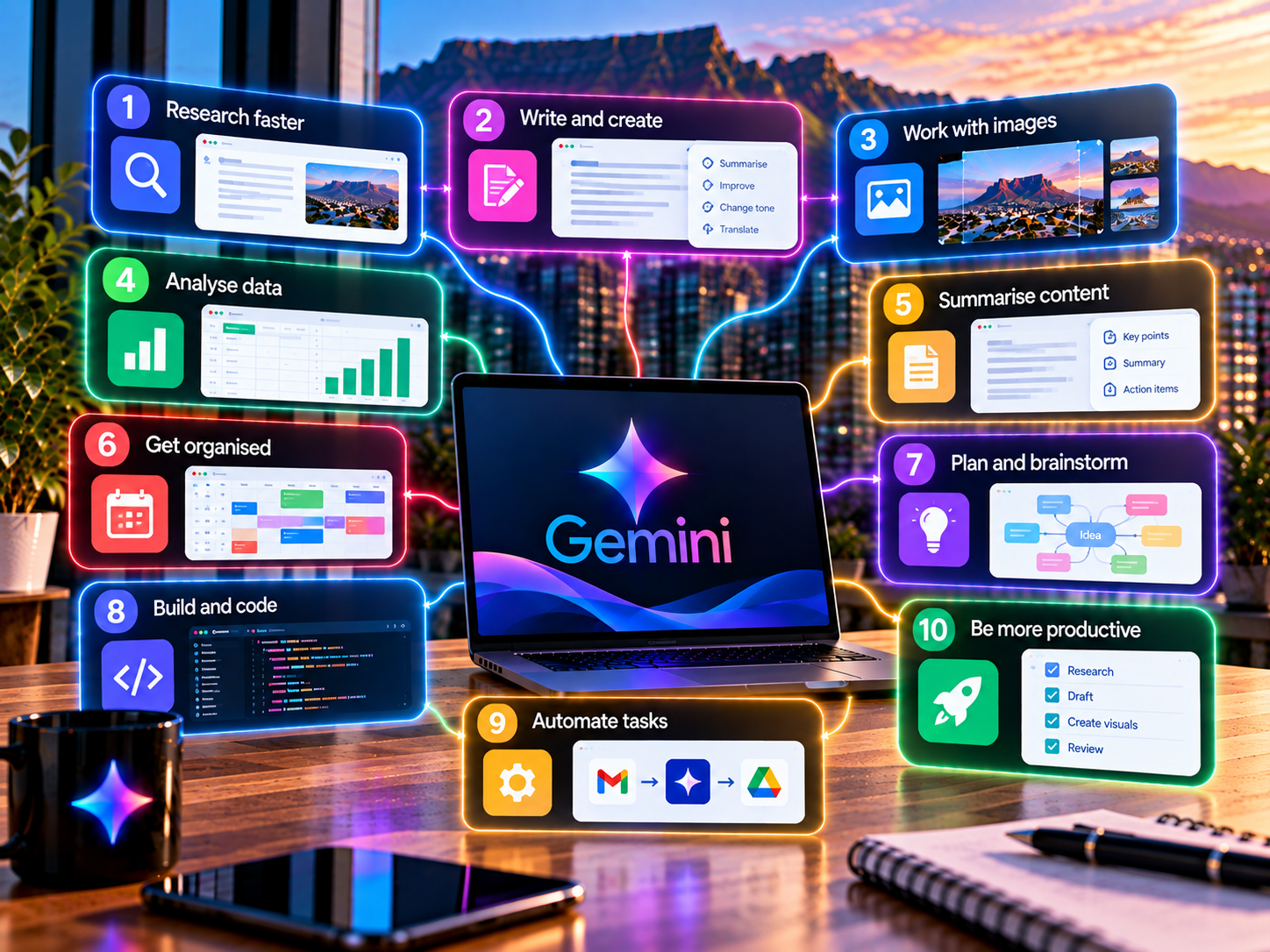
The evidence is unusually clear. Gemini is becoming more agentic, more deeply connected to Workspace, more present on desktop operating systems, more capable in real-time voice and more structured around reusable skills. This article treats those signals as evidence, not promises. For confirmed current features, use Gemini Latest Features and Updates; for the stable product overview, use Google Gemini Complete Guide.
1. Gemini is likely to become more agentic
Google’s 2026 releases repeatedly move from “answer” toward “act”. Gemini Spark is explicitly described as a personal agent, while Workspace updates let Gemini complete multi-step tasks across selected apps.
If that direction continues, more 2027 workflows may be framed as delegated tasks with checkpoints rather than a series of chat prompts.
2. Google Workspace will probably become the most important business surface
Gemini’s structural advantage is that Google’s productivity apps already contain email, files, documents, spreadsheets, presentations and communication. Workspace Intelligence and agentic cross-app capabilities give Gemini a context layer competitors cannot reproduce in exactly the same way.
The unresolved issue is governance: organisations will demand clear controls over which data an agent can use and which actions require approval.
3. Skills will matter more than today’s Gems
Google launched skills for personal Gemini accounts on 30 September 2026, while Gems remain scheduled to transition automatically starting in November. Reusable instructions are therefore already moving toward a more general mechanism that can be invoked across Gemini chats.
By 2027, users may think less about opening a special “Gem” and more about applying trusted instructions to whatever task is in front of them.
4. Voice is likely to become a work interface
Gemini 3.8 Live and Extended Thinking are designed for fluid conversation, visual context and background tool use. This suggests that voice will increasingly serve as an interface for completing tasks, not just asking spoken questions.
The challenge is error handling. A spoken workflow needs clear confirmations when an action is consequential.
5. Desktop Gemini will likely become more context-aware
Google introduced native Mac and Windows apps in 2026. The natural next step is deeper integration with local files, active applications and operating-system context, although the precise 2027 feature set is unconfirmed.
More context can improve usefulness while increasing the importance of permission boundaries.
6. Multimodal models will keep converging
Gemini already spans text, images, audio, video and PDFs, while Google is adding speech generation and agentic video understanding. The likely direction is fewer separate workflows for each media type and more tasks that mix them naturally.
A product team might give Gemini a specification, screenshots, a meeting recording and a spreadsheet as parts of one job rather than separate prompts.
7. Flash models will keep carrying more demanding work
Gemini 3.8 Flash is positioned for long-horizon software engineering and autonomous agents, not just lightweight chat. Google’s rapid Flash release cadence in 2026 suggests the company is trying to push stronger reasoning into lower-latency models.
If that continues, model selection may become less visible to ordinary users while the system routes tasks to the appropriate capability behind the scenes.
8. Research agents will become part of larger pipelines
Deep Research already sits between search and autonomous analysis. Google DeepMind’s 2026 work describes research agents as foundations for larger workflows.
In 2027 the most useful research product may not be the report itself, but what happens next: a dataset, comparison, presentation, decision brief or action plan built from verified evidence.
9. Privacy and auditability will become product features
As Gemini gains access to more context and actions, organisations will evaluate audit trails, approval controls, retention and data boundaries as core features rather than legal footnotes.
Google already exposes admin restrictions on Workspace data access and warns users to supervise agentic tasks. Expect those controls to matter more, not less.
10. The competition will push Gemini toward its ecosystem advantage
ChatGPT, Claude, Copilot and Perplexity are all developing quickly. Gemini’s most defensible position is not “another chatbot”; it is AI woven through Google Search, Android, Workspace, developer tooling and multimodal services.
That shifts the useful comparison: Gemini should be measured by what it can do across the Google environment, not only by the quality of one chat response.
11. South African adoption will depend on workflow value and governance
For South African organisations, the important question is not whether global AI competition is exciting. It is whether Gemini can improve a real process while meeting POPIA, client confidentiality, security and sector obligations.
Skills and training will matter as much as software. Teams need people who can frame tasks, verify evidence and understand when an AI action should be stopped.
What would change this outlook?
Regulation, technical limits, enterprise resistance to agent permissions or a major change in Google’s product strategy could slow this trajectory. Better reliability and clearer controls could accelerate it.
Confirmed announcements belong on the Gemini update tracker. This page is more useful when it preserves uncertainty instead of rewriting a forecast after the fact.
The most durable 2027 skill is judgement
Even if models become substantially more capable, organisations will still need people who can define a task, select evidence, protect data and recognise when an AI result should not be trusted. Better agents increase the value of those skills because the systems can affect more of the workflow.
The forecast should fail gracefully
A useful outlook should say what would prove it wrong. Agent adoption could slow if recovery from mistakes remains poor. Enterprises could limit connected-app permissions if governance costs outweigh productivity gains. Google could also change product direction in ways that make today’s surface distinctions less important.
That uncertainty is a feature of responsible forecasting, not a weakness. The job is to identify the strongest present signals and then update the analysis when the evidence changes.
What not to predict
There is no responsible basis today for promising a specific Gemini 4 release date, a named 2027 model, a fixed feature list or a guaranteed level of autonomy unless Google publishes it. Future coverage should clearly separate confirmed announcements from inference. That distinction protects readers from hype and gives the article a reason to be updated when evidence changes.


