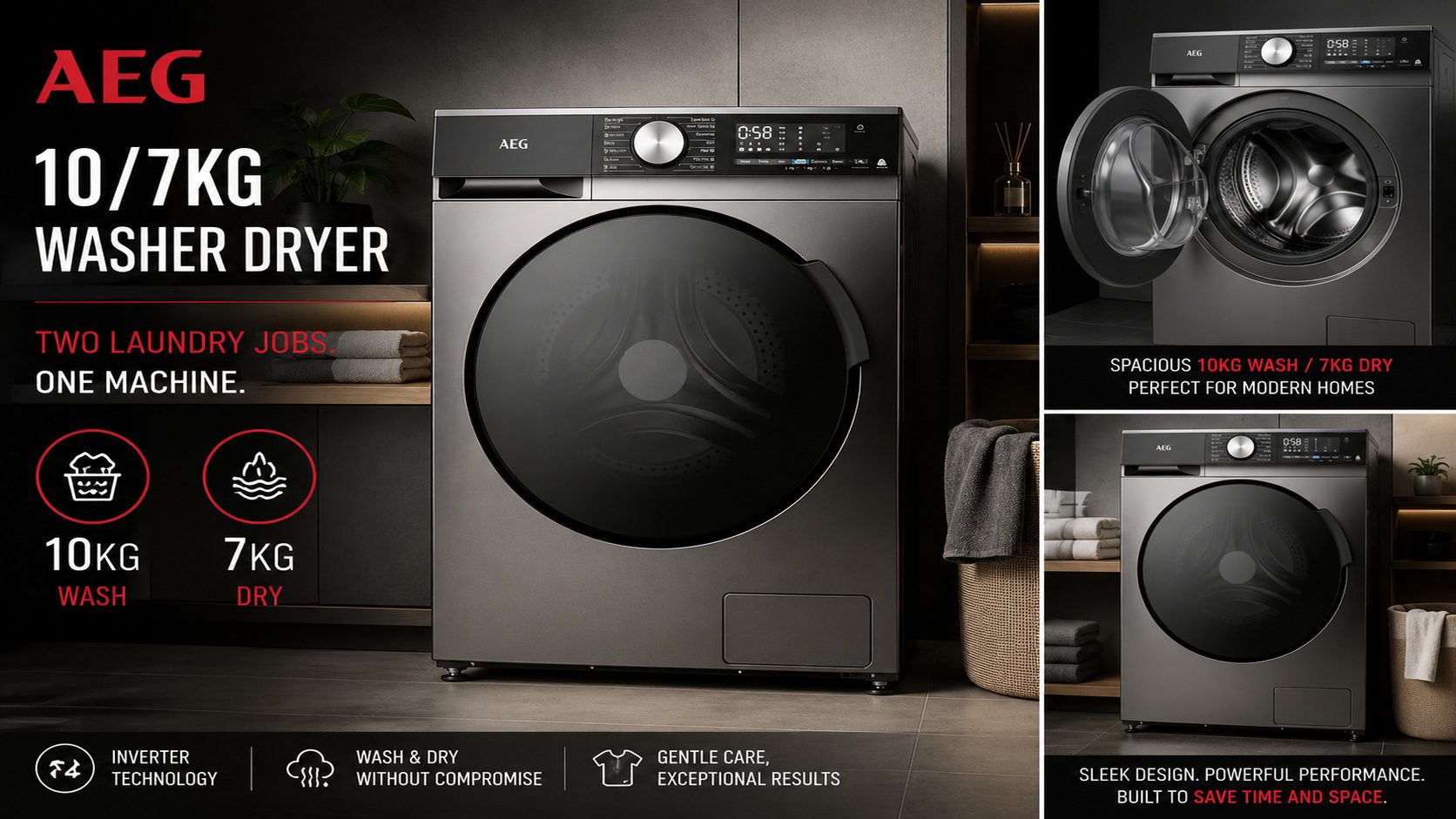
AEG 10/7kg Washer Dryer combines washing and drying in one appliance
Separate washing machines and tumble dryers make sense when space allows for both.
Not every home has that luxury.
The AEG 10/7kg Inverter Washer Dryer AEGZA10WD1 combines both jobs in one appliance, offering a 10kg washing capacity and a smaller 7kg drying capacity.
AEG adds 14 programmes, Steam Hygiene, Auto Dry, Baby Care and several additional wash functions. Smart sensors also monitor the load and fabric type to help optimise water and energy use.
For South African households dealing with limited laundry space, that combination is arguably more important than any single programme.
AEG 10/7kg Washer Dryer handles larger wash loads
The washing side of the machine supports up to 10kg.
That makes it suitable for larger weekly loads, bedding and the kind of everyday laundry produced by a busy household.
The drying capacity is lower at 7kg.
That difference matters.
A fully loaded 10kg wash cannot automatically be treated as a full 10kg drying load afterwards.
If the wash exceeds the dryer’s rated capacity, part of the laundry will need to be removed before starting the drying stage.
This is a normal characteristic of many washer-dryer combinations, but it is worth understanding before buying.
One appliance saves laundry-room space
The clearest benefit of a washer dryer is physical space.
Instead of finding room for two full-size appliances, one machine handles both functions.
That can suit apartments, smaller utility rooms and kitchens where laundry equipment shares space with other appliances.
There is also less plumbing and electrical infrastructure to accommodate.
However, combining both jobs into one cabinet introduces a practical trade-off.
You cannot run a separate drying load while another load washes in a second machine.
For households doing several loads back-to-back, separate appliances may still provide greater throughput.
The AEG’s advantage is consolidation rather than maximum laundry-room productivity.
Fourteen programmes provide more flexibility
AEG lists 14 programmes for the AEGZA10WD1.
The company highlights specialised options including:
- Steam Refresh
- Eco Wash
- Baby Care
- Extra Rinse
- Auto Dry
The broader programme range allows the machine to respond differently to normal clothing, more intensive loads and items that need additional care.
That is more useful than simply offering a large wash capacity with only a few general-purpose cycles.
Steam Hygiene adds another treatment option
The Steam Hygiene function is one of AEG’s more notable laundry features.
Steam can help refresh fabrics and support more hygienic treatment as part of selected programmes.
AEG positions the technology around garment care rather than only mechanical washing.
That can be useful for items that benefit from additional treatment or for loads where freshness matters as much as visible dirt removal.
However, TechnologyBlog has not independently tested the Steam Hygiene function, so we would not make independent sterilisation or medical claims for this exact washer-dryer model.
Baby Care targets sensitive laundry
AEG also includes a Baby Care programme.
This type of programme is generally designed around more thorough washing and rinsing where fabric cleanliness and detergent removal are important.
For households washing baby clothing, bedding or similar items, a dedicated cycle can be easier than manually configuring multiple options each time.
The presence of Extra Rinse provides another way to increase rinsing when required.
Auto Dry removes some of the guesswork
Drying clothes manually often involves choosing a time and hoping the load is ready when the cycle ends.
The Auto Dry programme gives the machine more control over that process.
AEG pairs this with smart sensor technology that monitors the load and fabric type.
The aim is to adapt operation rather than blindly applying the same settings to every load.
That can help reduce unnecessary drying and make the machine easier to use when switching between different laundry types.
Smart sensors adjust to the load
AEG specifically says its sensor technology detects load size and fabric type and then optimises water and energy use.
That matters because a washing machine does not need to treat a smaller everyday load exactly like a full drum.
Using load information allows the appliance to adapt its operation rather than relying exclusively on fixed settings.
The practical benefit is efficiency.
However, the exact amount of water or electricity saved will depend on the programme, load and household usage pattern.
TechnologyBlog has not independently measured those savings.
An inverter motor targets quieter operation
The AEG washer dryer uses an inverter motor.
AEG describes it as durable and quieter, with reduced vibration compared with more conventional motor operation.
That can be particularly relevant when the appliance operates near living spaces or bedrooms.
A washer dryer may also run for longer periods than a washer alone because one cycle can move directly from washing into drying.
Lower vibration and controlled motor operation are therefore useful considerations in a combination appliance.
Stain Master adds a targeted option
The machine includes a Stain Master function alongside Boost, Pre-wash and Extra Rinse.
These functions give users more control over difficult loads.
Pre-wash can prepare heavily soiled clothes before the main cycle.
Boost can provide a more intensive approach when needed.
Extra Rinse can help remove additional detergent or residue.
Stain Master sits alongside those functions as another treatment option for more demanding laundry.
This does not eliminate the need for stain-specific pretreatment in every situation, but it gives users more tools before resorting to manual intervention.
The controls remain conventional
Despite the smart sensing, AEG has kept the interaction relatively straightforward.
The machine uses a programme selection dial and LED display.
That is useful for an appliance that may be used by several people in the same household.
Users do not need to navigate an app simply to select a washing programme.
The combination of physical selection and a digital display provides modern feedback without turning basic laundry into a software task.
Child Lock adds household protection
AEG also includes a Child Lock.
This can prevent accidental changes to the selected programme when children are near the machine.
It is a small feature, but it becomes more relevant on appliances with touch controls and multiple selectable functions.
A long wash-and-dry cycle is not something most households want interrupted halfway through because somebody pressed the wrong control.
A+++ is AEG’s published energy rating
AEG lists the washer dryer with an A+++ energy rating on its current South African product page.
That rating should be reported exactly as AEG publishes it.
Energy-labelling systems vary between markets and have changed over time, so TechnologyBlog should avoid trying to translate A+++ directly into another labelling scale.
The more practical consideration is how efficiently the machine performs under the user’s normal wash and drying patterns.
A washer dryer may still consume considerable electricity when the drying function runs frequently, regardless of its headline efficiency classification.
Drying habits matter in South Africa
A combined washer dryer can be especially useful during wet weather or when outdoor drying space is limited.
However, drying every load electrically may not always make sense.
South African households with access to outdoor drying can still use the 10kg washing function and reserve the 7kg dryer for rain, bedding, urgent loads or specific fabrics.
That hybrid approach can make the combination appliance more flexible.
The dryer is available when it is useful without forcing the household to use it after every wash.
The dark grey finish is unusual for laundry appliances
AEG finishes the AEGZA10WD1 in dark grey with a tinted door.
Most washing machines still default to white or conventional stainless finishes.
The darker design gives this model a different appearance, particularly in modern kitchens or utility spaces where the appliance remains visible.
Appearance should obviously come after capacity and functionality, but integrated laundry spaces increasingly make appliance design part of the buying decision.
Dimensions deserve careful planning
AEG lists the appliance at 85cm high, 62.9cm wide and 59.5cm long on its current South African page.
Those figures should be checked carefully against the installation space.
In particular, the listed width is wider than the approximately 60cm footprint many consumers expect from full-size front-loading laundry appliances.
Buyers should therefore measure the actual space rather than assuming a standard cabinet opening will fit.
Door clearance, hoses and ventilation space also need to be considered.
AEG provides a three-year warranty
The machine carries a three-year warranty according to AEG South Africa.
AEG also provides a local store locator and South African support network.
Its store locator currently lists stockists across several provinces, including Gauteng, the Western Cape, KwaZulu-Natal, Free State and Eastern Cape.
That local support is significant for a large appliance.
A washer dryer contains both washing and drying systems in one cabinet, making after-sales support more important than it would be for a simple countertop product.
A washer dryer still involves compromises
The AEG AEGZA10WD1 solves one problem extremely well: space.
It gives users both laundry functions without requiring two machines.
However, the 10kg/7kg capacity split introduces a limitation.
Large wash loads may need to be reduced before drying.
Combination machines also prevent simultaneous washing and drying of separate loads.
Households with a dedicated laundry room and large volumes of washing may therefore still prefer separate machines.
The washer dryer makes the strongest case where convenience and space matter more than maximum throughput.
It also sits within AEG’s wider laundry range
AEG South Africa currently lists separate 8kg, 10kg and 12kg inverter front-load washing machines, as well as a 10kg heat-pump dryer.
The 10/7kg washer dryer therefore sits between two approaches.
Buyers can choose a single combination appliance or build a separate washing-and-drying setup using dedicated machines.
That makes the AEGZA10WD1 particularly relevant to users who want AEG’s laundry features but do not have room for two full-size appliances.
AEG 10/7kg Washer Dryer specifications
| Specification | AEG AEGZA10WD1 |
|---|---|
| Product type | Washer dryer |
| Washing capacity | 10kg |
| Drying capacity | 7kg |
| Motor | Inverter |
| Programmes | 14 |
| Steam Hygiene | Yes |
| Steam Refresh | Yes |
| Baby Care | Yes |
| Auto Dry | Yes |
| Eco Wash | Yes |
| Stain Master | Yes |
| Boost | Yes |
| Pre-wash | Yes |
| Extra Rinse | Yes |
| Smart load sensing | Yes |
| Fabric sensing | Yes |
| Display | LED |
| Programme selector | Rotary dial |
| Child Lock | Yes |
| Energy rating | A+++ as published by AEG SA |
| Colour | Dark Grey |
| Height | 85cm |
| Width | 62.9cm |
| Length | 59.5cm |
| Warranty | 3 years |
Who is the AEG 10/7kg Washer Dryer for?
The AEG 10/7kg Inverter Washer Dryer makes the most sense for households that need meaningful laundry capacity but cannot dedicate space to two full-size appliances.
A 10kg washer can handle larger loads, while the 7kg dryer provides a practical option when line drying is inconvenient.
The 14 programmes broaden its usefulness across different fabrics and household situations.
Steam Hygiene, Baby Care and Extra Rinse may appeal particularly to families, while Auto Dry and smart load sensing reduce some of the manual decision-making.
The main limitation remains the capacity difference between washing and drying.
Users who regularly fill the machine to its 10kg washing limit will need to manage the load before drying.
Is the AEG 10/7kg Washer Dryer worth considering?
The AEG AEGZA10WD1 is less about replacing two machines without compromise and more about fitting two laundry functions into one footprint.
Its 10kg wash capacity gives it enough room for larger household loads.
The 7kg drying capacity then provides flexibility when clothes cannot go straight onto the line.
AEG complements that core design with 14 programmes, Steam Hygiene, Auto Dry, Stain Master, smart sensing and an inverter motor.
For homes where floor space is limited, that combination can be more valuable than owning separate appliances.
The key is understanding the trade-off.
The machine can wash more than it can dry in one load, and it cannot wash and dry two separate loads simultaneously.
For the right household, those compromises may be acceptable in exchange for the convenience of one appliance doing both jobs.


