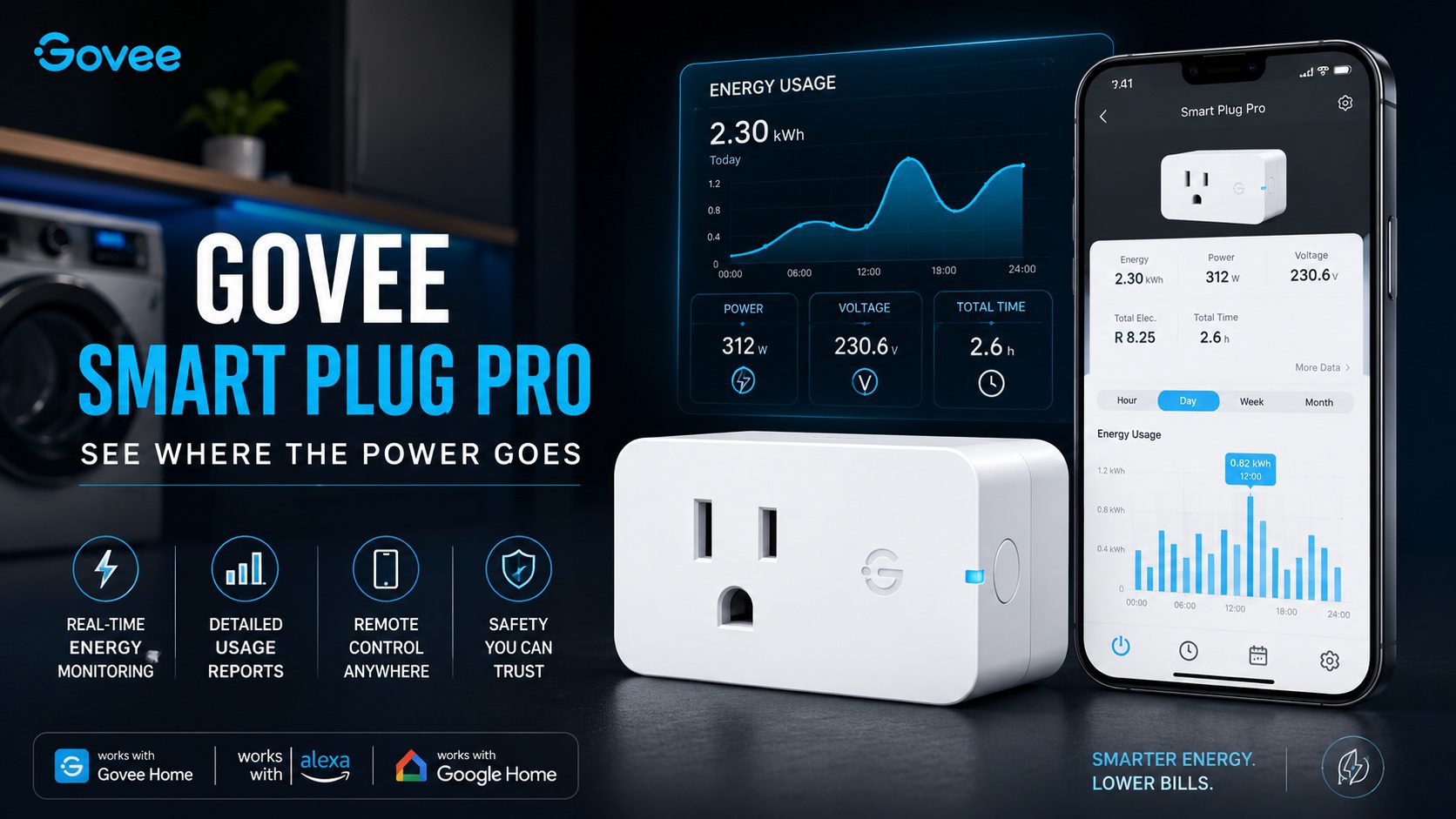
Govee Smart Plug Pro shows how much power your appliances are using
Switching an appliance on from a phone is useful.
Knowing how much electricity that appliance actually uses can be considerably more interesting.
The Govee Smart Plug Pro with Energy Monitoring H5086 combines both functions. It sits between an electrical outlet and an existing appliance, adding remote control, schedules, timers, voice commands and detailed energy monitoring through the Govee Home app.
That gives the smart plug a purpose beyond convenience.
It can help users identify which plug-in appliances are consuming electricity, when they are using it and how long they remain active.
Govee Smart Plug Pro adds energy monitoring
Energy monitoring is the H5086’s defining feature.
Govee allows users to track the power consumption of devices connected through the plug and presents that information through its app.
That can make an otherwise invisible part of household electricity use easier to understand.
For example, a user could connect an appliance and observe its consumption while operating rather than relying only on the wattage printed on a label.
The distinction matters because the number on an appliance label generally describes a rating or maximum condition. Actual energy use depends on how long the device runs and how it behaves during operation.
A monitoring plug makes some of that behaviour visible.
The dashboard turns consumption into useful data
Govee promotes a detailed energy dashboard for the Smart Plug Pro.
The interface provides consumption information through the Govee Home app rather than limiting the plug to a basic on/off control.
This can help answer practical questions.
How much electricity does a particular appliance use over several hours?
Does an older device draw more power than expected?
How often is something actually running?
Is an appliance continuing to consume electricity when nobody thinks it is being used?
A smart plug cannot replace a full household energy-monitoring system, but it can isolate one plug-in appliance at a time.
That makes it useful for investigating individual devices.
Remote control works through the Govee Home app
The H5086 connects to the Govee Home app, which provides remote control when the smart plug is connected to the network.
That means a conventional device can gain basic smart functionality without needing its own Wi-Fi hardware.
A lamp provides a simple example.
Instead of replacing the lamp with a connected model, the user can leave its normal switch on and control power through the Govee plug.
The same principle can work with many appliances that resume operation automatically when electricity is restored.
However, users need to understand how the connected appliance behaves.
A smart plug cannot press electronic controls on an appliance that requires a manual button after power returns.
Wi-Fi and Bluetooth work together
Govee provides both Wi-Fi and Bluetooth connectivity on the H5086.
The device uses 2.4GHz Wi-Fi, according to its published specifications.
That distinction matters because many smart-home devices still rely on 2.4GHz networks rather than 5GHz Wi-Fi.
The lower-frequency band is commonly used by smart-home hardware because of its range characteristics and broad compatibility.
Users setting up the H5086 therefore need access to a compatible 2.4GHz network.
Bluetooth provides the second connectivity path and helps support setup and local communication.
Alexa and Google Assistant provide voice control
The Govee Smart Plug Pro integrates with Amazon Alexa and Google Assistant.
Once linked correctly, users can control the plug through supported voice commands instead of opening the app each time.
This can be convenient for devices such as lamps, fans or other equipment that does not already provide its own voice control.
It is important, however, not to confuse this H5086 model with Govee’s separate B5083 Smart Plug Pro.
Govee currently advertises the B5083 with Matter compatibility, while the H5086 energy-monitoring product page specifically highlights Alexa and Google Assistant instead.
TechnologyBlog should therefore not claim Matter support for the H5086 unless Govee explicitly adds it to this model.
Scheduling can automate ordinary appliances
The Govee Home app allows users to create timers and schedules for the H5086.
That turns the plug into a simple automation controller.
A lamp could switch on at a particular time each evening.
A device could automatically switch off after a selected period.
Govee also supports multiple schedules for the same plug, according to its current FAQ.
The value is that the connected appliance itself does not need to understand schedules.
The plug simply controls whether electricity is available to it.
Countdown timers provide another option
Govee confirms that users can configure countdown timers through the app.
This is slightly different from a recurring schedule.
Instead of saying that an appliance should switch off at the same time every day, the user can tell it to turn off after a specific amount of time.
That could be useful for devices that should only operate temporarily.
The benefit is particularly obvious when someone might otherwise forget that the appliance is still running.
Group control can manage several devices together
Govee also includes group control.
Multiple compatible plugs can be organised so a group of connected devices can be switched together through the app.
That makes more sense as a smart-home installation grows.
Instead of controlling several lamps or devices individually, users can group them according to room or purpose.
A home office could therefore contain several separately connected devices that respond to one group command.
The feature does not change how each individual appliance works. It simply makes several smart plugs easier to manage together.
A physical button keeps manual control available
The H5086 also includes a physical on/off button.
Govee confirms that the plug can therefore be switched manually without using the app.
That is a small but important design choice.
Smart-home devices should ideally remain usable when a phone is unavailable or when someone simply wants to operate the appliance directly.
The physical control also makes the plug easier for other household members who may not have access to the Govee account.
The US model supports up to 15A and 1,800W
Govee rates the H5086 for a maximum 15A resistive load and 1,800W.
That gives the plug enough capacity for many North American household appliances.
However, the power rating should never be treated as a target.
Users need to ensure the connected device remains within Govee’s electrical limits.
Govee specifically warns against connecting appliances above 1,800W.
The company also says a surge protector can be connected, provided the total load remains within the smart plug’s 15A and 1,800W maximum.
This exact H5086 is a 120V product
This is the most important section for South African readers.
The H5086 covered by Govee’s US listing is rated for:
120V AC
60Hz
15A maximum
1,800W maximum output
Those are the published specifications for the North American model.
South African household electricity operates at roughly 230V and 50Hz.
That means the H5086 should not be connected directly to a South African wall outlet.
A travel adapter only changes the physical connector. It does not convert a 230V electrical supply into 120V.
Using a 120V smart plug on a 230V supply could damage the device and create an electrical safety risk.
Govee does have a South African operation
The compatibility problem does not mean Govee itself is absent from South Africa.
There is an official Govee South Africa site, which currently focuses primarily on the company’s smart-lighting range.
At the time of checking, I could not verify the H5086 Smart Plug Pro with Energy Monitoring as part of that South African catalogue.
That distinction is important.
South African consumers may recognise the Govee brand locally, but they should not assume every product appearing on Govee’s US site is electrically suitable or officially distributed here.
If Govee introduces a 230V locally compatible version, that would materially change the local buying case.
Indoor use only
The H5086 is intended for indoor use in dry locations.
That rules out treating it as an outdoor smart switch for garden equipment, patio lighting or other exposed installations.
Outdoor smart plugs need appropriate weather protection and electrical ratings for those conditions.
The H5086 is designed around household indoor appliances.
Energy monitoring could be particularly useful in South Africa
Even though this exact US electrical version is unsuitable locally, the concept behind the product is relevant to South African households.
Electricity costs make appliance consumption increasingly important.
A plug-level energy monitor can help users move beyond guessing.
Instead of assuming an appliance is expensive to run, users can measure how much power it draws and how long it operates.
That information becomes particularly useful for devices such as:
- heaters,
- dehumidifiers,
- older refrigerators,
- entertainment equipment,
- desktop computers,
- home-office hardware,
- fans, and
- other plug-in appliances.
Any locally compatible smart energy plug needs to be correctly rated for the connected appliance and South African electrical supply.
Energy monitoring can reveal standby behaviour
Not every device stops consuming electricity simply because its main function has stopped.
Some electronics continue drawing a smaller amount of standby power.
A monitoring smart plug can help show whether that consumption is meaningful.
The result may sometimes be surprising in the opposite direction.
A device might use so little electricity in standby that repeatedly switching it off saves almost nothing.
Actual measurement is more useful than assuming every standby device creates a major electricity bill.
That is one reason the H5086’s energy-monitoring capability is more interesting than remote switching alone.
Smart scheduling can complement energy monitoring
Monitoring shows what is happening.
Automation can then act on that information.
Once users understand when a device consumes power, schedules can prevent it from remaining active unnecessarily.
For example, a device that should never remain powered overnight could have a scheduled shut-off.
A lamp can automatically follow a household routine.
A piece of home-office equipment can be disconnected outside working hours if that is appropriate for the device.
The combination of measurement and control creates more value than either feature by itself.
Not every appliance should be controlled with a smart plug
A smart plug is not appropriate for every electrical device.
Some appliances have startup requirements, internal electronics or safety systems that make external power interruption undesirable.
Others require a physical button press every time electricity is restored, which means remotely switching the smart plug back on achieves nothing.
High-power appliances also need careful attention to current and power ratings.
Users should check the appliance manufacturer’s instructions rather than assuming that anything with a wall plug can safely become a smart appliance.
The Govee Home ecosystem is broader than this plug
Govee now operates a sizeable smart-home ecosystem covering lighting and a growing collection of home devices.
Its US store positions the Smart Plug Pro alongside air-quality monitors, humidifiers and other connected home products.
Govee has also begun moving some of its smart-appliance products towards its GoveeLife storefront and branding.
The company notes on some current pages that smart appliances are being phased out of its original US storefront and moved to the newer platform.
That explains why the H5086 appears under both Govee Smart Plug Pro and GoveeLife Smart Plug Pro with Energy Monitoring branding in current material.
Who is the Govee Smart Plug Pro for?
The Govee Smart Plug Pro H5086 is most interesting for someone who wants to know what a particular appliance is doing rather than simply controlling it remotely.
Timers and voice control are useful, but many smart plugs already provide those functions.
Energy monitoring creates the stronger reason to use this model.
It turns the plug into a basic measurement tool.
Users can identify consumption, observe runtime and then use schedules or remote control to change behaviour where appropriate.
The compact form also means this can be done without replacing the appliance itself.
Is the Govee Smart Plug Pro worth considering in South Africa?
As a product concept, absolutely.
As the specific H5086 sold through Govee’s US store, no — not for direct connection to a South African electrical outlet.
The 120V electrical rating is the deciding factor.
That is an important distinction for TechnologyBlog readers.
The product shows exactly why smart energy plugs can be useful: they combine measurement, automation and remote control in one small device.
However, South African consumers need an equivalent designed for the country’s electrical system.
Govee already has an official South African operation, so a locally rated energy-monitoring plug would be a logical addition to its range.
Until one is confirmed, the H5086 is best treated as an interesting example of Govee’s expanding smart-home ecosystem rather than a product South African buyers should simply import and plug in.
Govee Smart Plug Pro H5086 specifications
| Specification | Govee H5086 |
|---|---|
| Product | Smart Plug Pro with Energy Monitoring |
| Model | H5086 |
| Energy monitoring | Yes |
| Remote app control | Yes |
| App | Govee Home |
| Wi-Fi | 2.4GHz IEEE 802.11 b/g/n |
| Bluetooth | Yes |
| Google Assistant | Yes |
| Amazon Alexa | Yes |
| Matter | Not confirmed for H5086 |
| Timers | Yes |
| Countdown timer | Yes |
| Multiple schedules | Yes |
| Group control | Yes |
| Physical on/off button | Yes |
| Rated voltage | 120V AC |
| Frequency | 60Hz |
| Maximum current | 15A resistive |
| Maximum output | 1,800W |
| Intended location | Indoor, dry location |
| App support | iOS and Android |
| US warranty | 1 year |
| Direct SA electrical compatibility | No |
| Confirmed official SA H5086 availability | Not confirmed |

Pingback: Shelly 1 Gen3: Matter Smart Relay Explained