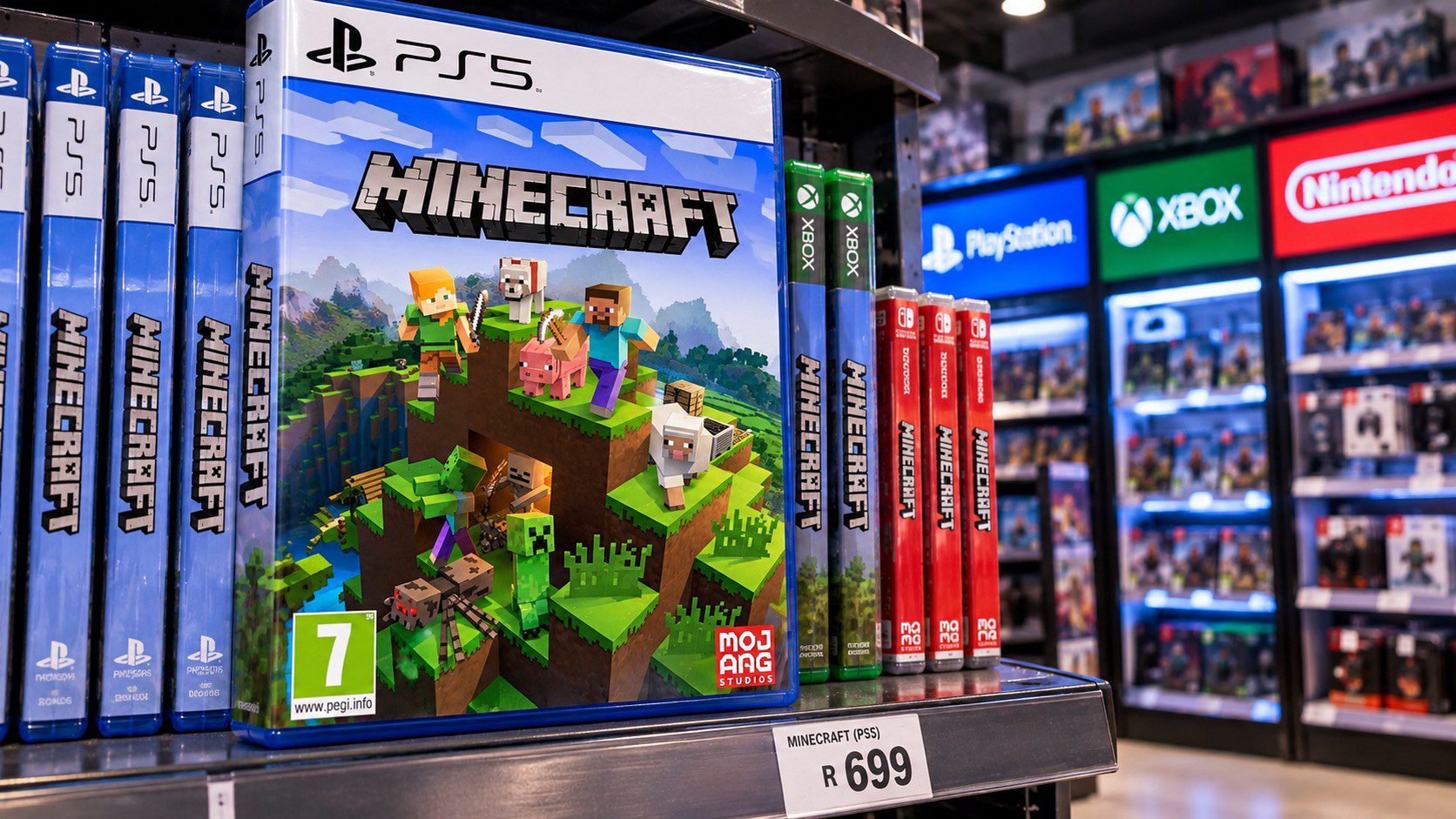
Minecraft turned a world of blocks into endless possibilities
Minecraft begins with almost nothing. A player appears in an unfamiliar landscape, surrounded by trees, hills, rivers and whatever else the world has generated. There is no lengthy introduction explaining who they are or what they must accomplish.
Instead, they can walk towards a forest, break a tree and collect some wood.
That simple action introduces a system capable of supporting an extraordinary range of experiences. Wood becomes tools, tools make mining easier, and mining provides materials for increasingly ambitious projects. Before long, a temporary shelter might become a house, a farm, a fortified settlement or an enormous construction project.
Yet none of those outcomes is compulsory.
Developed by Mojang Studios, Minecraft has endured because it allows players to decide what constitutes progress. Survival, exploration, engineering, architecture and multiplayer communities all exist within the same basic framework.
In 2026, the game continues expanding through regular content drops. However, its strongest feature remains the freedom to make a world worth returning to.
Minecraft makes the first night matter
Survival mode gives Minecraft its most recognisable opening challenge.
Players enter a procedurally generated world with limited resources. Daylight provides time to gather wood, craft tools and explore the immediate surroundings. Once darkness arrives, hostile creatures can make an exposed position dangerous.
A player who spent the afternoon collecting supplies may have enough materials to build a shelter. Somebody who wandered too far might need to improvise.
That first night introduces Minecraft’s central relationship between preparation and reward.
Resources allow players to build safer structures. Better tools make it easier to collect additional materials, while food and equipment improve their chances of surviving further expeditions.
The game rarely needs to explain why preparation matters. The consequences become obvious when a Creeper appears outside an unfinished house.
The world becomes more interesting as players learn its rules
Minecraft’s landscape initially appears simple because everything is constructed from blocks.
However, the world contains different biomes, terrain formations, underground systems and generated structures. A forest can lead into mountains, while an apparently ordinary cave may reveal a much larger network beneath the surface.
Exploration creates practical questions.
Should the player establish a base near useful resources? Is a distant village worth visiting? Would a river make transporting materials easier?
Those decisions gradually turn an unfamiliar landscape into somewhere recognisable.
A mountain becomes a landmark. A bridge connects two settlements, while a torch-lit tunnel provides a route through dangerous terrain.
Players do not merely discover the world. They change it in ways that make future journeys easier.
Crafting gives ordinary materials new possibilities
The crafting system is central to Minecraft’s progression.
Wood can become planks, sticks and tools. Stone provides more durable equipment, while valuable ores support stronger weapons, armour and other useful items.
Materials also have different purposes beyond improving combat effectiveness.
Glass allows players to create windows. Rails support transport systems, while agricultural resources can help sustain a settlement.
The important feature is how these systems connect.
A player might begin mining to obtain iron for armour. During that expedition, they discover resources needed for a railway. Building the railway then encourages them to expand their base.
One objective creates another.
Minecraft rarely needs to manufacture a reason for the next project because the previous project often provides it.
Minecraft turns construction into personal expression
Survival gives building a practical purpose. A shelter protects the player, while storage rooms and farms make resources easier to manage.
However, those practical structures often become creative projects.
A basic house can acquire additional rooms, decorative materials and landscaping. Players may eventually replace it with a castle, a modern city or an elaborate underground complex.
Creative mode removes many of the restrictions that shape Survival.
Players gain access to unlimited resources, flight and the ability to build without managing hunger or ordinary survival threats. Mojang describes the mode as a space for unrestricted construction and experimentation.
Minecraft
That makes Minecraft useful to people who enjoy designing environments without necessarily wanting to fight monsters or search for materials.
The game can become an architectural tool as readily as an adventure.
Redstone introduces engineering to a world of blocks
Minecraft becomes considerably more complex when players begin experimenting with redstone.
The system allows blocks and components to transmit signals, activate mechanisms and respond to inputs.
A beginner might use redstone to operate a door or switch on a lamp. More experienced builders can construct automatic farms, sorting systems, elaborate transport networks and computational machines.
Redstone adds another kind of creativity.
Instead of asking how a structure should look, players begin asking how it should work.
A farm that automatically collects resources changes the amount of manual work required. A hidden entrance creates an engineering problem, while a large automated storage system requires careful planning.
The satisfaction comes from understanding the rules well enough to make them perform a useful task.
Farming and animals make the world feel inhabited
Not every Minecraft project involves mining or fighting.
Players can cultivate crops, raise animals, establish gardens and build agricultural settlements.
These activities provide food and resources, but they also give a base a sense of permanence.
A farm creates a reason to return to the same location. Animals need suitable enclosures, while fields and pathways gradually shape the surrounding landscape.
Villages add another layer through inhabitants, buildings and trading systems.
A player might initially visit a village to obtain supplies. Later, they may build roads, improve structures or incorporate the settlement into a larger project.
The world becomes more meaningful as players invest time in particular places.
Minecraft’s underground world changes the pace
Mining begins as a way to collect materials, but underground exploration develops into its own adventure.
Caves can contain valuable ores, dangerous drops, hostile mobs and large spaces that are difficult to navigate.
A short expedition may become complicated when the player discovers an extensive cavern system.
Should they continue exploring or return with the resources already collected?
That decision becomes more difficult when valuable equipment is at risk.
Minecraft’s death and inventory rules can make recovery important, depending on the selected game settings.
Players who venture too far without supplies may discover that finding their way home is more challenging than reaching the cave in the first place.
The Nether makes preparation essential
Minecraft eventually encourages players to explore beyond the familiar Overworld.
The Nether introduces a dangerous dimension filled with unfamiliar terrain, lava and hostile creatures.
Reaching it requires building a portal, but entering is only the beginning.
Players need equipment, supplies and a plan for returning safely.
The Nether also contains resources and structures that support further progression.
Its distinctive environment changes how players approach exploration. A route that appears manageable can become hazardous when lava, difficult terrain or hostile mobs interrupt the journey.
The dimension demonstrates how Minecraft can introduce new challenges without abandoning its basic systems.
The End provides a major challenge without ending the game
Minecraft includes a progression route leading towards the End dimension and the Ender Dragon.
Defeating the dragon is often treated as a major achievement, particularly in Survival mode.
However, Mojang makes an important distinction: Minecraft does not have a compulsory final objective in the conventional sense. Players can continue exploring and building after defeating the dragon.
Minecraft
That freedom changes the significance of completion.
Some players focus on reaching the End as efficiently as possible. Others spend months constructing elaborate settlements before attempting the encounter.
The dragon provides a milestone, not a requirement that every player must pursue.
Minecraft remains open to whatever comes next.
Multiplayer turns individual projects into shared worlds
Minecraft’s creative possibilities expand when players work together.
Friends can build settlements, explore caves, establish farms and divide responsibilities across a shared world.
One player might enjoy gathering resources, while another concentrates on construction. Someone else may prefer exploration or redstone engineering.
Those different interests can contribute to the same project.
Online servers take the idea further by supporting communities with their own rules, activities and long-running worlds.
Private Realms offer another way to maintain a persistent multiplayer environment.
The result is a game where social interaction can become just as important as the underlying mechanics.
Community creations extend Minecraft beyond its original design
Minecraft’s community has created experiences that differ substantially from ordinary Survival gameplay.
Custom maps can introduce puzzles, stories or carefully designed adventures. Minigames can establish entirely different objectives, while community servers may develop their own economies and competitive activities.
Java Edition also supports an extensive modding ecosystem, allowing players to experiment with modifications that change or expand gameplay.
Bedrock Edition offers Marketplace content and add-ons through its own systems.
These creations demonstrate how Minecraft functions as more than a fixed collection of developer-designed challenges.
It provides a foundation that players and creators can continue adapting.
Minecraft Java and Bedrock offer different experiences
Minecraft is available through two principal editions.
Java Edition is associated with Windows, macOS and Linux computers. It has a long-established community built around custom servers, modifications and technical experimentation.
Bedrock Edition supports a wider selection of devices, including consoles, mobile platforms and Windows PCs.
The editions share Minecraft’s fundamental gameplay, but they are not identical.
Their multiplayer networks, technical behaviour and customisation systems differ. Standard Java and Bedrock clients also cannot directly join the same multiplayer worlds.
Minecraft
That distinction matters when choosing how to play with friends.
Players should establish which edition their group uses before selecting a platform or server.
Minecraft keeps growing through game drops
Mojang continues developing Minecraft through regular updates that introduce features, creatures, blocks and changes to existing systems.
Rather than relying exclusively on occasional enormous updates, the studio has increasingly organised content into smaller releases called game drops.
This approach allows new features to arrive throughout the year.
Some drops focus on particular creatures or environmental themes. Others expand building options or introduce new exploration opportunities.
For a game where worlds can remain active for years, these additions have an unusual effect.
A new block might inspire players to redesign an existing building. A new structure could provide a reason to explore territory beyond a familiar base.
Even relatively small additions can create new projects.
Tiny Takeover brought new personality to Minecraft in 2026
The first game drop of 2026, Tiny Takeover, arrived on 24 March.
Its focus was redesigned baby mobs, additional sounds and other changes intended to make younger creatures more distinctive.
Minecraft
That may sound modest compared with a new dimension or major combat overhaul.
However, Minecraft’s appeal is not limited to large progression systems.
Animals, settlements and decorative details matter to players who spend much of their time building and maintaining worlds.
Small visual and behavioural improvements can make those environments feel more lively.
Wilderness Bound expanded exploration in September
Minecraft’s third 2026 game drop, Wilderness Bound, launched on 15 September for Java and Bedrock editions.
The update introduced the dappled forest, abandoned camps, poplar trees, straw beds, cushions and additional building possibilities.
Minecraft
Abandoned camps provide new discoveries during exploration, while their variations help them fit into different environments.
The update also expanded the selection of decorative materials available to builders.
These additions reinforce two of Minecraft’s strongest activities: discovering places and creating somewhere to live.
A new forest is another landscape to explore.
A new collection of blocks is another reason to start building.
Minecraft’s next 2026 drop is already in testing
Mojang has also begun previewing the fourth game drop of 2026.
Official September and October testing information describes a colder theme involving icy environments and new features available through development snapshots and previews.
Minecraft
+1
However, testing does not mean every feature is final.
Mojang uses previews to collect feedback and identify problems before releasing updates to the wider player base.
The next drop therefore represents an ongoing development process rather than a completed release.
Its final launch date should not be assumed until officially announced.
Why Minecraft remains relevant in 2026
Minecraft has remained successful because it does not require every player to enjoy the same activity.
A survival player might spend an evening gathering resources for better armour. A builder could devote that time to designing a new house, while a technically minded player experiments with redstone machinery.
Friends may work together on a settlement without agreeing on a single long-term objective.
Those experiences can all exist within Minecraft’s basic rules.
Mojang’s continuing updates add new materials, environments and opportunities, but the game does not depend on constant reinvention to remain recognisable.
Its greatest strength is the relationship between simple actions and increasingly ambitious ideas.
A player begins by collecting a block of wood.
Hours later, they might be constructing a railway, exploring another dimension or planning an enormous city with friends.
The game provides the world and the tools.
What happens next belongs to the player.


