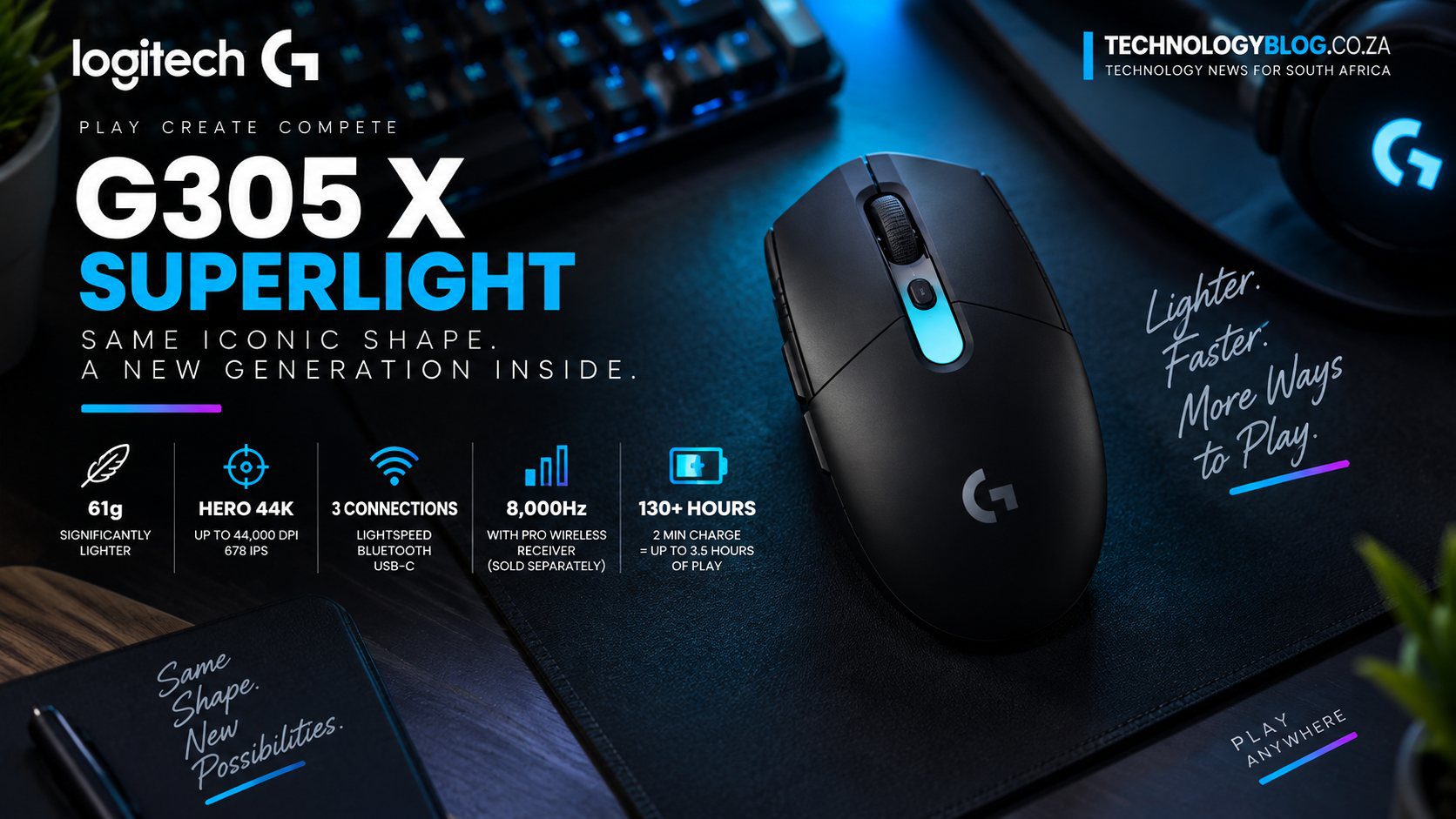
Logitech G305 X SUPERLIGHT puts a 44K sensor into one of Logitech’s most familiar mouse shapes
The Logitech G305 X SUPERLIGHT takes one of Logitech G’s longest-running wireless gaming-mouse shapes and rebuilds it around considerably newer hardware.
The familiar G305 profile remains, but the new model drops to 61g for the European and South African specification, switches from a replaceable AA battery to USB-C recharging and introduces Logitech’s HERO 44K sensor.
It also supports LIGHTSPEED wireless, Bluetooth and wired USB-C connections, while owners who buy Logitech’s optional PRO Wireless Receiver can increase the mouse’s report rate to as much as 8,000Hz.
Logitech rates battery life at more than 130 hours and says a two-minute USB-C charge can provide up to 3.5 hours of use.
The interesting part is the positioning.
The original G305 built its reputation as a relatively affordable wireless gaming mouse. The G305 X SUPERLIGHT keeps that recognisable shape but borrows several ideas associated with Logitech’s considerably more performance-focused SUPERLIGHT products.
TechnologyBlog.co.za has not tested the G305 X SUPERLIGHT. This article therefore examines its verified specifications and design rather than presenting conclusions about sensor performance, click feel, wireless latency or comfort.
The G305 shape survives a major internal redesign
Logitech has deliberately retained the shape associated with the original G305.
That matters because mouse shape is often more important than another increase in sensor resolution.
Players become accustomed to where the hump sits, how the sides support their fingers and how easily the mouse can be repositioned inside the hand.
Instead of replacing that design completely, Logitech has modernised what sits inside it.
The largest physical change is weight.
The original G305 is officially listed at 99g with its AA battery installed. The new G305 X SUPERLIGHT weighs 61g in Logitech’s European and South African specifications.
That is a reduction of roughly 38g.
A lighter mouse generally requires less effort to start and stop during quick movements, which can be particularly noticeable for low-sensitivity players making large movements across a mouse pad.
Weight alone does not make a mouse better, though.
Shape, balance, grip style and hand size still determine whether a design actually feels comfortable.
HERO 44K replaces the original 12K sensor
The original G305 used Logitech’s HERO sensor with sensitivity from 200 to 12,000 DPI.
The G305 X SUPERLIGHT moves to a HERO 44K sensor, extending the maximum setting to 44,000 DPI and supporting tracking speeds of up to 678 inches per second according to Logitech.
That enormous DPI ceiling is primarily a specification demonstrating the sensor’s operating range.
Most competitive players will never use anything close to 44,000 DPI.
Common gaming sensitivity settings sit far lower because an extremely high DPI would make small physical mouse movements produce enormous cursor movement.
The more meaningful benefit is that Logitech is bringing its newer sensor technology into a G305-class mouse rather than reserving high-end tracking hardware exclusively for its PRO range.
Sensor settings can be customised through Logitech G HUB.
8kHz is available — but there is an important catch
The G305 X SUPERLIGHT can reach a maximum 8,000Hz report rate, but the standard mouse does not provide that capability on its own.
Logitech requires the PRO Wireless Receiver, which is sold separately, for the mouse to reach the maximum 8kHz mode.
That detail matters when reading the specifications.
At 8,000Hz, the mouse can theoretically report its position to the computer once every 0.125 milliseconds.
A conventional 1,000Hz gaming mouse reports every millisecond.
Higher polling gives the computer more frequent input updates, although the practical benefit depends heavily on the gaming system.
High-refresh-rate monitors, very high frame rates and competitive titles are more likely to expose differences than a 60Hz display or a game running at modest frame rates.
Higher polling rates can also place additional load on the PC.
Buyers should therefore treat 8kHz as an optional performance mode rather than assuming it is necessary for every game.
It is also important to include the cost of the PRO Wireless Receiver when evaluating that feature because Logitech does not bundle it as standard.
LIGHTSPEED is no longer the only wireless option
The original G305 concentrated on Logitech’s LIGHTSPEED connection.
The G305 X SUPERLIGHT is more flexible.
It offers three connection methods:
- LIGHTSPEED wireless;
- Bluetooth;
- wired USB-C.
LIGHTSPEED remains the obvious choice for gaming where low latency is the priority.
Bluetooth makes the mouse easier to use with another computer, laptop or compatible device without moving the USB receiver.
USB-C provides both a wired operating mode and charging.
That combination makes the G305 X considerably more practical as a general everyday mouse than a gaming design tied entirely to one proprietary wireless receiver.
The AA battery is finally gone
The original G305 used a replaceable AA battery.
That design had advantages.
A flat battery could be replaced immediately, and Logitech rated the mouse for as much as 250 hours of operation from one AA cell.
The G305 X SUPERLIGHT moves to an internal rechargeable battery.
Logitech rates it for more than 130 hours per charge.
That is shorter than the original model’s maximum AA-battery figure, but the charging model is entirely different.
Instead of carrying replacement batteries, users connect USB-C.
Logitech also claims that two minutes of charging can provide as much as 3.5 hours of playtime.
For many users, that will be more convenient than replacing disposable batteries.
It also helps Logitech reduce the mouse’s weight because it no longer needs to accommodate a conventional AA cell.
The G305 X is part of Logitech’s more accessible G3 Series
Logitech introduced the G305 X SUPERLIGHT in June 2026 as part of the expanded G3 Series.
The range is positioned below Logitech’s specialised PRO esports products while still borrowing technologies associated with higher-performance gaming equipment.
The G3 family includes the G305 X SUPERLIGHT mouse, the G316 X gaming keyboard range and G325 wireless headset.
That positioning helps explain why Logitech retained the G305 name.
This is not intended to become another PRO X SUPERLIGHT.
Instead, Logitech is bringing some of the SUPERLIGHT philosophy to a broader gaming product.
TechnologyBlog.co.za has already covered the Logitech G PRO X SUPERLIGHT 2c, a much more explicitly esports-focused mouse built around a compact shape, HERO 2 sensor and native high-performance wireless platform.
The G305 X SUPERLIGHT has a different job.
It keeps the familiar G305 design while making lightweight wireless gaming considerably more modern.
Logitech has also thought about repairability
One of the less obvious changes is the construction.
Logitech says the G305 X SUPERLIGHT uses at least 51% post-consumer recycled plastic and incorporates exposed screws intended to make the product easier to repair.
Repairability deserves attention because gaming mice are high-use devices.
Switches, scroll wheels and batteries can all become wear points over years of use.
A product that can be opened more easily has a better chance of remaining useful when an individual component develops a problem.
Whether replacement components will remain readily available throughout the mouse’s life is a separate issue, but accessible fasteners are preferable to a design intended never to be opened.
G305 X SUPERLIGHT specifications
| Specification | Logitech G305 X SUPERLIGHT |
|---|---|
| Product type | Wireless gaming mouse |
| Series | Logitech G3 |
| Sensor | HERO 44K |
| Maximum sensitivity | 44,000 DPI |
| Maximum tracking speed | 678 IPS |
| EMEA / South African weight | 61g |
| Main wireless mode | LIGHTSPEED |
| Additional wireless mode | Bluetooth |
| Wired connection | USB-C |
| Maximum optional polling | Up to 8,000Hz |
| 8kHz requirement | PRO Wireless Receiver, sold separately |
| Claimed battery life | 130+ hours |
| Fast charging | Up to 3.5 hours from two minutes |
| Charging | USB-C |
| Recycled plastic | Minimum 51% |
| Configuration | Logitech G HUB |
| Colours announced | Black and white |
Specifications are based on Logitech’s official product information checked on 23 September 2026.
Official European pricing is €79.99
Logitech’s official European store listed the G305 X SUPERLIGHT at €79.99 on 23 September 2026.
The black model was shown as in stock and ready to ship at the time of checking.
That price comes directly from Logitech and was correct at the date of publication. It may change.
Logitech also lists the G305 X SUPERLIGHT on its official South African website, confirming the model for the local market.
However, the South African Logitech page did not publish an official rand price when checked on 23 September 2026.
TechnologyBlog.co.za therefore has not converted the European price into rand and has not used third-party retailer pricing.
Official South African pricing had not been published by Logitech at the date of publication.
The G305 has changed more than its name suggests
Calling this mouse the G305 X understates how substantial the update is.
The familiar shape survives, but much of the hardware philosophy has changed.
The 99g AA-powered original has become a 61g rechargeable mouse.
The old 12,000 DPI HERO sensor gives way to a HERO 44K unit.
LIGHTSPEED remains, but Bluetooth and wired USB-C make the mouse more flexible.
An optional PRO Wireless Receiver can take polling all the way to 8kHz.
Logitech has even changed how the chassis is put together, using recycled plastic and exposed fasteners intended to make repair easier.
The company’s long relationship with mice is explored in our history of Logitech, tracing how an early mouse developed in Switzerland helped turn Logitech into one of the largest peripheral companies in personal computing.
The G305 X SUPERLIGHT fits neatly into that history.
It does not abandon one of Logitech’s most recognisable gaming-mouse designs.
Instead, it takes that familiar shell philosophy and rebuilds almost everything around it for the current generation of PC gaming.
