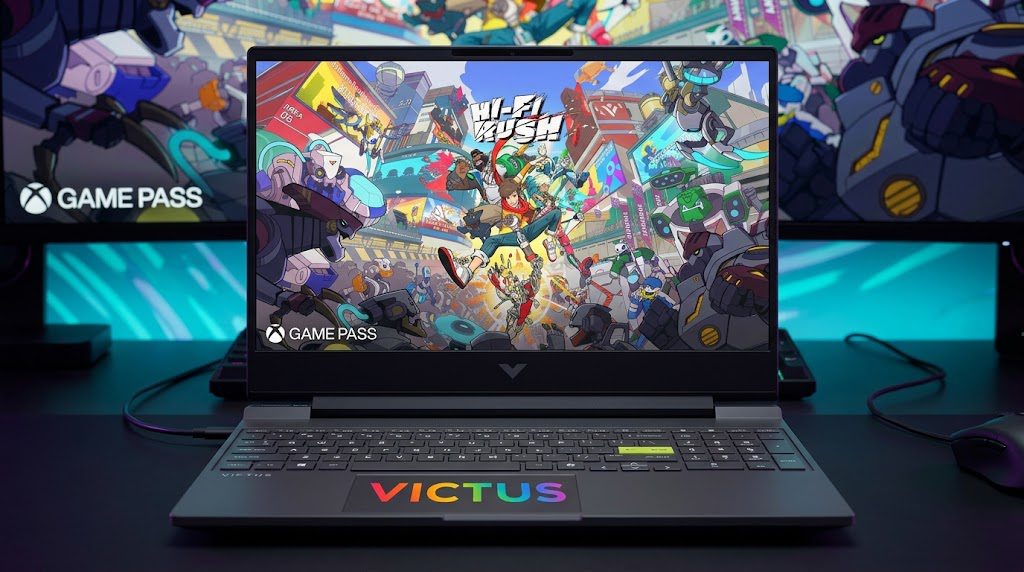
HP Victus is growing up: RTX 50-series graphics bring new muscle to the gaming range
HP Victus is the company’s gaming PC family positioned below its higher-end OMEN products. The range targets gamers who want dedicated graphics and high-refresh displays without necessarily moving into HP’s most expensive gaming hardware.
The Victus name does not refer to one fixed laptop specification. HP sells multiple configurations with different AMD processors, NVIDIA GPUs, memory capacities and storage options.
That distinction has become particularly important as newer Victus 15 models have arrived with NVIDIA GeForce RTX 50-series laptop graphics.
HP’s current South African catalogue includes configurations with the GeForce RTX 5050 and RTX 5060 alongside models using older RTX 2050, RTX 3050 and RTX 4050 hardware.
TechnologyBlog.co.za has not tested these Victus laptops. This article therefore examines the range and verified specifications rather than providing gaming benchmarks or a performance review.
New Victus 15 models reach the GeForce RTX 5060
One of the more interesting developments in the current Victus range is the arrival of NVIDIA’s newer laptop GPUs.
HP lists the Victus Gaming Laptop 15-fb3000ni with an AMD Ryzen AI 7 350 processor, 16GB of DDR5 memory, a 1TB SSD and NVIDIA GeForce RTX 5060 graphics.
Another South African configuration, the 15-fb3038ni, combines the Ryzen AI 7 350 with 24GB of DDR5 memory, a 512GB SSD and RTX 5060 graphics.
The Ryzen AI 7 350 itself provides eight CPU cores and 16 threads, with a maximum boost frequency of up to 5GHz.
These configurations give Victus buyers access to substantially newer graphics hardware without moving automatically into the OMEN family.
However, the GPU model alone does not establish real-world gaming performance. Laptop GPU performance also depends on power limits, cooling, game settings and the complete system configuration.
RTX 5050 creates another option
HP also offers Victus configurations using NVIDIA’s GeForce RTX 5050 Laptop GPU.
The South African Victus 15-fb3003ni, for example, combines a Ryzen AI 7 350 with an RTX 5050 Laptop GPU containing 8GB of GDDR7 dedicated graphics memory.
That model includes 16GB of DDR5-5600 memory and a 512GB PCIe Gen4 NVMe M.2 SSD.
HP also lists the 15-fb3029ni with an AMD Ryzen 5 240, 12GB of DDR5 memory, 1TB SSD and RTX 5050 graphics.
The variation illustrates why buyers should pay attention to the full Victus model number rather than purchasing based only on the family name.
Two laptops carrying the Victus badge can have substantially different gaming capabilities.
Older RTX configurations remain in the range
New RTX 50-series hardware has not immediately removed previous-generation Victus configurations.
HP South Africa still lists models using GPUs including the GeForce RTX 2050, RTX 3050 and RTX 4050.
For example, the Victus 15-fb3010ni pairs an AMD Ryzen 5 8645HS with 16GB of DDR5 memory, a 1TB SSD and RTX 4050 graphics.
Another configuration combines a Ryzen 7 7445H with 16GB of RAM, 512GB storage and an RTX 4050.
This creates a wide performance range within the same product family.
It also means shoppers should avoid assuming that every Victus 15 represents the same generation.
A 144Hz FHD display targets mainstream gaming
A common feature across many current Victus 15 configurations is a 15.6-inch Full HD 144Hz display.
The 1,920 × 1,080 resolution places a lower rendering burden on the GPU than QHD or 4K while still providing considerably more refresh headroom than a conventional 60Hz notebook display.
That combination makes sense for a mainstream gaming laptop.
Competitive games can benefit from the higher refresh rate when the GPU produces sufficiently high frame rates. More demanding single-player games can instead prioritise visual settings while targeting lower frame rates.
HP also lists AMD FreeSync Premium support on current models.
FreeSync can synchronise the display refresh behaviour with compatible graphics output to reduce visible tearing and improve smoothness when frame rates fluctuate.
Not every Victus display is identical
Buyers should still check the display specifications for the exact SKU.
For example, HP specifies the current Victus 15-fb3003ni with a 15.6-inch IPS FHD panel operating at 144Hz. It has an anti-glare surface, 300-nit rated brightness and 62.5% sRGB colour coverage.
The 62.5% sRGB figure is worth noticing.
A high refresh rate can make the panel appropriate for gaming, but limited colour-gamut coverage makes this particular configuration less attractive for colour-critical professional photography, design or video grading.
Someone who wants one laptop for both gaming and professional creative work should therefore compare display specifications as carefully as the processor and GPU.
Ryzen AI brings an NPU to newer configurations
Some current Victus models use AMD Ryzen AI processors.
The Ryzen AI 7 350 combines conventional CPU cores with integrated graphics and a dedicated neural processing unit, or NPU.
An NPU is designed to accelerate supported AI workloads more efficiently than running every task on the CPU or discrete GPU.
This can benefit compatible Windows and application features, but the presence of an NPU should not be confused with faster gaming by itself.
Gaming performance still depends heavily on the CPU, discrete NVIDIA GPU, cooling system and game.
The RTX GPU also provides its own specialised AI hardware for supported graphics and application workloads.
DDR5 memory is standard across current examples
HP’s current South African Victus 15 listings use DDR5 memory.
Configurations vary considerably.
Examples currently listed by HP include 12GB, 16GB and 24GB capacities, depending on the model.
The Victus 15-fb3003ni uses 16GB of DDR5-5600 memory in a single 16GB module, while the 15-fb3038ni is listed with 24GB.
For gaming, memory capacity can affect how comfortably the system handles modern titles alongside Windows, voice chat, browsers and background applications.
Buyers interested in future upgrades should verify the memory layout and supported upgrade capacity for the exact product number rather than assuming every Victus chassis has the same configuration.
SSD capacities also differ
Storage varies across the Victus family.
Current HP South Africa listings include both 512GB and 1TB SSD configurations.
A 512GB drive can fill quickly on a gaming laptop. Modern games can occupy tens or even hundreds of gigabytes each once updates and additional content are installed.
A 1TB configuration therefore provides considerably more flexibility for someone maintaining several large games locally.
Storage capacity should still be considered separately from gaming performance. A larger SSD gives the user more space but does not turn a lower-tier GPU into a faster one.
Victus specifications vary by configuration
| Feature | Current HP Victus 15 range examples |
|---|---|
| Product family | HP Victus Gaming Laptop |
| Display size | 15.6-inch on current Victus 15 examples |
| Typical resolution | FHD, 1,920 × 1,080 |
| Refresh rate | Up to 144Hz on referenced configurations |
| Display technology | IPS on referenced models |
| Adaptive sync | AMD FreeSync Premium on supported configurations |
| Processor examples | AMD Ryzen 5, Ryzen 7 and Ryzen AI 7 |
| Newer CPU example | AMD Ryzen AI 7 350 |
| GPU examples | RTX 2050, RTX 3050, RTX 4050, RTX 5050, RTX 5060 |
| Memory | DDR5 |
| Referenced capacities | 12GB, 16GB and 24GB |
| Storage examples | 512GB or 1TB SSD |
| Operating system | Windows 11 on current South African configurations |
| Main use | PC gaming and general computing |
These are family-level examples rather than specifications for every HP Victus laptop. Buyers should always check the complete product number before comparing machines.
Victus can also handle everyday computing
Dedicated graphics make gaming the obvious focus, but a Victus laptop remains a Windows PC.
The processor, DDR5 memory and SSD can also handle everyday productivity, web browsing, study and general office applications.
That gives the range a practical advantage for students or users who cannot justify maintaining separate gaming and productivity computers.
The trade-off is portability.
For example, HP lists the 15-fb3003ni at approximately 2.29kg. A gaming laptop also needs a substantial cooling system and power supply compared with a thin ultraportable.
Users who carry their laptop throughout the day should therefore consider weight and battery requirements alongside gaming performance.
Creators should check the screen before buying
Dedicated NVIDIA graphics can make a Victus useful for supported creative applications, video editing, 3D work and GPU-accelerated workloads.
However, creators should not choose the machine based solely on its RTX branding.
Display quality matters.
The 62.5% sRGB coverage specified for the 15-fb3003ni, for example, indicates that its internal panel is primarily gaming-focused rather than intended for demanding colour-sensitive workflows.
A creator could connect an appropriate external monitor, but that adds another consideration to the overall setup.
RTX 50-series makes model numbers even more important
The current Victus range demonstrates a common problem with gaming-laptop shopping.
The product-family name tells only part of the story.
A Victus with an RTX 2050 and a Victus with an RTX 5060 may share similar styling and the same family branding, but they occupy very different positions in terms of graphics hardware.
Processor, RAM and storage can vary at the same time.
Shoppers should therefore compare the exact HP product number, CPU, GPU, dedicated graphics memory, RAM configuration, SSD capacity and display before making a decision.
Who is HP Victus for?
HP Victus primarily targets gamers looking for a dedicated gaming laptop without automatically moving into HP’s higher-tier OMEN range.
The latest configurations broaden that appeal through Ryzen AI processors and NVIDIA GeForce RTX 5050 and RTX 5060 graphics, while older configurations remain available for buyers considering different hardware tiers.
A 144Hz FHD display also fits the intended audience well. It gives the GPU a more manageable resolution for gaming while providing substantially higher refresh capability than an ordinary 60Hz notebook.
The biggest purchasing consideration is variation.
HP Victus is a family, not a specification.
The exact model number matters more than the Victus badge alone. A buyer who checks the CPU, GPU, display, RAM and SSD carefully can identify the configuration that best matches the games and other applications they actually intend to run.


